climax
Apple — Fuji
saib — Fuji (سیب)
Malus domestica cv. Fuji
- kpk hills
- balochistan highlands
International hardiness
- USDA 4-8
- RHS H6
- AU: Cool temperate, Warm temperate, Mediterranean
Where it grows — regional guide
| Zones / rating | Regional notes |
|---|---|
USDA 4-8 | Grown as a late-ripening dessert apple across temperate zones; it needs a long, sunny autumn to ripen fully. |
| Zones / rating | Regional notes |
|---|---|
H6 (-20 to -15C) | Hardy under RHS H6: best grown in sheltered, sunny sites or against a warm wall, as fruit ripens very late in the season. |
| Zones / rating | Regional notes |
|---|---|
Cool temperate, Warm temperate, Mediterranean | Cultivated in cool-temperate and highland orchards for crisp, sweet dessert fruit that hangs late on the tree. |
| Zones / rating | Regional notes |
|---|---|
USDA 4-8 (USDA scale) Canada uses its own zone system; Canadian zones run roughly one lower than USDA. | Hardy in milder southern valleys; it requires a long, frost-free autumn to fully ripen its crisp dessert fruit. |
| Zones / rating | Regional notes |
|---|---|
KPK hills, Balochistan highlands | Pakistan:Planted in high-altitude orchards of Balochistan and the northern valleys where winter chill and long sunny autumns suit it. |
Fuji apple (Malus domestica cv. Fuji) is a modern dessert-apple cultivar prized for its dense, crisp, very sweet fruit and its exceptional keeping quality. It was bred in Japan at the Tōhoku Research Station in Fujisaki, Aomori Prefecture, from a cross of the American varieties ‘Red Delicious’ and ‘Ralls Janet’; the work began around 1939 and the named variety was commercialised in 1962, with the name “Fuji” taken from the first part of Fujisaki. It has since become one of the most widely grown apples in the world, planted heavily in China, the United States, and Japan. For a homesteader, the honest reason to plant Fuji is storage: with refrigeration the fruit holds for many months, so a single autumn picking can be eaten or sold long into the off-season when other apples are gone.
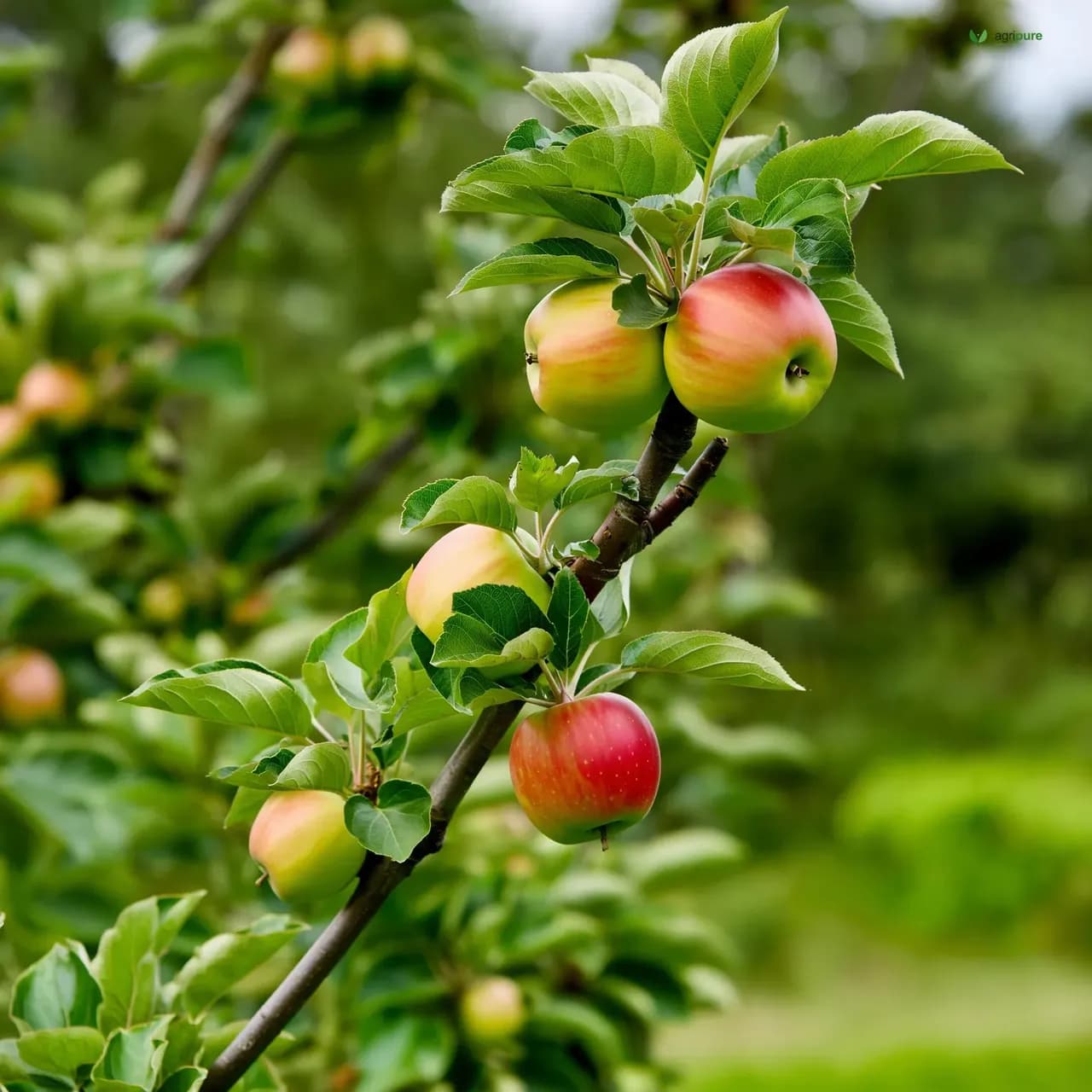
The fruit is moderate to large, typically round to ovate and often slightly lopsided, averaging roughly 6 to 8 cm across. The skin is semi-thick, smooth, and waxy, with a yellow-green to cream background overlaid by red to red-pink striping and blush; the exact colouring varies between the many sport (mutant) strains of the variety. Inside, the flesh is pale ivory to dull white, dense, fine-grained, and very juicy, snapping cleanly when bitten. The flavour is predominantly sweet and low in acid, often described as sweet-tart with notes of honey and citrus; sugar content runs roughly 9 to 11 percent by weight, and commercial measurements of 15 to 18 °Brix place it among the sweetest apples commonly sold.
Growing Fuji apple
Fuji is a named cultivar, which means it does not come true from seed and must be propagated vegetatively (by grafting or budding onto a rootstock) to keep its identity. This is standard practice for all Malus domestica dessert apples; the Fuji-specific sources here describe the fruit rather than the nursery method, so beyond that general principle no precise rootstock or grafting detail is claimed.
The site requirement that the sources are explicit about is light. Fuji needs plenty of sunshine to ripen properly, so for homestead planting this means a position in full sun. As a domestic apple it is grown in the major temperate orchard regions of Japan, China, and the United States — climates with cold winters and warm, sunny summers — and it behaves horticulturally like other domestic apples rather than as a distinct species.
The supplied sources do not give Fuji-specific figures for soil texture, soil pH, irrigation, or tree spacing, and they do not assign a USDA hardiness-zone rating to the variety. Rather than invent precise numbers, those details are deliberately left out here. In practice, treat Fuji as you would any temperate dessert apple: give it a sunny, well-drained site in a region with genuine winter cold and a long enough season to finish a late crop, and choose rootstock and spacing to suit the size of tree you want.
Harvest and uses
Fuji is a distinctly late-ripening apple. In the Northern Hemisphere it is picked in late autumn, with fresh fruit appearing through November and December; fruit held in Southern Hemisphere storage then reaches markets around May and June, which is part of how Fuji stays available almost year-round. Because it ripens so late, it suits sites with a season long enough to mature the crop before hard cold sets in.
The standout trait at harvest is keeping quality. Fuji has a very long shelf life: under refrigeration the apples can remain fresh for up to a year, and extension and retail sources describe it as an excellent storing apple that can be offered essentially year-round. For a grower this turns a concentrated autumn harvest into a supply that can be eaten or sold across the winter window rather than all at once.
The fruit is a fresh-eating dessert apple first and foremost — large, firm, dense-fleshed, and sweet, one of the better apples for eating out of hand. Its low acidity and high sugar also make it a sweet contribution to juice and cooking, though the sources here emphasise its role as a crisp, sweet table apple. Globally it is grown at enormous scale, with recent trade commentary attributing on the order of 30 million tonnes of annual apple production to the variety.
How to identify it
A ripe Fuji can be recognised by a consistent set of features drawn from the descriptions above:321
- Size and shape: Moderate to large fruit, round to ovate and often slightly lopsided, about 6 to 8 cm in diameter.
- Skin: Smooth, semi-thick and waxy; a yellow-green to cream background overlaid with red to red-pink stripes and blush, variable between sports.
- Flesh: Pale ivory to dull white, dense, fine-grained and very juicy, snapping cleanly when bitten.
- Flavour: Markedly sweet and low in acid, with honey and citrus notes; among the sweetest commonly marketed apples.
- Season: Very late ripening, picked in late autumn (November–December in the Northern Hemisphere) and an outstanding keeper.
Sources
- Fuji apple variety — Orange Pippin
- [Fuji (apple) — Wikipedia](https://en.wikipedia.org/wiki/Fuji_\(apple\))
- Fuji Apples — Specialty Produce
- Apple Number One (the story of Fuji) — Apples & People
- Apple (Malus domestica) research article — PMC, National Library of Medicine