climax
Apple — American (Kashmiri local)
saib — American (سیب امریکن)
Malus domestica cv. American
Also known as Ambri (Pakistan).
- kpk hills
International hardiness
- USDA 4-8
- RHS H6
- AU: Cool temperate, Warm temperate, Mediterranean
Where it grows — regional guide
| Zones / rating | Regional notes |
|---|---|
USDA 4-8 | No region-specific data yet |
| Zones / rating | Regional notes |
|---|---|
H6 (-20 to -15C) | No region-specific data yet |
| Zones / rating | Regional notes |
|---|---|
Cool temperate, Warm temperate, Mediterranean | No region-specific data yet |
| Zones / rating | Regional notes |
|---|---|
USDA 4-8 (USDA scale) Canada uses its own zone system; Canadian zones run roughly one lower than USDA. | No region-specific data yet |
| Zones / rating | Regional notes |
|---|---|
KPK hills | Pakistan:A heritage apple cultivar of the northern hill valleys, prized for crisp flesh, sweet fragrance and long storage life. India:The traditional heritage apple of the Kashmir Valley, valued for its crisp texture, sweet fragrance and exceptional keeping quality. |
The “American” or Ambri apple (Malus domestica) is a heritage Kashmiri cultivar of the ordinary domestic, or orchard, apple rather than a separate species. The domestic apple is the standard fruit tree grown for eating across the temperate world, a deciduous member of the rose family (Rosaceae). The species traces back to Central Asia and Afghanistan, descended from wild progenitors such as Malus sieversii, and is now cultivated worldwide wherever winters are cold enough to satisfy a tree’s dormancy. For a homesteader, the appeal is straightforward: a well-sited apple is a long-lived, low-maintenance canopy tree that crops reliably for decades once established, and named heritage cultivars like Ambri keep regionally adapted, named genetics in circulation rather than letting them disappear into anonymous commercial blocks.
Description and identification
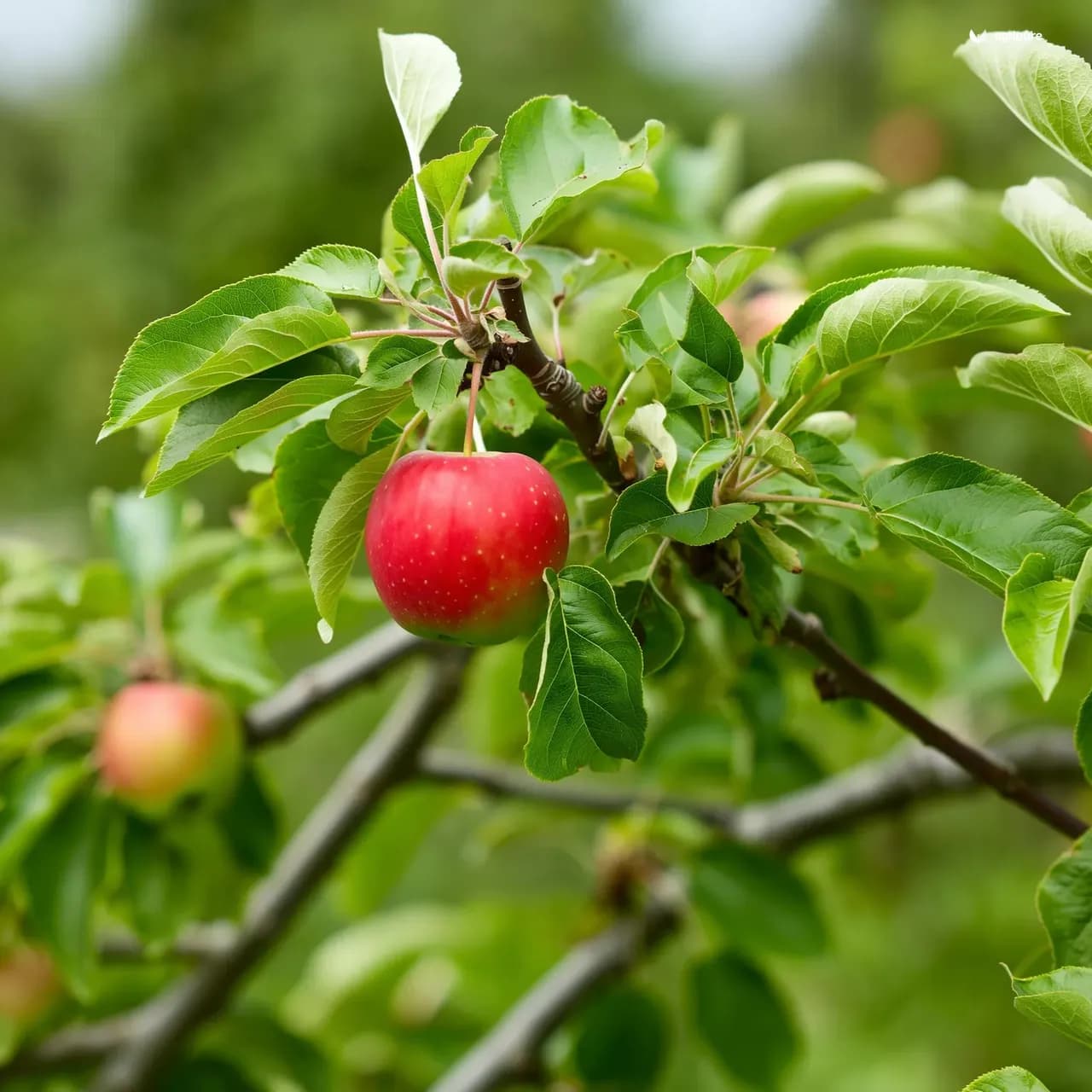
The domestic apple is a deciduous tree that floristic treatments describe as typically 2 to 10 m tall; grown from seed on its own roots it can reach roughly 9 m (about 30 ft) tall and wide, though most orchard trees are kept far smaller by grafting onto size-controlling rootstocks. Young branches are dark or reddish-brown and densely hairy, giving twigs a slightly fuzzy look, and the buds are dark red to purple and also hairy. The leaves are simple, unlobed, and arranged alternately along the stem; the upper surface is only lightly hairy while the underside is densely woolly. In spring the tree carries white, sometimes pink-tinged flowers about 1.5 to 2.5 cm across with yellow anthers. The fruit is botanically a pome, generally 2 to 5 cm wide or larger depending on the cultivar, ripening green, yellow, or red, in solid colours or stripes. The Kashmiri Ambri is a red-skinned, dessert-type apple within this range, valued locally as a heritage eating apple rather than a processing variety.
Growing apples
Apples are almost always propagated by grafting a named cultivar onto a chosen rootstock rather than grown from seed, because seedlings do not come true to type and grafting also lets the grower control the eventual tree size. Rootstocks are grouped as dwarfing, semi-dwarf, or standard: dwarfing stocks hold a tree to roughly 2 to 5 m, while standard stocks allow it to grow up to about 9 m and demand much more room. A dwarf or semi-dwarf tree is the practical choice for most homesteads because it stays within reach for pruning and picking and tends to bear fruit sooner.
Site the tree in full sun for the best cropping; apples will tolerate partial shade but fruit far better in the open. They accept a variety of soils as long as the ground is reasonably well drained. Water is the one thing not to skimp on: extension references rate the domestic apple as having no drought tolerance and high water use, so the tree needs steady moisture, especially while it is establishing and while the fruit is sizing up. Reliable, regionally specific figures for planting dates, exact spacing, and time to first harvest for the Ambri cultivar are not available in the sourced literature and are deliberately left out here rather than stated with false precision; in practice, follow your rootstock’s recommended spacing and expect a few years before a grafted dwarf tree begins to crop in earnest.
Pollination
Apples are an outcrossing crop, and the species belongs to the insect-pollinated rose family. A single isolated tree of one variety usually sets poorly; for dependable fruit set, plant at least two compatible cultivars that flower at the same time so that bees and other pollinators can move pollen between them. When pairing a heritage variety like Ambri with a pollinizer, the key is overlapping bloom time so both trees are in open flower together.
Harvest and uses
The apple is grown first and foremost as an edible dessert fruit eaten fresh, and the Ambri in particular is prized locally as a sweet, crisp eating apple. Beyond the kitchen, named cultivars carry real conservation value: the domestic apple is the subject of dedicated germplasm collections such as the USDA’s apple genetic resources unit, which exists to preserve the diversity of cultivars and wild relatives that breeders and growers draw on. Keeping a heritage variety like the Kashmiri American apple in cultivation is, in that sense, both a harvest and a small act of preservation. Mature trees also provide the wider homestead benefits of any large fruiting canopy tree: spring blossom for pollinators, summer shade, and a sustained autumn crop. Specific yield figures for the Ambri cultivar are not documented in the sourced material, so none are quoted here.
Sources
- Malus domestica (Apple) – NC State Extension Gardener Plant Toolbox
- Apple – Wikipedia
- Apple Collection – USDA Agricultural Research Service
- Domestic Apple (Malus domestica) – iNaturalist
- All About Apples – University of Vermont Extension