secondary
Himalayan Barberry
sumbal
Berberis lycium
Also known as Sumbal (Pakistan), Kasmal (India).
- kpk hills
- pothohar
- balochistan highlands
International hardiness
- USDA 6-9
- RHS H5
- AU: Cool temperate, Warm temperate
Where it grows — regional guide
| Zones / rating | Regional notes |
|---|---|
USDA 6-9 | No region-specific data yet |
| Zones / rating | Regional notes |
|---|---|
H5 (-15 to -10C) | A hardy spiny shrub with edible berries; take care with sharp three-pronged thorns and avoid toxic bark. |
| Zones / rating | Regional notes |
|---|---|
Cool temperate, Warm temperate | No region-specific data yet |
| Zones / rating | Regional notes |
|---|---|
USDA 6-9 (USDA scale) Canada uses its own zone system; Canadian zones run roughly one lower than USDA. | No region-specific data yet |
| Zones / rating | Regional notes |
|---|---|
KPK hills, Pothohar, Balochistan highlands | Pakistan:Native to dry stony hill slopes across KPK and Balochistan for sour edible berries; sharp three-pronged thorns and toxic bark warrant care. India:Native to rocky Himalayan slopes, yielding edible berries; branches carry sharp thorns and toxic bark. |
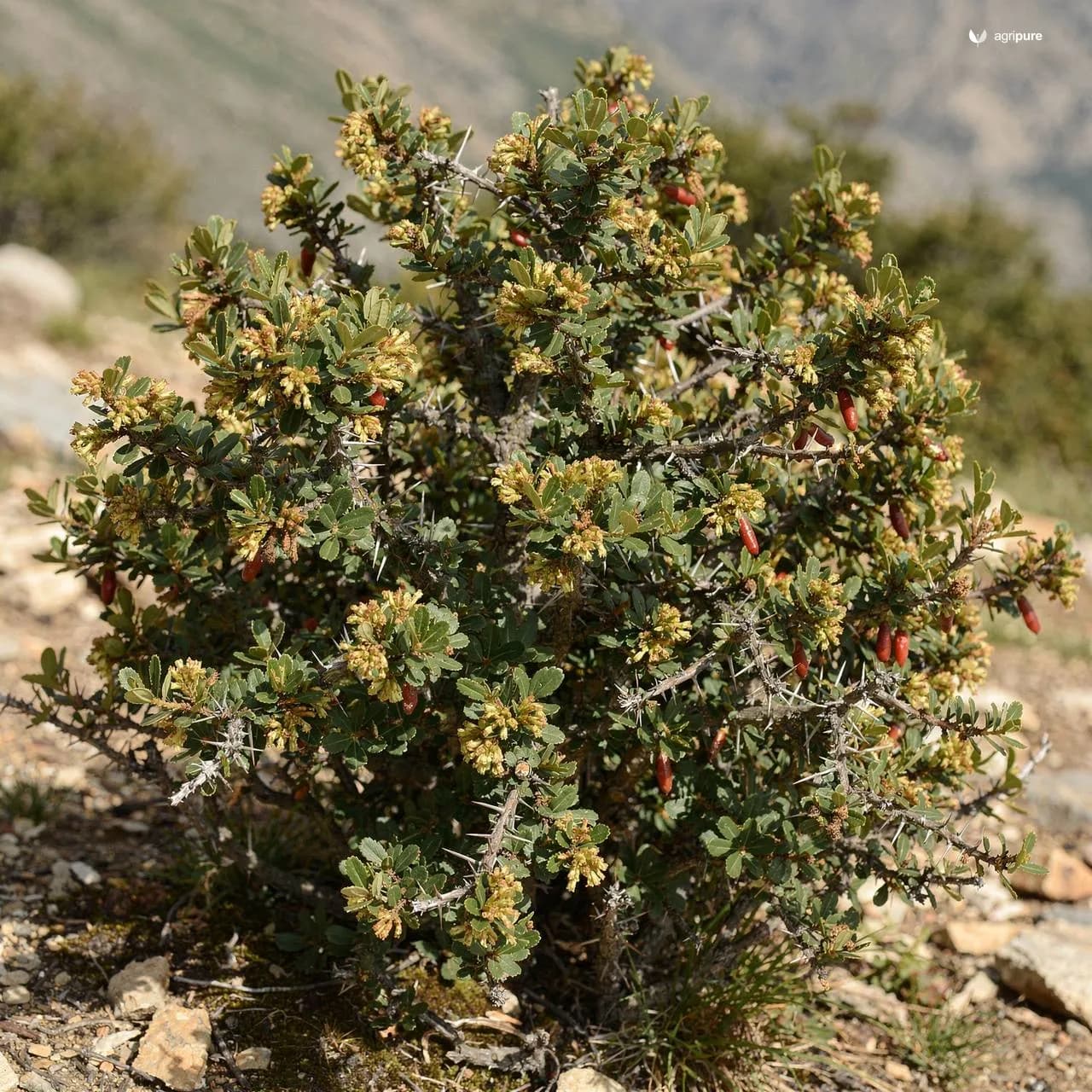
Himalayan barberry (Berberis lycium) is a spiny, evergreen shrub in the barberry family (Berberidaceae) that grows on the dry, rocky slopes of the Himalaya. It is native to the Himalayan region, with documented populations in Nepal and the north-western Indian Himalaya, including Jammu and Kashmir, Himachal Pradesh, and Uttarakhand. For a homesteader, its appeal is twofold: the berries are an edible wild fruit, while the root and bark are a long-used, berberine-rich medicinal material. It is a tough, dual-purpose shrub that establishes on the kind of poor, stony ground where most crops fail.
How to identify it
Himalayan barberry is described as a shrub roughly 2 to 3 m tall, classed as evergreen within the Berberidaceae. Its identifying features, drawn from floristic and pharmacognostic descriptions, combine as follows:
- Stems and thorns: Reddish-brown to gray branches armed with sturdy, three-pronged (three-branched) thorns — a spine type characteristic of Berberis generally and seen in B. lycium and its close Himalayan relatives.
- Leaves: Simple, entire, and evergreen, described as small and leathery, clustered on short shoots — typical of the genus.
- Flowers: Borne in spring as bright yellow clusters of roughly 2 to 8 flowers, of the typical small, six-petalled Berberis form.
- Fruit: Small berries that ripen to red or purple, noted locally as sour but edible.
Because the Himalayan barberries include several closely related species — B. lycium, B. aristata, and others — some field descriptions apply at the species-complex level rather than to B. lycium alone.
Growing Himalayan barberry
Little formal horticultural protocol is published for B. lycium; the points below are drawn from ecological and ethnobotanical accounts. Sowing dates, exact spacing, and time-to-harvest figures are not reliably documented in the accessible sources, so they are left out rather than stated with false precision.
- Climate: Suited to harsh mountain conditions and placed mainly in the temperate to subalpine belts of the western Himalaya; its evergreen habit and high, cold-elevation range point to substantial frost hardiness. The accessible sources assign no formal USDA hardiness zone, so a zone number is omitted rather than guessed.
- Soil and site: It thrives in poor, rocky, shallow, well-drained mountain soils where other plants struggle, and its natural home on dry, rocky slopes tells you it wants an open, free-draining position rather than rich, damp ground.
- Propagation: Profiles report that B. lycium is propagated by seed — the berries produce seed in abundance — and also vegetatively, the latter used to help meet demand for its roots and bark. Detailed cutting protocols are not given in the accessible scientific sources and so are not invented here.
In practice, treat it like the dryland mountain shrub it is: an open, sunny, sharply drained spot, tolerant of cold and poor ground, started from the seed inside ripe berries or by vegetative propagation.
Harvest and uses
Himalayan barberry yields two distinct harvests. The first is the fruit: small berries that ripen to red or purple, described as sour, edible, and enjoyed by both children and wildlife in Himalayan villages. They are the safe, food-grade part of the plant and the reason barberries have traditionally been appreciated as a wild fruit.
The second harvest is the root and bark, which are strongly medicinal and rich in the alkaloid berberine. Across the Himalaya, B. lycium is increasingly dug for its roots rather than valued for its berries, and that root-harvesting pressure has become a conservation concern for wild stands. For a homesteader this is an argument for cultivating the shrub rather than stripping wild plants: berries can be picked without harm, whereas heavy root harvesting destroys the plant. The dense, three-pronged thorns also make a mature shrub a natural, stock-deterring barrier, so a planted row doubles as fruit source and living hedge.
Safety and cautions
This plant carries a real edibility split worth stating plainly: the berries are documented as edible, but the root and bark are strongly medicinal, berberine-rich, and potentially toxic if misused. A few grounded points:
- Keep the food use and the medicinal use separate. The sour ripe berries are the edible part; the root and bark are not a casual food and should not be eaten as though they were.
- The root and bark owe their activity to berberine and related alkaloids, which have a long record of traditional use and scientific study — but that is not a proven, safe treatment. This profile makes no claim that the plant treats or cures any condition, and gives no dosages.
- Approach the medicinal parts conservatively and never self-administer them without qualified guidance, especially if pregnant, breastfeeding, or taking prescription medication.
Sources
- Berberis lycium — Indian Journal of Forestry (IndianJournals)
- Barberry plants in the Himalayas are being exploited for their roots — Down To Earth
- Berberis lycium review — PMC (National Library of Medicine)
- Berberis lycium: a Medicinal Plant with Immense Value (review)
- Berberis lycium: botany and phytochemistry — ScienceDirect
- Berberis lycium — iNaturalist
Sourcing notes
Propagate from ripe berries or by dividing established clumps off local hill stands; avoid digging wild plants out whole, as the species is heavily collected for rasaut. Sited as a hedge, its spines make a stockproof boundary while you harvest root bark a portion at a time.