climax
Indian Barberry (Kashmir Barberry)
sumbal / kashmal
Berberis aristata
Also known as Sumbal (Pakistan), Daruharidra (India).
- kpk hills
- balochistan highlands
International hardiness
- USDA 5-9
- RHS H6
- AU: Cool temperate, Warm temperate
Where it grows — regional guide
| Zones / rating | Regional notes |
|---|---|
USDA 5-9 | No region-specific data yet |
| Zones / rating | Regional notes |
|---|---|
H6 (-20 to -15C) | Fully hardy under RHS H6 as a deciduous spiny garden shrub with edible berries; handle sharp spines with care and avoid self-dosing bark. |
| Zones / rating | Regional notes |
|---|---|
Cool temperate, Warm temperate | No region-specific data yet |
| Zones / rating | Regional notes |
|---|---|
USDA 5-9 (USDA scale) Canada uses its own zone system; Canadian zones run roughly one lower than USDA. | No region-specific data yet |
| Zones / rating | Regional notes |
|---|---|
KPK hills, Balochistan highlands | Pakistan:Native to the KPK hills and Balochistan highlands for edible berries and rasaut; handle sharp spines with care and avoid overdosing potent berberine. India:Native to the hill forests for edible berries and traditional rasaut; handle sharp thorns with care and avoid overdosing potent berberine. |
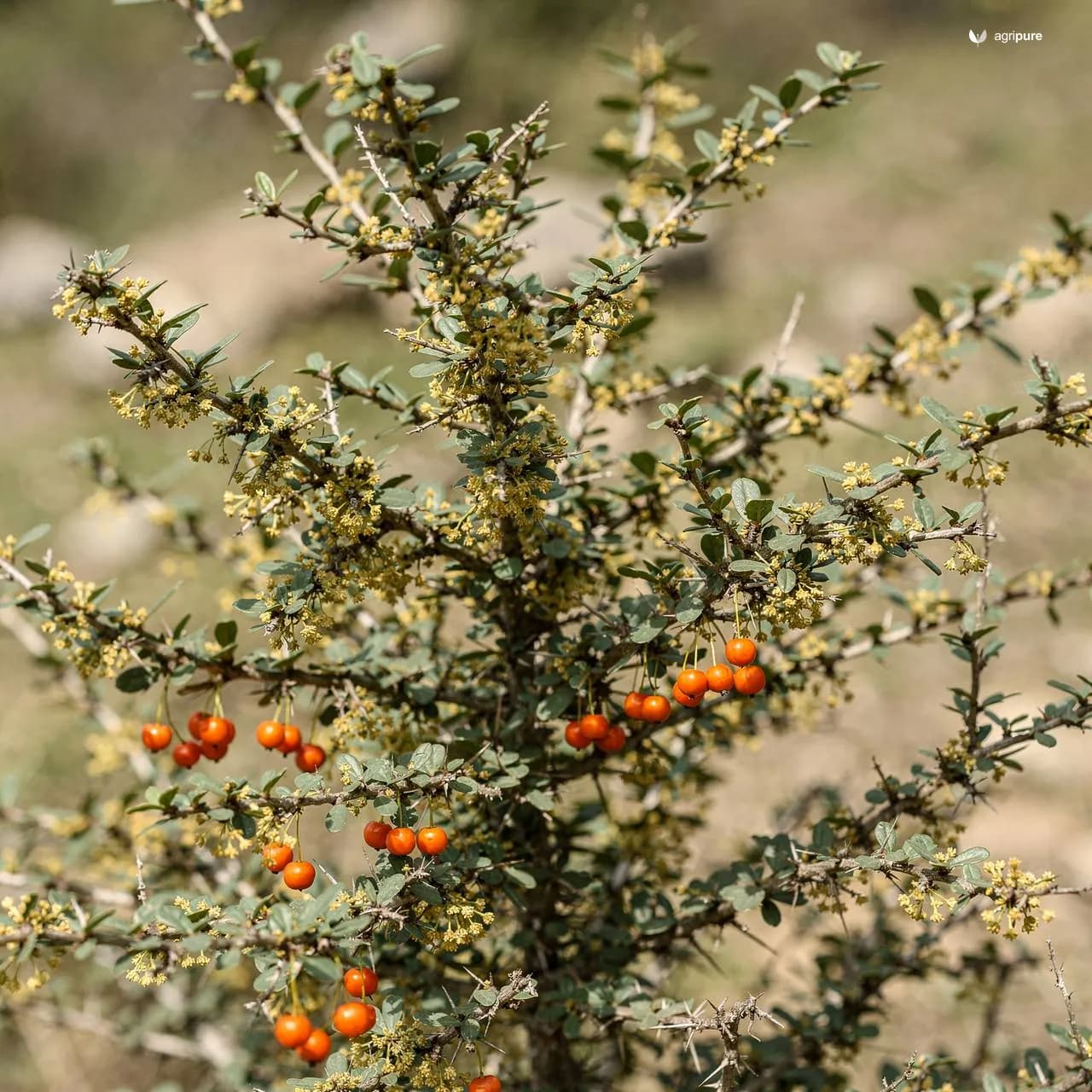
Indian barberry (Berberis aristata, locally sumbal or kashmal) is the spiny, yellow-wooded medicinal shrub of the hill forests — a shade-tolerant understorey plant of the KPK hills and the higher Balochistan highlands. Its bright red berries feed birds and people, and its root bark yields rasaut, the bitter yellow eye-and-skin remedy that has carried this plant’s name for centuries. For a maturing hill planting it is a long-lived layer that pays in medicine and fruit.
Where it thrives
In Pakistan it grows mainly through the Hazara division of KPK and Azad Kashmir, on montane hillsides and forest margins. It occurs roughly between 1,000 and 3,500 m as a deciduous spiny shrub, commonly found in forest clearings, along forest edges, and in shrubberies. It takes full sun to part shade and well-drained soil, and it carries hill-country cold and snow that lowland shrubs cannot.
Role in the system
This is a climax, shade-tolerant shrub for the understorey of a mature hill guild, not a fast pioneer to throw at bare ground. It is slow to establish and long-lived, content beneath taller trees once the canopy is up, where it fills the spiny shrub layer that an open planting lacks. There it does steady, quiet work: its roots hold soil on slopes prone to slipping, its thorny growth gives cover and its berries give food to birds, and it occupies a layer that would otherwise grow weeds. It fixes no nitrogen, so it is not a fertility plant; its contribution is permanence and yield in the lower storey of a settled system. The way to use it is to plant it for the long run, under trees that are already established, and let it mature into the understory over years rather than expecting a quick return.
What you get
The standout is medicine. Every part of the plant contains the alkaloid berberine, most concentrated in the roots, stems, and inner bark, and the root bark is boiled down into rasaut, used traditionally for eye infections and skin complaints. The berberine behind that use carries documented antimicrobial activity. The ripe berries are edible and rich in vitamin C, with very low berberine, so they can be eaten freely. The hard yellow wood gives useful firewood from prunings.
Cautions
The value of the root bark is also the threat to the plant: harvesting rasaut by digging up whole plants has thinned wild stands, and the species is best cropped by coppicing branches and partial root bark rather than lifting it entirely. Berberine is potent — the medicinal preparations are not for casual or heavy self-dosing, and are best left to those who know the traditional doses.
Sources
- Flora of Pakistan. “Berberis aristata DC.” eFloras.org, Missouri Botanical Garden & Harvard University Herbaria.
- Plants For A Future. “Berberis aristata — Chitra, Indian Barberry or Tree Turmeric.” PFAF Plant Database.
- Belwal, T., et al. (2025). “Berberis aristata DC. (Indian barberry): current insight into botanical, phytochemical, and pharmacological aspects.” Fitoterapia, ScienceDirect.
Sourcing notes
Slow to establish; raise from seed or semi-hardwood cuttings, or transplant from nursery stock. Harvest root bark for rasaut sustainably by coppicing rather than lifting whole plants, which destroys the stand.