climax
Himalayan Clematis
Clematis montana
Also known as Mountain Clematis (India, United States, UK & Ireland).
- kpk hills
International hardiness
- USDA 6-9
- RHS H6
- AU: Cool temperate, Warm temperate, Mediterranean
Where it grows — regional guide
| Zones / rating | Regional notes |
|---|---|
USDA 6-9 | Hardy in USDA zones 6 to 9 on sturdy trellises; wear gloves against irritant sap, and prevent pets from chewing vines as it is poisonous if eaten. |
| Zones / rating | Regional notes |
|---|---|
H6 (-20 to -15C) | Hardy under RHS H6 for covering arbours and walls; wear gloves to avoid dermatitis from sap, and keep away from pets as it is poisonous if swallowed. |
| Zones / rating | Regional notes |
|---|---|
Cool temperate, Warm temperate, Mediterranean | Suits cool-temperate gardens on sturdy fences; wear gloves when pruning to avoid skin burning, and prevent pets from chewing foliage as it is toxic if eaten. |
| Zones / rating | Regional notes |
|---|---|
USDA 6-9 (USDA scale) Canada uses its own zone system; Canadian zones run roughly one lower than USDA. | No region-specific data yet |
| Zones / rating | Regional notes |
|---|---|
KPK hills | Pakistan:Native to moist hill valleys as a vigorous climber; wear gloves against skin-burning sap, and keep away from pets as it is poisonous if swallowed. India:Climber of Himalayan slopes; protect skin with gloves against burning sap, and keep pets away as it is poisonous if eaten. |
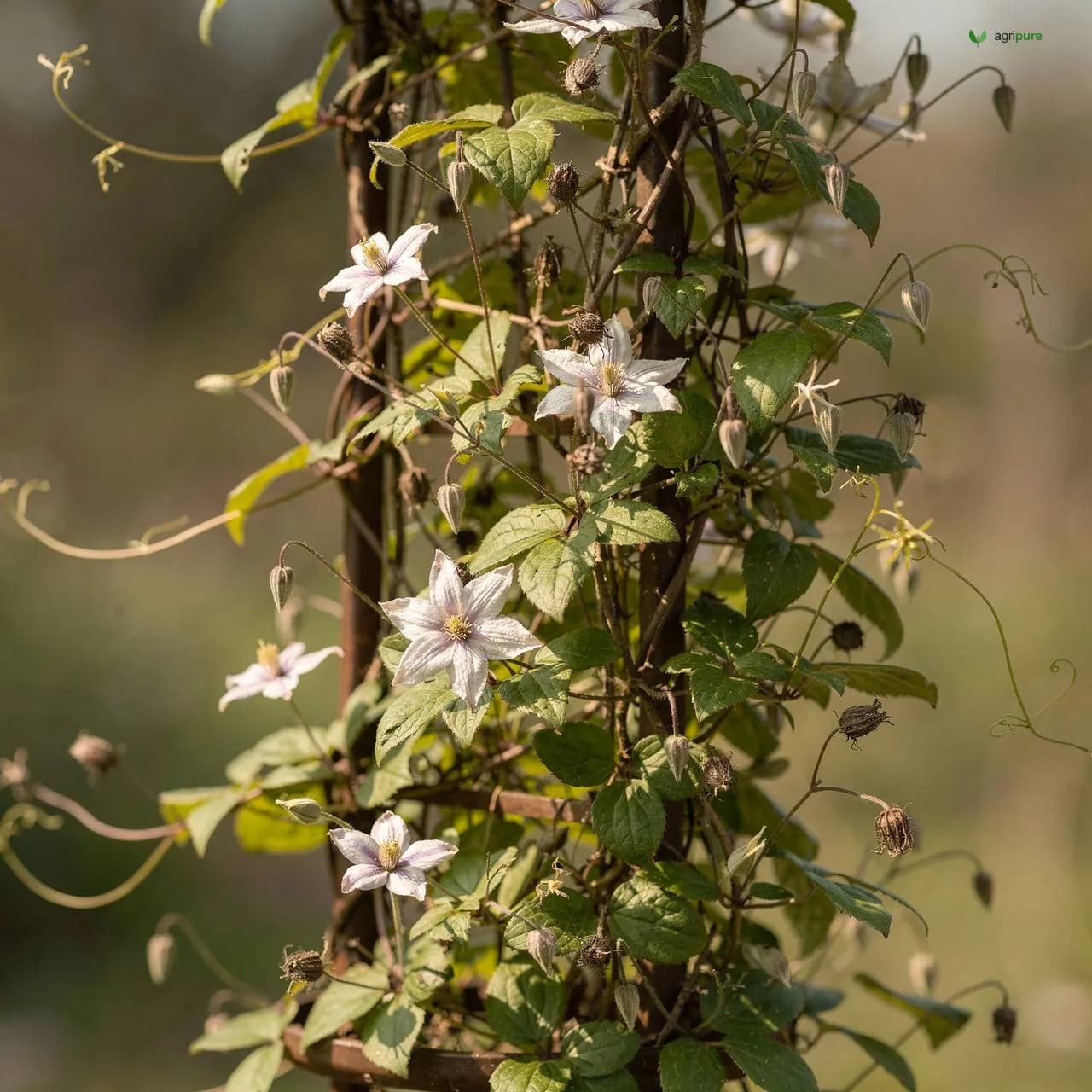
Mountain clematis (Clematis montana) is a vigorous, deciduous climbing vine in the buttercup family (Ranunculaceae). It is a widespread, very variable Sino-Himalayan species, native across the Himalaya, China, and Tibet and extending toward Taiwan, with forms that differ in flower size and colour, including pink-flowered types alongside the familiar white. For a homesteader it is best understood as an ornamental, pollinator-friendly climber for covering a wall, arbour, or sturdy frame rather than as a food or fibre plant — its value sits in spring bloom and the bees, butterflies, and hummingbirds it draws.
It is a woody, twining perennial vine that can climb roughly 7 to 12 m where it is left unchecked, and other horticultural descriptions put its reach at 16 to 40 feet with a spread of 8 to 15 feet depending on the support it is given. It carries small, single, star-shaped white flowers in late spring, and the emerging leaves often flush bronze or purple before turning green. The combination of a woody twining habit, late-spring flowering, and bronzy new foliage is the easiest way to recognise the species in the garden.
Growing mountain clematis
Mountain clematis is hardy and adaptable across a broad temperate range. The RHS rates it at hardiness H5, while North Carolina State Extension places it in **USDA zones 6a to 9b and Gardenia likewise reports it as hardy in **USDA zones 6 to 9.124 To grow it well at homestead scale:
- Sun: Plant in full sun to partial shade. Aim for at least six hours of sun a day, with some afternoon shade in hot climates.
- Soil: Give it moisture-retentive but well-drained soil that is rich in organic matter, with a neutral to alkaline pH. A useful old rule for clematis applies here: keep the roots and base cool and shaded even as the top of the vine climbs into the sun.
- Water: Keep the site moisture-retentive. Mulch to keep the roots cool and damp, and water regularly through the first growing season while the plant establishes.
- Spacing and support: It may spread 8 to 15 feet wide and needs a sturdy support structure such as a trellis or arbour to carry its weight as it matures.
- Propagation: The RHS recommends layering or semi-hardwood cuttings; NC State similarly lists layering or stem cuttings.
I have intentionally left out a specific time-to-maturity figure: the general botanical and horticultural sources here do not give a reliable, species-specific number for how long it takes to reach flowering size, so stating one would be false precision. In practice, treat it like other vigorous woody climbers — site it well, give it a strong frame from the start, and let it bulk up over several seasons.
Harvest and uses
Mountain clematis is grown almost entirely as an ornamental vine, and there is no reliable, species-specific harvest or yield to report — the available sources document no edible crop and no quantified yield for flowers, seed, or foliage, so no such figure is given here. Its real “harvest” is ecological. NC State Extension reports that it attracts bees, butterflies, and hummingbirds, which makes a large established plant a genuine pollinator resource in a garden or managed landscape during its late-spring bloom. There is no reliable evidence of culinary use, and because the plant is toxic, ingestion is warned against; there is likewise no trustworthy source supporting a medicinal or material use (fibre, cordage, or dye) specific to this species, so those categories are omitted rather than guessed at.
Safety and cautions
Mountain clematis is a poisonous ornamental, not an edible plant, and the sources are explicit about the cautions:124
- Toxic if eaten: NC State rates the plant as having high-severity poison characteristics and notes it can cause severe mouth pain and ulcers if eaten; Gardenia likewise warns that ingestion can cause severe discomfort. Do not eat any part of the plant.
- Skin irritant: The RHS flags the species as potentially harmful and a skin irritant, advising gloves and protective equipment when handling it. NC State identifies the leaves and sap/juice as the poison parts and names protoanemonin as the toxic principle, noting it can cause contact dermatitis with redness and burning in some people.
- Toxic to animals: Gardenia warns that the plant is toxic to cats, dogs, and horses. Households with cats, dogs, horses, or rabbits should treat it as a plant to keep away from animals.
People with sensitive skin should avoid unprotected handling, and the plant should be grown for its flowers and pollinator value only — never as a casual home remedy or anything to be ingested.
Sources
- Clematis montana — Royal Horticultural Society (RHS)
- Clematis montana — North Carolina State Extension
- Clematis montana — Royal Botanic Garden Edinburgh
- Clematis montana Group — Gardenia
Sourcing notes
Propagate from softwood or semi-ripe cuttings or layers taken from an established plant in the moist KPK hills; nursery stock is sold ornamentally, so a healthy local mother plant is the simplest source.