secondary
Himalayan Clematis (Snow Creeper)
garni-bel
Clematis buchananiana
Also known as Garni-bel (Pakistan).
- kpk hills
International hardiness
- USDA 6-9
- RHS H5
- AU: Cool temperate, Warm temperate
Where it grows — regional guide
| Zones / rating | Regional notes |
|---|---|
USDA 6-9 | No region-specific data yet |
| Zones / rating | Regional notes |
|---|---|
H5 (-15 to -10C) | No region-specific data yet |
| Zones / rating | Regional notes |
|---|---|
Cool temperate, Warm temperate | No region-specific data yet |
| Zones / rating | Regional notes |
|---|---|
USDA 6-9 (USDA scale) Canada uses its own zone system; Canadian zones run roughly one lower than USDA. | No region-specific data yet |
| Zones / rating | Regional notes |
|---|---|
KPK hills | Pakistan:Native climber of moist hill forest margins; wear gloves against blister-causing sap, and keep away from young trees to prevent smothering. India:Found along Himalayan forest margins; handle with gloves as fresh sap causes skin blisters, and prune hard to prevent smothering shrubs. |
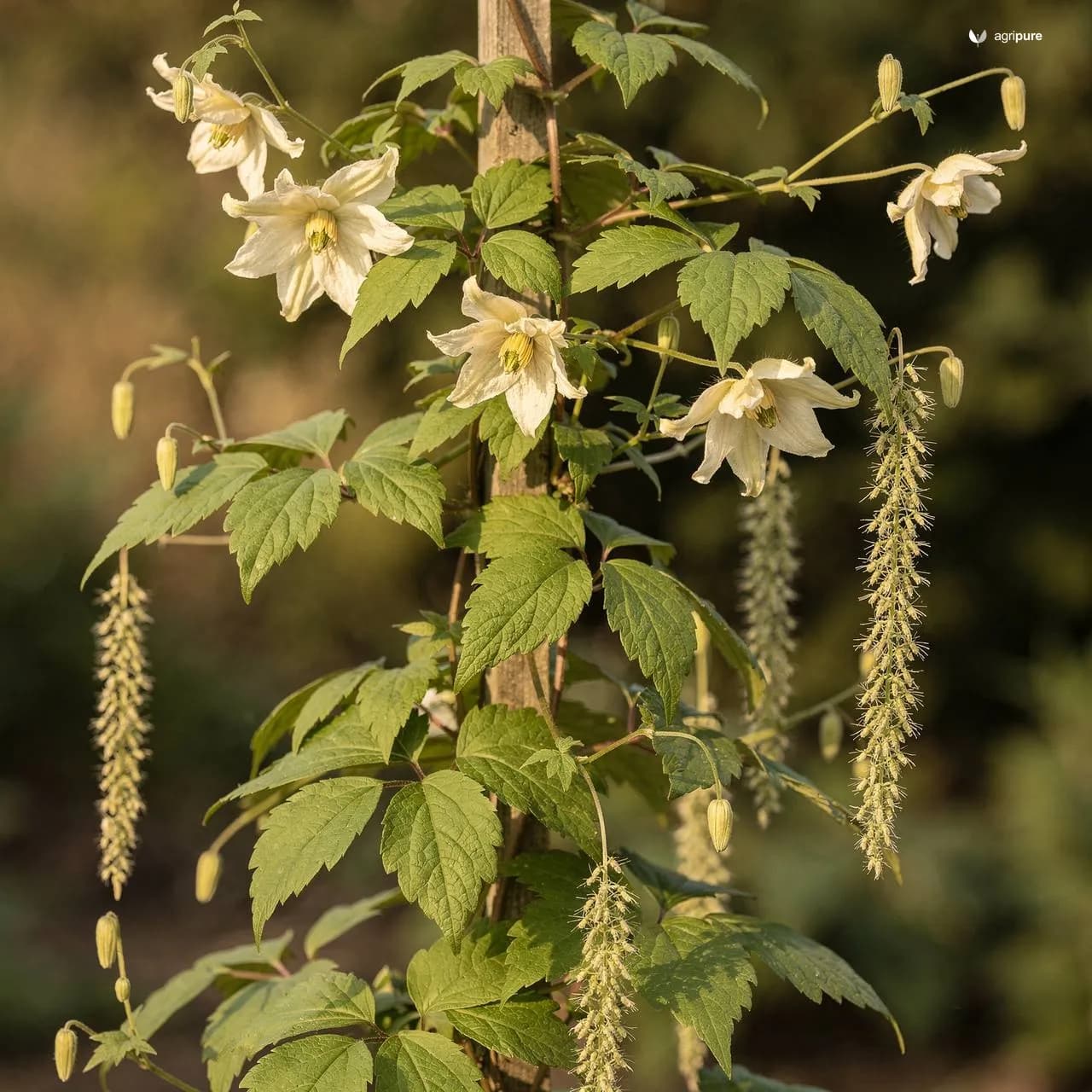
Himalayan clematis (Clematis buchananiana, garni-bel) is a vigorous yellow-belled clematis of forest edges in the the KPK hills, a deciduous woody climber whose leaf-stalks coil around twigs to haul it up to 6 m. It throws a great deal of growth in a season and is used in counter-irritant and other folk remedies. On a syntropic site it works as a secondary-stage biomass vine: a rampant climber that piles on leaf for chop-and-drop and carries a medicinal use alongside.
Where it thrives
It is native across the Himalaya from Kashmir eastward, recorded from north-east Pakistan and on through India, Nepal, southern China, and Indo-China, growing in forest and on forest margins at roughly 460 to 3,650 m.2 That band sits squarely in the KPK hills, where it scrambles along edges and over scrub in the moist hill forest. The trait that defines it is vigour: it is a deciduous climber that can push new shoots up to 4 m in a single season, which is what makes it both useful and something to site with care.
Role in the system
Use it as a biomass and mulch vine on edges and rough cover. Its fast, heavy yearly growth is the whole point: a vine that can throw new shoots up to 4 m in a season puts on more cuttable leaf and stem than almost any standing plant of the same age, and cut back, that rampant growth returns as chop-and-drop mulch and green manure while the vine regrows from its woody base for another cut. It scrambles over scrub, fences, and edge cover rather than climbing high into a closed canopy, so it suits the boundary and transition zones of a hill planting where biomass is wanted on tap. The flip side of that vigour is plain: it will smother smaller plants if it reaches them. Keep it off young trees and crop beds, give it a fence or rough scrub to climb, and harvest it hard — the more you cut, the better it does the one job you want from it.
Uses
The main service value is mulch from its biomass; the named human use is medicinal. In Himalayan folk medicine the root paste is applied as a poultice to swellings caused by inflammation — the counter-irritant use — while root juice is taken for peptic ulcers and indigestion, root or stem-bark paste is pressed against aching teeth, and leaf juice is used for coughs, colds, and sinusitis.3 The stems also serve as tying material. A caution runs through the genus: fresh Clematis is acrid and can blister or irritate the skin, which is exactly why it works as a counter-irritant, so it is handled knowingly and not eaten raw.
Sources
- Useful Temperate Plants. “Clematis buchananiana.” (woody climber to 6 m, 4 m shoots a season, range, elevation, root poultice, tying material).
- Plants of the World Online. “Clematis buchananiana DC.” Royal Botanic Gardens, Kew (native range including Pakistan).
- Pradhan, B. K., et al. (2020). “Traditional uses and anti-inflammatory property of Clematis buchananiana.” (anti-inflammatory and counter-irritant use).
Sourcing notes
Grows fast from seed or by layering a trailing stem; site it on a fence, edge, or scrub it can scramble over, because its yearly growth is too vigorous for a small bed.