secondary
Roundleaf Cotoneaster
luni
Cotoneaster nummularius
Also known as Luni (Pakistan).
- kpk hills
- balochistan highlands
International hardiness
- USDA 4-8
- RHS H6
- AU: Cool temperate, Warm temperate, Mediterranean
Where it grows — regional guide
| Zones / rating | Regional notes |
|---|---|
USDA 4-8 | Hardy in USDA zones 4 to 8 on sunny rocky banks; do not eat red berries as they contain cyanogenic toxins, and watch for weedy spread. |
| Zones / rating | Regional notes |
|---|---|
H6 (-20 to -15C) | Hardy under RHS H6 for stabilising dry banks; keep berries away from children because they carry cyanide compounds, and check weed status. |
| Zones / rating | Regional notes |
|---|---|
Cool temperate, Warm temperate, Mediterranean | No region-specific data yet |
| Zones / rating | Regional notes |
|---|---|
USDA 4-8 (USDA scale) Canada uses its own zone system; Canadian zones run roughly one lower than USDA. | No region-specific data yet |
| Zones / rating | Regional notes |
|---|---|
KPK hills, Balochistan highlands | Pakistan:Native to dry rocky slopes in Balochistan and KPK; do not consume the red berries or leaves because they contain toxic cyanogenic compounds. |
Roundleaf cotoneaster (Cotoneaster nummularius) is a low, spreading deciduous shrub in the rose family (Rosaceae), native to dry, rocky sites that run from southeastern Europe through West and Central Asia. It is grown mainly as a hardy ornamental and a soil-holding shrub rather than as a crop; it is not a common food plant, and like all cotoneasters it contains cyanogenic glycosides, so its fruit and foliage should be treated as potentially toxic rather than edible. For a homesteader, its appeal is its toughness: it is a cold-hardy, low-maintenance shrub built for thin, stony, sun-baked ground where thirstier plants struggle, which makes it a candidate for holding and covering difficult dry slopes.
How to identify Cotoneaster nummularius
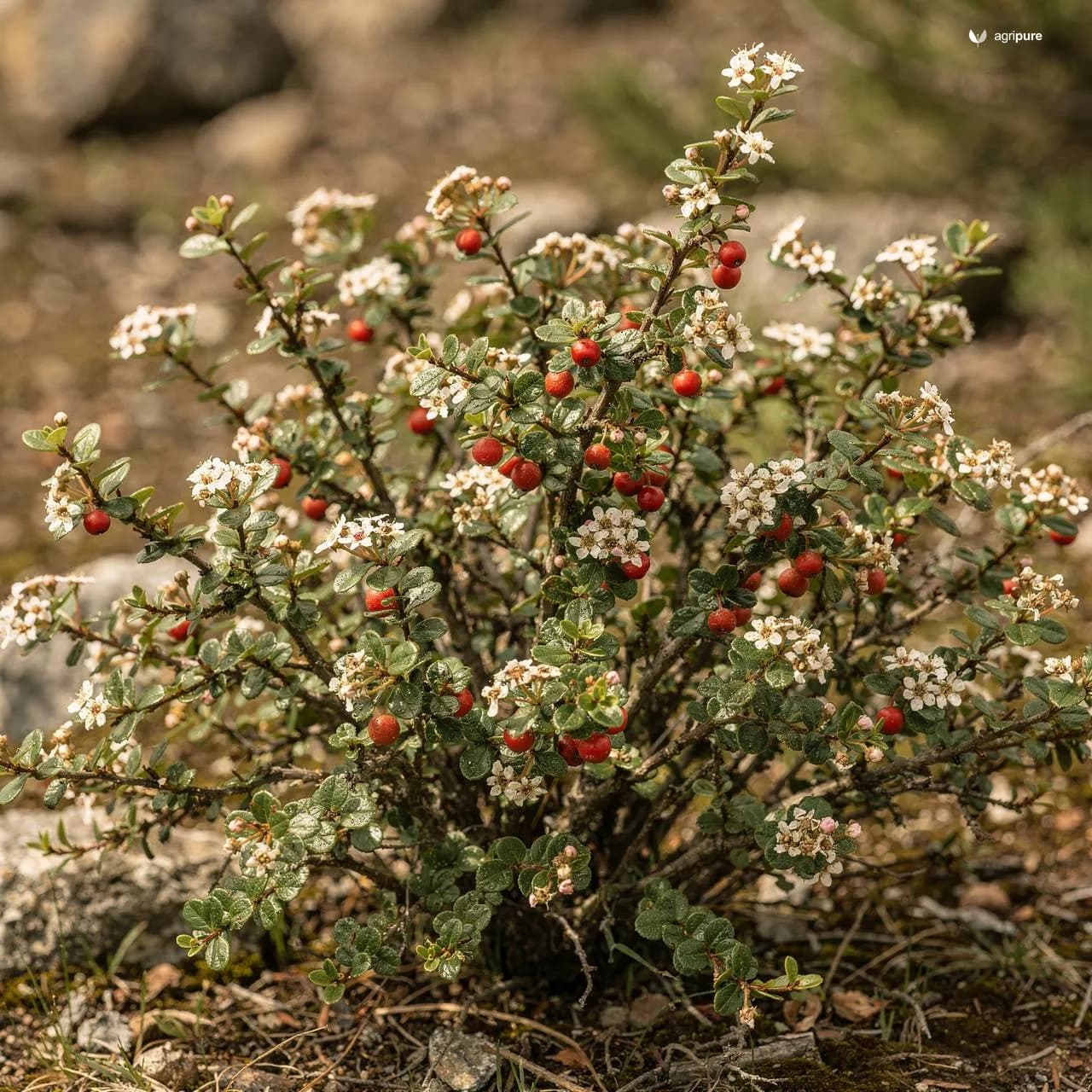
This is a low, much-branched deciduous shrub, often roughly 0.5 to 1.5 m tall, sometimes forming a dense mound or spreading across rocky slopes. A few field cues, drawn from floras and horticultural references, help separate it from look-alikes:124
- Stems: Younger twigs are slender and brownish, older stems grey-brown. Like all cotoneasters the stems are thornless, which distinguishes the genus from many hawthorns and from spiny Pyracantha.
- Leaves: Small, round to broadly oval and described as “coin-like” — the epithet nummularius means “coin-shaped.” Leaves are alternate, with entire (untoothed) margins; the upper surface is green and the underside paler and at least sparsely hairy, a common trait across the genus.
- Flowers: Small, white to pinkish, five-petalled and typical of the rose family, borne singly or in few-flowered clusters in late spring to early summer; in related small-leaved cotoneasters they are roughly 5 to 7 mm across.
- Fruit: Small, nearly spherical pomes, usually red when ripe in late summer to autumn, typically 5 to 8 mm in diameter; in many cotoneasters such berries persist into winter.
Because C. nummularius is easily confused with other small-leaved cotoneasters, reliable identification often depends on leaf measurements, hairiness, and flower and fruit detail, and may require working through a flora key rather than casual inspection.
Growing roundleaf cotoneaster
This is a plant of dry, rocky regions. Distribution sources place its native range across the Balkans and adjacent southeastern Europe, Turkey and the Caucasus, and Iran and parts of West and Central Asia (the Irano-Turanian region). Its typical habitat is rocky slopes, open woodland edges, and dry, often calcareous (limey) hillsides, usually at mid to upper elevations below about 2,500 m — consistent with the genus’s general preference for rocky slopes and forests below that altitude. The practical reading is to match it to the site it favours in the wild: open, sunny, free-draining stony ground rather than rich, sheltered, or wet soil.
Precise USDA hardiness zones for this particular species are not published in the major North American databases. A USDA plant guide treats cotoneasters as a group as suited to roughly USDA zones 3 to 5, preferring cool-temperate climates and disliking hot, humid summers, which fits this shrub’s natural range in continental, cold-winter regions. Treat it as a cold-hardy temperate shrub and confirm suitability with local trials or nurseries rather than relying on a single zone number.
There are no detailed, species-specific cultural instructions for C. nummularius in the major horticultural databases, so the points below are drawn from genus-level and closely related small-leaved cotoneaster guidance, which authoritative sources treat as broadly similar in requirements; species-specific sowing dates, exact spacing, and a firm time to maturity are intentionally left out rather than stated with false precision.
- Soil: Match the wild habitat — well-drained, rocky or stony ground, tolerant of dry and often calcareous (limey) sites.
- Sun: An open, sunny position on rocky slopes or woodland edges suits it.
- Water: Adapted to dry conditions; it is built for dry hillsides, not waterlogged ground, and the genus dislikes hot, humid summers.
- Climate: Best in cool-temperate, continental climates with cold winters, in line with both its native range and the zone 3-to-5 guidance for cotoneasters as a group.
Harvest and uses
Roundleaf cotoneaster is grown chiefly as a hardy ornamental and a soil-holding shrub, valued for being tough and low-maintenance on dry, rocky ground; it is not a food plant. Its low, spreading habit and tolerance of thin, stony, calcareous soils make it a candidate for covering and stabilising difficult dry slopes, and its red autumn berries are an ornamental feature that, as in other cotoneasters, can persist into winter. Because there are no species-specific yield figures in the available sources, none are given here. The honest summary is that the value of this shrub is in service and ornament: cover, hardiness, and structure on poor ground, rather than a harvest.
Safety and cautions
This shrub should be treated as potentially toxic, not edible. The sources are explicit that, like all cotoneasters, C. nummularius contains cyanogenic glycosides, and that its fruits and foliage should be handled as potentially toxic rather than eaten. A few grounded points:
- It is not a common food plant, and the sources do not describe any edible use; the red berries should not be treated as fruit for people.
- All parts that contain cyanogenic glycosides can release toxic compounds, so foliage and fruit are best kept away from casual nibbling, and care is sensible around children and grazing livestock.
- This profile makes no medical or edibility claims; where the research does not specify amounts or preparations, none are invented here.
One further homestead caution: several cotoneasters are recorded as invasive or weedy where they have been introduced outside their native range, spread by birds eating the berries. Before planting, check whether cotoneaster is regulated or discouraged in your area, and choose a non-invasive option if so.
Sources
- Cotoneaster identification and management — PBA Solutions
- Cotoneaster plant guide (PDF) — USDA NRCS Plants Database
- Small-leaved cotoneaster (Cotoneaster microphyllus) — Oregon State University Landscape Plants
- Cotoneaster — Missouri Botanical Garden Plant Finder
Sourcing notes
Grow from seed or cuttings off local hill stands and plant on dry, stony, sunny slopes where erosion control and bee forage are the goal. Treat it as supporting scrub and take prunings for fuel rather than expecting a harvest.