support
Jwarancusa Lemongrass
khavi
Cymbopogon jwarancusa
Also known as Khavi (Pakistan).
- punjab plains
- balochistan highlands
- pothohar
International hardiness
- USDA 9-11
- RHS H2
- AU: Arid / semi-arid, Subtropical
Where it grows — regional guide
| Zones / rating | Regional notes |
|---|---|
USDA 9-11 | No region-specific data yet |
| Zones / rating | Regional notes |
|---|---|
H2 (1 to 5C) | No region-specific data yet |
| Zones / rating | Regional notes |
|---|---|
Arid / semi-arid, Subtropical | No region-specific data yet |
| Zones / rating | Regional notes |
|---|---|
USDA 9-11 (USDA scale) Canada uses its own zone system; Canadian zones run roughly one lower than USDA. | No region-specific data yet |
| Zones / rating | Regional notes |
|---|---|
Punjab plains, Balochistan highlands, Pothohar | Pakistan:Forms dense aromatic tussocks on dry stony hills and plains; it is grown for essential oil distillation and is not a culinary herb. India:Cultivated on exposed rocky slopes for essential oil; treat as an aromatic service crop and avoid using as a culinary lemongrass. |
Jwarancusa grass (Cymbopogon jwarancusa) is a tufted, aromatic perennial grass in the grass family, Poaceae, grown mainly for its essential oil and its long history of traditional medicinal use rather than as a food or fodder crop. Drawing on Plants of the World Online, eFlora of India gives it a wide native range running from Turkey to Socotra and south-central China, taking in Afghanistan, India, Nepal, Pakistan, Iran, Iraq, Oman, the Gulf states, Tibet, Vietnam, and Yemen. For a homesteader on hot, stony, low-fertility ground, its appeal is straightforward: it is a hardy aromatic grass adapted to dry slopes and valleys, holding marginal ground while yielding a fragrant, oil-bearing leaf.
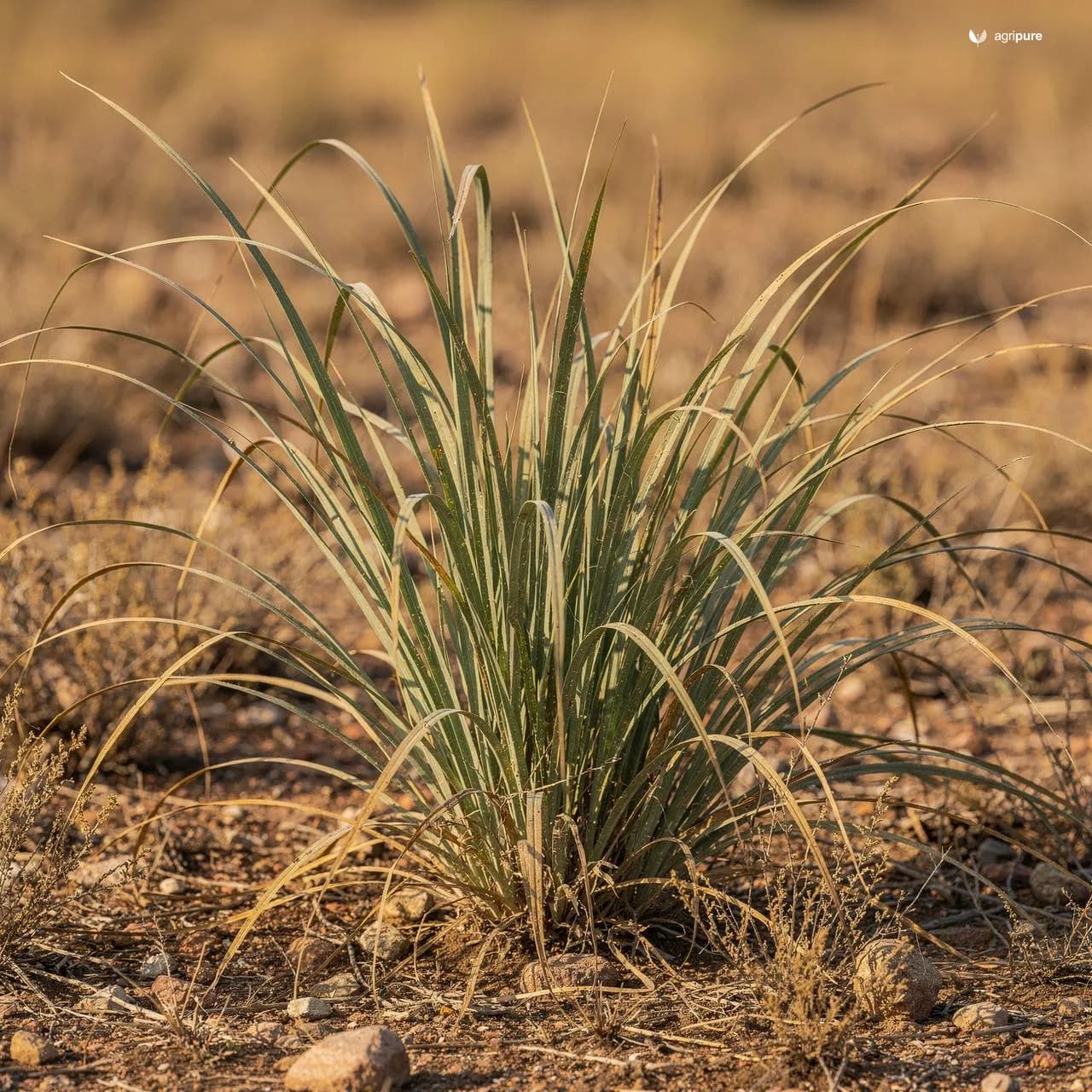
The plant forms dense tussocks of culms (flowering stems) that rise from a short, creeping rhizome, with smooth, overlapping leaf sheaths congested at the base. Its glaucous, bluish-green leaf blades and narrow, woolly flowering panicle are described under “How to identify it” below. One field-grown Ayurvedic account describes especially vigorous plants reaching up to about 2.5 m, consistent with a coarse aromatic Cymbopogon.
Growing jwarancusa grass
Jwarancusa grass is a dryland species of mountain slopes and dry valleys rather than rich, moist beds, growing naturally on exposed, stony hill ground. An Ayurvedic overview notes it thrives at elevations of roughly 1,500 to 3,000 m on Himalayan slopes, pointing to a plant adapted to bright, well-drained, semi-arid conditions. Like other tussock-forming Cymbopogon grasses it is a clumping perennial that regrows from its base after cutting.
The botanical sources here describe where the grass grows in the wild but do not set out homestead-scale agronomy such as sowing dates, plant spacing, irrigation rates, or time-to-harvest figures. Rather than invent precise numbers, treat it as a hardy dryland grass: give it an open, sunny spot and free-draining, stony ground, keep it lean and dry, and let the clumps establish before cutting.
Harvest and uses
The principal products are the aromatic leaf, harvested for distillation of its essential oil, and the roots, both of which carry the plant’s traditional value; the leaf is cut, dried, and processed rather than eaten. In its Chinese range the species flowers and fruits in two windows, March to May and again July to August, a useful cue for timing cutting around the reproductive flush.
Importantly, jwarancusa grass is not the same as the lemongrass used in cooking. There is no strong evidence in these sources that it is used as a culinary herb the way common lemongrass (Cymbopogon citratus) is, so it is best understood as an aromatic, oil-bearing service crop, useful on a homestead as a low-input grass for hot, marginal corners.
How to identify it
Several features together separate jwarancusa grass from other grasses and from related oilgrasses:12
- Habit: A densely tufted perennial grass with a short, creeping rhizome, forming clumps of wiry to robust culms about 0.2 to 1.5 m tall.
- Leaves: Glaucous, bluish-green blades, rolled or flat, 20 to 50 cm long and 1 to 5 mm wide, hairless and finely tapered, with a strong aromatic scent when crushed.
- Flower head: A narrow, spathe-bearing compound panicle 10 to 40 cm long, with dense, woolly, straw-coloured to purplish clusters and conspicuous white hairs on the small branches.
- Leaf base (versus relatives): In C. jwarancusa the leaves are linear and parallel-sided at the base, whereas in the related palmarosa (C. martinii) they are lanceolate with a heart-shaped base, a handy way to tell the two oilgrasses apart.
Some floras list this plant under the alternative spelling Cymbopogon iwarancusa, with common names including iwarancusa grass and oilgrass; recognising these synonyms helps when cross-checking sources. Occurrence databases place the species across Africa and Asia, and in the United States it is recorded as introduced, not native, in Florida, so growers outside its home range should treat it as a non-native specialty grass and site it responsibly.
Safety and cautions
Jwarancusa grass is a medicinal and aromatic plant, not a food crop, and the sources are clear that its documented uses centre on the essential oil and roots taken in prepared, topical, or traditional forms. A few grounded points for anyone considering it:
- Reliable sources emphasise topical and medicinal applications of the oil and roots and provide no support for using the leaf as an everyday culinary herb like common lemongrass.
- Safety data for the species are incomplete, so internal use, and use during pregnancy, in children, and by people with chronic illness, should be approached cautiously.
- This profile describes traditional and reported uses only; it makes no claim that the plant treats or cures any condition, and it gives no dosages. Anyone weighing medicinal use, or taking prescription medication, should seek qualified advice first.
Sources
- Cymbopogon jwarancusa — Flora of China (eFloras.org)
- Cymbopogon iwarancusa — eFlora of India
- Cymbopogon jwarancusa — Ask Ayurveda (horticultural overview)
- Cymbopogon jwarancusa — Global Biodiversity Information Facility (GBIF)
- Cymbopogon jwarancusa — Atlas of Florida Plants, University of South Florida
- Cymbopogon jwarancusa essential oil and medicinal use — PMC (National Library of Medicine)
Sourcing notes
Most reliably established by splitting and planting rooted slips from an existing clump, though it also grows from seed; it spreads slowly into a dense tussock. Local Salt Range and Pothohar stands are the usual source of planting material.