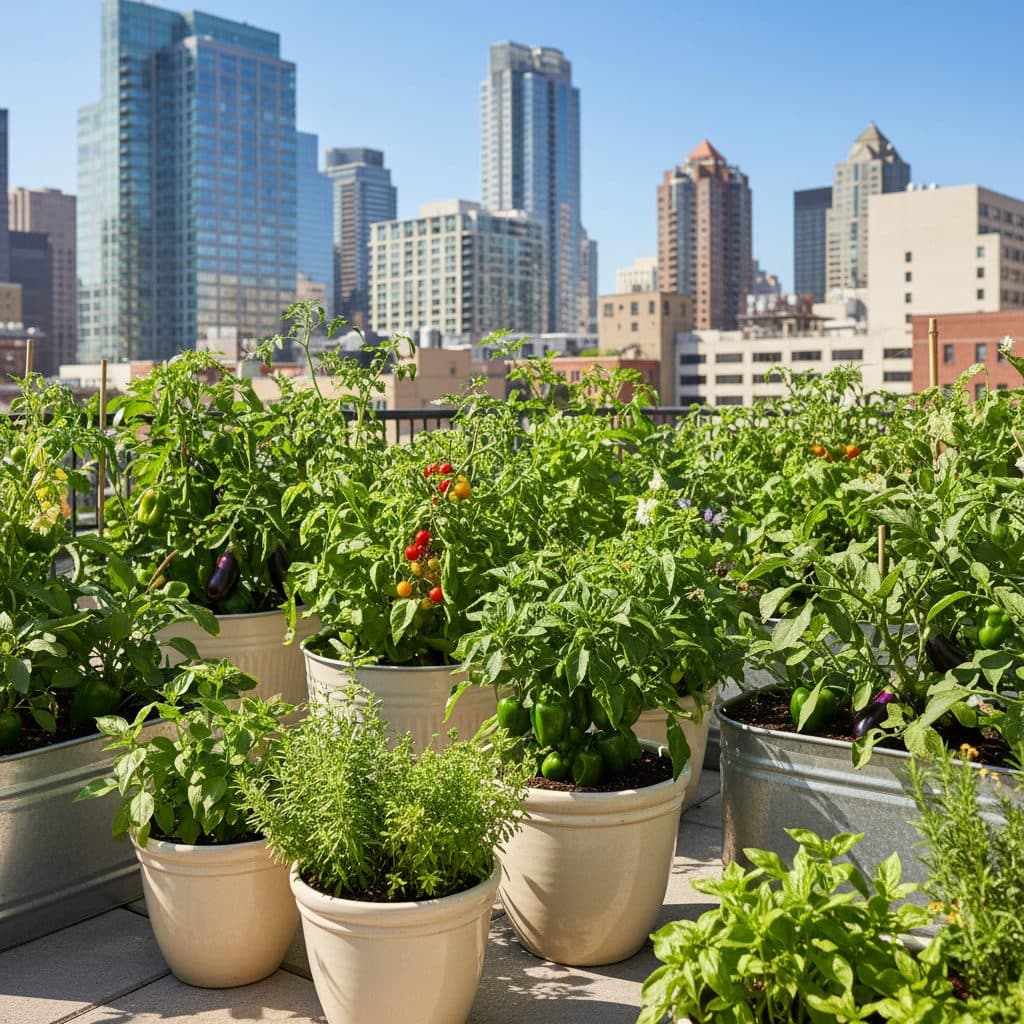
Key takeaways
- Choose large, light-colored containers made of plastic or fabric to reduce soil temperatures by 10°F to 20°F compared to dark, small pots.
- Ensure containers have ample drainage holes, at least one-half inch in diameter, and avoid drainage layers which can hinder water flow.
- Create a custom potting mix with a 1:1:1 ratio of coir, compost, and perlite for superior water retention and aeration.
- Water deeply and frequently, often twice daily during heatwaves exceeding 90°F, and use a soil moisture meter to guide irrigation.
- Select heat-tolerant plant varieties like okra or sweet potatoes, and provide afternoon shade using shade cloth to protect plants from direct sun.
- Consider the weight of filled containers; a 15-gallon pot can weigh over 100 pounds, requiring structural assessment for rooftops.
Quick answer: To make rooftop and patio container gardening thrive in hot weather, choose large, light-colored containers with ample drainage, use a custom potting mix for water retention, and water deeply and frequently. Also select heat-tolerant plants and provide afternoon shade.
Gardening on a hot US rooftop or patio presents unique challenges, especially when summer temperatures consistently climb above 90°F. In regions like Phoenix, Arizona, where summer highs regularly exceed 100°F for weeks, or across USDA zones 7 through 10, container plants face intense heat from direct sun, reflected heat from surfaces, and elevated soil temperatures. The USDA Natural Resources Conservation Service estimates that soil temperatures on exposed rooftops in USDA zones 7 and higher can easily exceed 120°F on a 90°F day, stressing plant roots and demanding specific strategies for success.
Growing vegetables and herbs in these conditions comes down to the containers, the drainage, and the potting mix. Getting those right helps plants handle the heat, even when the thermometer hits 105°F.
Choosing the right container for heat resilience
The container material, size, and color play a big role in how well your plants will survive intense heat on a rooftop or patio. Dark-colored containers, particularly those made of metal or dark plastic, can absorb significant solar radiation, raising soil temperatures by 10°F to 20°F compared to lighter-colored options. For instance, a black plastic pot can reach 130°F on a 95°F day, while a white fabric pot might only hit 110°F under the same conditions. Larger containers offer a greater volume of potting mix, which insulates roots better and retains moisture for longer periods, reducing the need for constant watering by up to 30%.
container materials and their thermal properties
Plastic containers are lightweight and retain moisture well, making them a practical choice for many growers. Fabric grow bags, often made from recycled materials, provide excellent aeration to the root zone, preventing roots from circling and promoting a healthier root structure. However, they can dry out faster than plastic in arid climates, sometimes requiring watering twice a day when temperatures are above 90°F. Terra cotta pots, while aesthetically pleasing, are porous and allow water to evaporate quickly from their sides, leading to rapid drying, especially in USDA zone 8 and higher. Early container gardening, as documented in 1976, often relied on materials like terra cotta, which can dry out quickly in hot climates due to its porous nature [3].
- Light-colored plastic pots: Reflect sunlight, keeping soil cooler by 5°F to 10°F.
- Fabric grow bags: Offer superior root aeration, but may need more frequent watering.
- Large ceramic or glazed pots: Provide insulation and retain moisture well, but are heavy.
- White or light-colored metal containers: Can be effective if insulated internally to prevent overheating.
- Self-watering containers: Reduce watering frequency by 50% to 70% by providing a water reservoir.
Optimizing drainage: dispelling myths and ensuring success
Proper drainage is critical for container plants, preventing waterlogging and root rot. Many growers believe that adding a layer of gravel, broken pottery, or packing peanuts at the bottom of a container improves drainage. However, research consistently shows this practice is ineffective and can be detrimental. Studies from 2021 and 2025 confirm that drainage layers of gravel or pot shards at the bottom of containers do not improve drainage and can reduce the total volume of usable potting mix by 10% to 20% [1], [2]. This reduction in soil volume means less space for roots and less moisture retention, which is counterproductive in hot conditions.
the perched water table and drainage holes
Instead of improving drainage, these layers create a ‘perched water table’ — a zone where water accumulates above the drainage layer, limiting root growth in the bottom 2 to 4 inches of a container [2]. The key to good drainage lies in the potting mix itself and the size and number of drainage holes. Containers should have multiple drainage holes, each at least one-half inch in diameter, to allow excess water to escape freely. For a 15-gallon container, three to five one-inch drainage holes are ideal. If a container has only one small hole, consider drilling additional holes to ensure adequate water flow. This simple adjustment can prevent 40% to 60% of common container gardening issues related to overwatering.
- Avoid drainage layers: Gravel or shards reduce usable soil volume by 10% to 20%.
- Ensure ample drainage holes: At least three to five one-inch holes for a 15-gallon pot.
- Check for perched water table: Water can accumulate 2 to 4 inches above dense layers.
- Use appropriate potting mix: A well-draining mix is the primary defense against waterlogging.
- Elevate containers: Use pot feet or blocks to lift containers one to two inches off the surface, allowing free drainage.
Crafting the ideal potting mix for water retention and aeration
The potting mix is the foundation of your container garden’s success, especially in hot environments. A good mix must balance water retention with adequate drainage and aeration. Standard garden soil is too dense for containers, compacting over time and suffocating roots. Instead, a custom blend designed for containers will provide the necessary structure and nutrients. Successful container gardening, as introduced in 2012, requires careful consideration of container size, material, and potting mix composition to support plant health [5].
components of a superior potting mix
A balanced potting mix typically includes a base material for structure and moisture, an amendment for drainage and aeration, and a component for nutrient retention. For example, a common and effective blend for hot climates is a 1:1:1 ratio of coir, compost, and perlite. Coir, derived from coconut husks, can hold up to eight to ten times its weight in water, making it excellent for moisture retention. Compost provides essential nutrients and beneficial microbes, improving overall soil health. Perlite, a lightweight volcanic glass, ensures good aeration and drainage, preventing compaction. Other options include peat moss (though coir is often preferred for its sustainability and rewetting properties) and vermiculite, which also aids in moisture retention and nutrient exchange. A well-formulated mix can reduce watering frequency by 25% to 35% compared to generic, low-quality mixes.
- Coir (one part): Exceptional water retention, holding 8-10 times its weight in water.
- Compost (one part): Provides slow-release nutrients and beneficial microorganisms.
- Perlite (one part): Ensures aeration and drainage, preventing compaction.
- Worm castings (optional): Boosts nutrient content and microbial activity by 5% to 10%.
- Slow-release fertilizer (optional): Supplies consistent nutrients for up to three to four months.
Strategic watering and monitoring in extreme heat
Even with the best containers and potting mix, plants on hot rooftops or patios will require a precise watering strategy. High temperatures, intense sunlight, and constant wind exposure can dramatically increase evapotranspiration rates, meaning plants lose water much faster. During heatwaves when temperatures consistently exceed 90°F, plants may need watering twice daily — once in the early morning before 8 AM and again in the late afternoon after 5 PM. Watering during the hottest part of the day can lead to significant water loss through evaporation and may not effectively reach the roots.
using tools for precise moisture management
A reliable soil moisture meter is an invaluable tool for preventing both underwatering and overwatering. Insert the probe several inches into the potting mix to get an accurate reading of moisture levels at root depth. Aim to water when the meter reads in the ‘moist’ range, typically between 30% and 60% saturation, depending on the plant species. For larger containers, a deep watering that allows water to flow out of the drainage holes is generally recommended to ensure the entire root ball is moistened. This can be 2 to 5 gallons for a 20-gallon container. Consistent moisture, rather than cycles of extreme wet and dry, helps plants cope with heat stress more effectively, potentially increasing yields by 15% to 20%.
- Water deeply: Ensure water reaches the entire root zone, allowing some to drain out.
- Water frequently in heat: Twice daily during periods above 90°F, morning and late afternoon.
- Use a soil moisture meter: Check moisture levels 4 to 6 inches deep before watering.
- Avoid midday watering: Up to 50% of water can evaporate before reaching roots in peak sun.
- Consider drip irrigation: Automate watering and reduce water waste by 30% to 50%.
Plant selection and placement for hot rooftops and patios
Even with optimal containers, drainage, and potting mix, selecting the right plants and placing them strategically can make a significant difference in a hot rooftop or patio garden. Some plants are simply better equipped to handle sustained heat and intense sun than others. For instance, in USDA zones 9 and 10, plants like okra, sweet potatoes, and certain pepper varieties (e.g., ‘Habanero’, ‘Jalapeño’) thrive in conditions that would cause lettuce or spinach to bolt and become bitter. Consider varieties specifically bred for heat tolerance, which often have thicker leaves or more vigorous root systems.
providing shade and maximizing space
Strategic placement involves understanding sun exposure throughout the day. A spot that receives full morning sun but is shaded from the intense afternoon sun (from 1 PM to 5 PM) is often ideal for many vegetables. If natural shade is unavailable, consider using shade cloth. A 30% to 50% shade cloth can reduce ambient temperatures by several degrees and protect plants from scorching, potentially increasing yields by 20% to 30% during summer months. Vertical gardening structures can also maximize space and provide some self-shading for lower plants. For inspiration on maximizing space, consider principles from square-foot gardening, which focuses on intensive planting in small areas. Remember that a fully watered 15-gallon container can weigh over 100 pounds, so assess the structural capacity of your rooftop or balcony before placing multiple large pots.
- Choose heat-tolerant species: Okra, sweet potatoes, certain peppers, basil, and rosemary excel in heat.
- Provide afternoon shade: Use 30% to 50% shade cloth from 1 PM to 5 PM to prevent scorching.
- Orient containers strategically: Place taller plants to shade shorter, more sensitive ones.
- Consider vertical gardening: Maximizes space and can offer partial shade to lower tiers.
- Assess weight limits: A 20-gallon container with soil and water can weigh 150 pounds; plan accordingly.
Container Material Performance in Hot Climates (USDA Zone 8+)
Material Type | Soil Temperature Impact | Moisture Retention | Weight (Empty/Full 15-gal) | Durability |
|---|---|---|---|---|
Dark Plastic | High (120°F-130°F) | Good | 5 lbs / 100 lbs | Moderate (UV degradation) |
Light Plastic | Moderate (110°F-120°F) | Good | 5 lbs / 100 lbs | Moderate (UV degradation) |
Fabric Grow Bag | Moderate (105°F-115°F) | Moderate (evaporative cooling) | 2 lbs / 97 lbs | Moderate (3-5 years) |
Terra Cotta | High (120°F-130°F) | Poor (porous) | 20 lbs / 115 lbs | Low (fragile, frost crack) |
Glazed Ceramic | Low (100°F-110°F) | Excellent | 40 lbs / 135 lbs | High (heavy, can crack) |
Soil Temperature: Exposed rooftop soil temperatures can reach over 120°F on a 90°F day in USDA zones 7 and higher, impacting root health.
Drainage Layers: Adding drainage layers of gravel can reduce usable potting mix volume by 10% to 20% and impede proper water flow [1].
Water Retention: A custom potting mix with coir can hold 8 to 10 times its weight in water, significantly extending watering intervals.
Shop gardening essentials
Frequently asked questions
How large should containers be for rooftop gardening?
For most vegetables, containers should be at least 15 gallons in volume, and preferably 20 gallons or more, to provide adequate root space and moisture retention in hot conditions. A 15-gallon pot can support a single tomato plant effectively.
Can I use regular garden soil in my containers?
No, regular garden soil is too dense for containers. It compacts easily, leading to poor drainage and aeration, which can suffocate roots. Always use a high-quality, well-draining potting mix, ideally one containing coir or peat moss, perlite, and compost.
How often should I water container plants on a hot patio?
During periods when temperatures exceed 90°F, container plants may need watering twice daily: once in the early morning and again in the late afternoon. Use a soil moisture meter to check the moisture level 4 to 6 inches deep before watering.
What is a ‘perched water table’ and why is it bad?
A perched water table is a layer of water that accumulates above a denser layer, like gravel, at the bottom of a container. It prevents the bottom 2 to 4 inches of potting mix from draining properly, leading to waterlogged roots and reduced usable soil volume.
What are some good heat-tolerant vegetables for containers?
Excellent choices for hot container gardens include okra, sweet potatoes, hot peppers like jalapeños, basil, and eggplant. These plants generally thrive in temperatures above 80°F and can produce well with consistent care.
References
- Effect of drainage layers on water retention of potting media in containers. (2021). Effect of drainage layers on water retention of potting media in containers..
- Effect of drainage layers on water retention of potting media in containers (2025). Effect of drainage layers on water retention of potting media in containers.
- Plant containers (1976). Plant containers.
- PREFACE (2012). PREFACE.
- INTRODUCTION (2012). INTRODUCTION.