support
Russian Olive
ghwaraskey
Elaeagnus angustifolia
Also known as Oleaster (United States, UK & Ireland), Ghwaraskey (Pakistan).
- balochistan highlands
- kpk hills
International hardiness
- USDA 2-7
- RHS H7
- AU: Cool temperate, Arid / semi-arid, Warm temperate
Where it grows — regional guide
| Zones / rating | Regional notes |
|---|---|
USDA 2-7 | Cold-hardy in USDA zones 2 to 7; regulated as an invasive weed along streams and watercourses, and twigs bear sharp thorns. |
| Zones / rating | Regional notes |
|---|---|
H7 (below -20C) | Fully hardy under RHS H7 as a silver-leaved shelter shrub; can spread aggressively near water and branches are thorny. |
| Zones / rating | Regional notes |
|---|---|
Cool temperate, Arid / semi-arid, Warm temperate | Grown in cool-temperate areas for dryland shelter; poses an invasive risk along waterways and branches carry sharp thorns. |
| Zones / rating | Regional notes |
|---|---|
USDA 2-7 (USDA scale) Canada uses its own zone system; Canadian zones run roughly one lower than USDA. | Hardy in cold continental winters down to USDA zone 2; behaves as an aggressive invasive along waterways and bears thorns. |
| Zones / rating | Regional notes |
|---|---|
Balochistan highlands, KPK hills | Pakistan:Grown in high cold valleys for windbreaks and nitrogen fixation; site away from open waterways as it spreads and is thorny. |
Grows alongside
Species that appear with Russian Olive in 5 of our published guides — a starting list for a guild, not a planting plan.
Russian olive (Elaeagnus angustifolia) is a deciduous, thorny shrub or small tree with a rounded to irregular, often leggy crown, narrow silver-gray foliage, fragrant yellowish flowers, and dry, olive-like fruits. It is native to Eurasia (southern Europe, western Asia, Russia, and adjacent parts of Asia) and is not native to North America, where it has been widely planted and has since become invasive across many regions. For a homesteader, its appeal is its toughness: it is drought tolerant, salt tolerant, fixes its own nitrogen, and will establish on poor or disturbed ground that defeats most trees, but that same vigor is exactly why it must be sited and managed with care rather than turned loose.
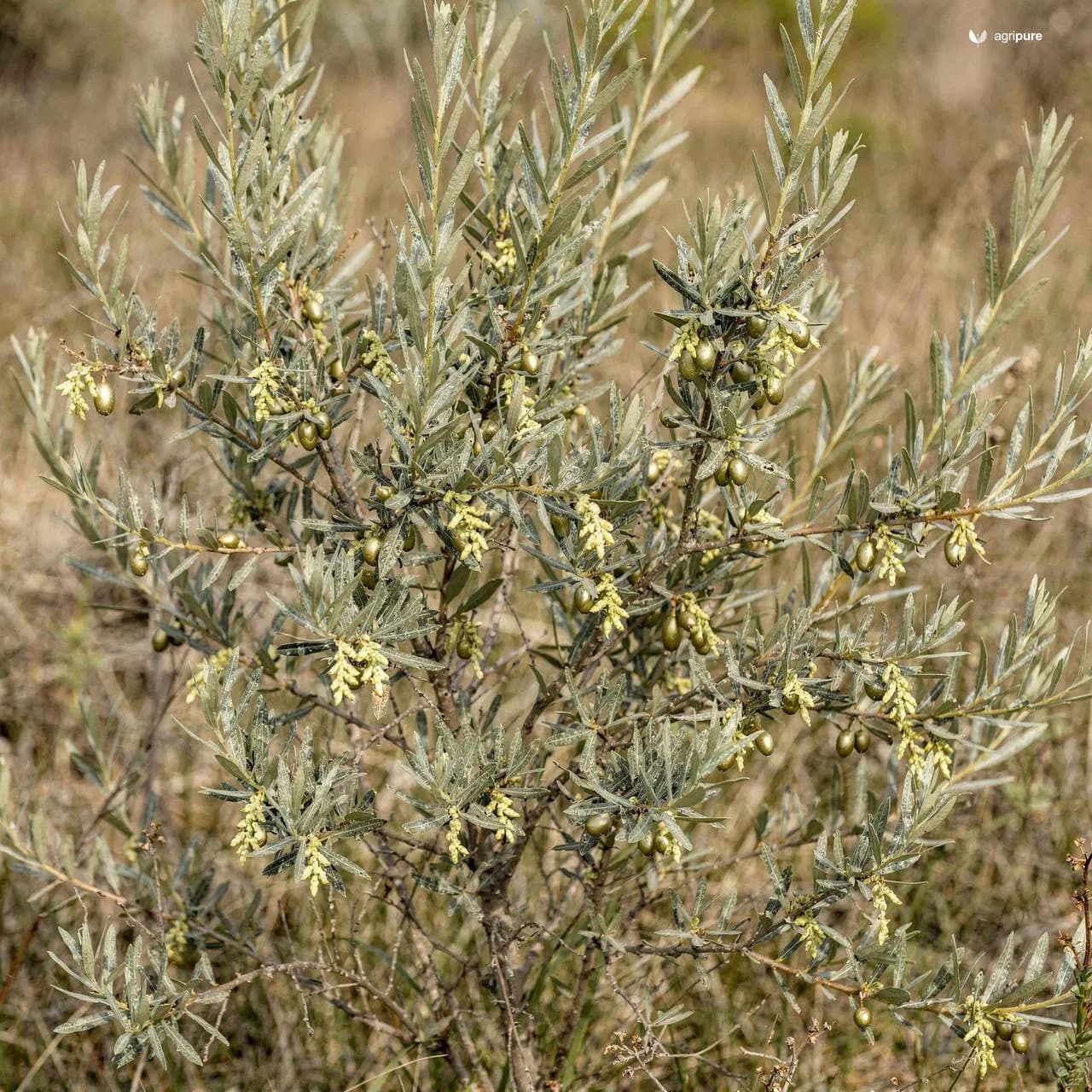
Mature plants are commonly reported at about 10 to 30 ft (roughly 3 to 9 m) tall, with a dense, frequently leggy form. The leaves are alternate and narrow-lanceolate, silvery to gray-green with a mealy or scaly look; that distinctive silver cast comes from a coating of fine hairs and scales. Twigs and branches are thorny, with young growth that may be silvery before maturing to a reddish-brown or shiny finish. The University of Minnesota reports it as hardy in **USDA zones 3 to 7**. This reflects its tolerance of cold winters as well as dry, difficult sites.
Growing Russian olive
Russian olive performs best in full sun and tolerates a wide range of soil types. One source notes a preference for light sandy or loamy soil while also pointing out that it copes with many soils because it fixes nitrogen, drawing its own fertility from the air rather than depending on rich ground. Once established, plants are drought tolerant, and the species is well known for growing on poor, disturbed, and even bare mineral or saline sites.
The botanical and extension sources used here do not give reliable, species-specific figures for propagation method, plant spacing, or time to harvest maturity, so those details are deliberately left out rather than stated with false precision. In practice, treat it as a hardy, low-input shelter species: site it in an open, sunny position on lean ground where its drought and salt tolerance are an advantage, and give serious thought to containment before planting (see the cautions below).
Harvest and uses
The fruit is a dry, olive-like drupe, silvery-green to grayish, that ripens and often persists on the plant into late season or winter. The flowers are small, creamy-white to yellow, strongly fragrant, and borne in clusters from spring into early summer. The sources used here do not provide trustworthy yield figures or a standard homestead harvest method for the fruit, so no numbers are invented for this page.
Where Russian olive earns its keep is as a shelter and reclamation plant. Its salt tolerance and ability to colonize bare mineral soil have led to its use in windbreaks, roadside plantings, and the reclamation of disturbed sites. Beyond that structural role, one source reports that an essential oil distilled from the flowers is used in perfumery and that a gum obtained from the plant is used in the textile industry. The fruits are eaten in some local and traditional contexts, but the sources here do not supply a detailed, high-confidence culinary or preparation guide, so edibility is noted only in passing rather than presented as a reliable food crop.
Safety and cautions
The sources used here do not identify a specific poison or toxic principle for Russian olive, and they do not state which parts, if any, are poisonous. At the same time, the species is treated as an invasive ornamental rather than a standard food crop, so any edibility claims should be treated cautiously unless backed by local, species-specific food references; the sources here do not provide enough reliable evidence for detailed food-safety recommendations. These sources likewise do not document medicinal drug interactions, contraindications, or groups who should avoid it, so no such guidance is offered.
A serious caution: invasiveness
Russian olive is widely treated as an invasive species across much of North America. The very traits that make it useful (nitrogen fixation, drought and salt tolerance, and the ability to grow on poor or bare ground) also let it spread aggressively and displace native vegetation, particularly along rivers, streams, and other watercourses. The U.S. federal invasive-species resources list it among problem terrestrial plants, and it is regulated or discouraged in a number of areas. Before planting, check whether it is restricted where you live, keep it well away from open waterways and natural areas, and be prepared to control seedlings; in many regions the responsible choice is to plant a non-invasive nitrogen-fixing or shelter species instead.
How to identify it
Russian olive can be recognized by this combination of features:123
- Habit: Deciduous, thorny shrub or small tree, about 10 to 30 ft tall, with a rounded to irregular, often leggy crown.
- Leaves: Alternate, narrow and lance-shaped, silvery to gray-green with a mealy or scaly surface.
- Twigs: Thorny; young twigs silvery, later reddish-brown or shiny.
- Flowers: Small, creamy-white to yellow, strongly fragrant, in spring-to-early-summer clusters.
- Fruit: Dry, olive-like, silvery-green to grayish drupes that persist into late season or winter.
Sources
- Russian Olive (Elaeagnus angustifolia) — University of Minnesota
- Elaeagnus angustifolia — North Carolina Extension Gardener Plant Toolbox (NC State)
- Russian Olive — Montana Field Guide (Montana Natural Heritage Program)
- Russian Olive — National Invasive Species Information Center (USDA)
- Russian Olive publication — University of Nevada, Reno Extension
Sourcing notes
Seedlings and seed are available locally in Gilgit-Baltistan; propagate from local cold-valley stock and site it as a managed shelterbelt away from open watercourses, since it can spread along water.