pioneer
Chinese Water Chestnut
singara chini
Eleocharis dulcis
Also known as Singara Chini (Pakistan).
- punjab plains
- sindh coast
International hardiness
- USDA 9-11
- RHS H2
- AU: Tropical, Subtropical, Warm temperate
Where it grows — regional guide
| Zones / rating | Regional notes |
|---|---|
USDA 9-11 | Grown in USDA zones 9 to 11 in flooded tubs or bog margins; crisp corms must be washed and cooked to prevent parasite risks. |
| Zones / rating | Regional notes |
|---|---|
H2 (1 to 5C) | Tender under RHS H2, grown in standing water trays in warm greenhouses; corms must be washed and cooked to prevent parasites. |
| Zones / rating | Regional notes |
|---|---|
Tropical, Subtropical, Warm temperate | Native to wetlands across the tropical north; edible crisp corms must be thoroughly washed and cooked to avoid parasites. |
| Zones / rating | Regional notes |
|---|---|
USDA 9-11 (USDA scale) Canada uses its own zone system; Canadian zones run roughly one lower than USDA. | No region-specific data yet |
| Zones / rating | Regional notes |
|---|---|
Punjab plains, Sindh coast | Pakistan:Grown in shallow muddy water or pond margins on the plains; corms must be thoroughly washed and cooked to prevent parasites. India:Cultivated in shallow water and paddy margins for crisp corms; raw material can transmit flukes and must be cooked clean. |
Grows alongside
Species that appear with Chinese Water Chestnut in 11 of our published guides — a starting list for a guild, not a planting plan.
Chinese water chestnut (Eleocharis dulcis) is an aquatic, perennial sedge in the family Cyperaceae, grown across warm regions for the crisp, edible corms that have become a staple of Asian cooking. Despite the name it is neither a nut nor a true root: the “chestnut” is a corm, a swollen, starchy stem base that develops underground. The species originates in Southeast Asia and is native or naturalised across Asia, tropical Africa, and Oceania, including China, Japan, India, Madagascar, tropical West Africa, northern Australia, and many Pacific islands. For a homesteader with a pond margin, a boggy corner, or a paddy-style bed, it is one of the few productive food crops that genuinely wants its feet in shallow water and mud, turning waterlogged ground into a harvest.
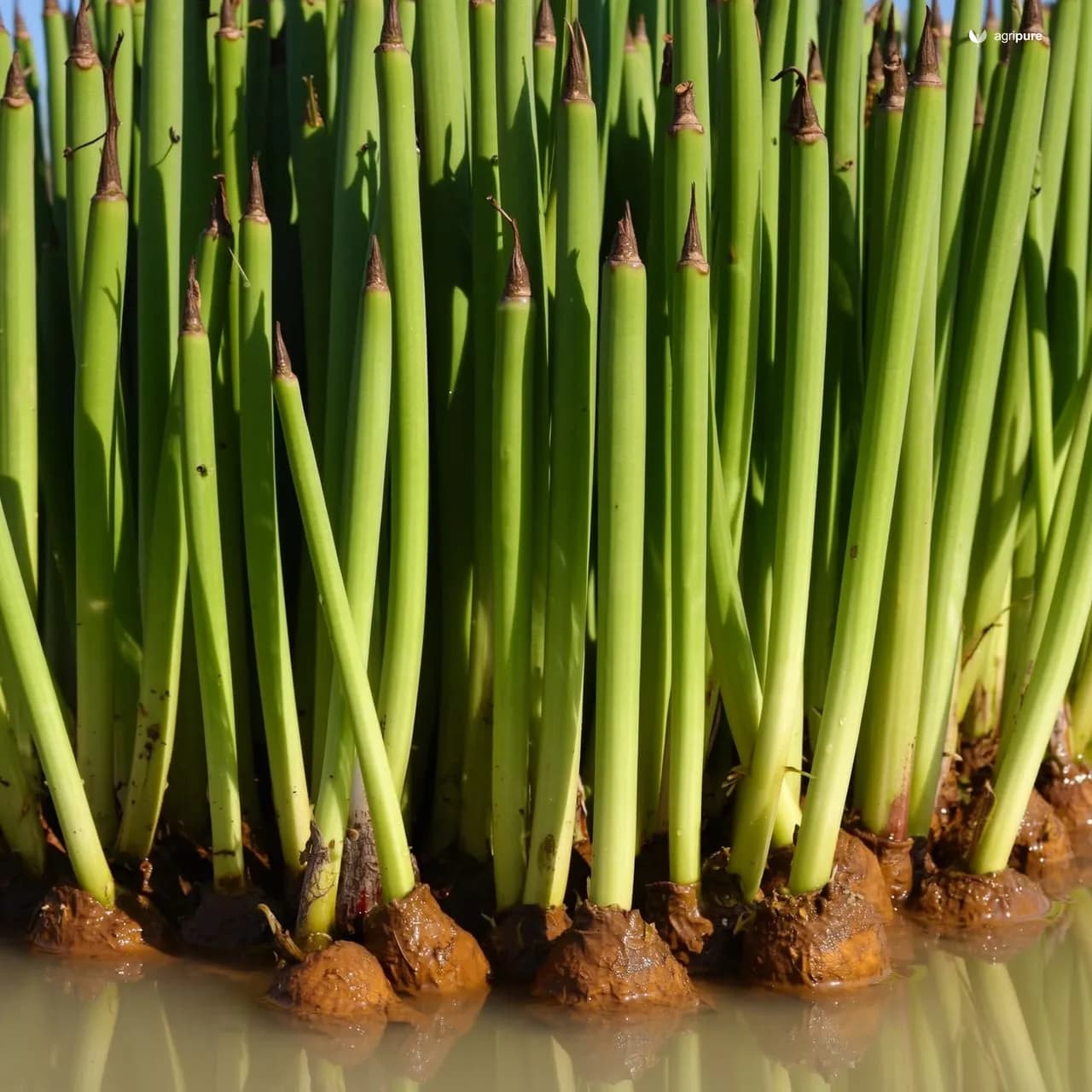
The plant forms clumps of tall, stiff, upright, leafless tubular stems that look much like green drinking straws: round and smooth, roughly 2 to 10 mm thick, transversely septate (jointed by faint cross-partitions), with clumps reaching about 0.6 to 1.5 m (2 to 5 ft) tall. A short, cylindrical spike of small yellow-brown florets sits at the stem tips. Below ground the plant spreads by horizontal rhizomes that link the clumps into dense colonies, with the corms forming at stolon and rhizome tips: small, rounded, dark brown to almost black outside, with crisp white flesh inside. This is not the floating, horned “water chestnut” of Trapa natans, an unrelated plant; Eleocharis dulcis is a sedge with shallow-water stems and underground corms.
Growing Chinese water chestnut
Chinese water chestnut is an aquatic or swamp species that thrives in moist soil or in standing water up to about 15 cm deep, found naturally in marshes, bogs, wetland margins, and drainage and irrigation canals. On the homestead it is grown in muddy, marshy ground or in paddy-like conditions, often rotated with rice where it is farmed, and it does best in full sun. The sources describe its preferred soil as wet, organic, and mud-like but give no specific pH or fertility figures, so those are left out.
Propagation is vegetative. The species can be raised from rhizomes, corms, or seed, but commercial and farm-scale growing is carried out chiefly from corms and rhizomes; for a homestead, the standard approach is to save corms from the previous season and replant them. Detailed seed-raising protocols and plant spacing are not given in the cited sources, so neither is stated here.
The crop follows the seasons rather than a fixed countdown. Corm formation begins in late summer into autumn, as the days shorten and the plants prepare for dormancy. The cited references give no reliable “days to maturity” from planting, so no exact duration is claimed; instead, the plant signals readiness by dying back, as below.
Harvest and uses
Harvest comes in late autumn, after the tall stems have turned straw-coloured and died back. That die-back is the cue to lift the corms, which by then have bulked up at the rhizome tips in the mud below. The cited sources do not quantify a per-plant or per-area yield, so no yield figure is given.
The corms are the reason to grow the plant. Their crisp white flesh stays notably crunchy even after cooking, which is why they are prized as a vegetable across Asian cuisines, used in stir-fries and many cooked dishes. Beyond the kitchen, the dense colonies it forms along shallow margins make it a natural occupant of the wet edge of a pond, paddy, or boggy bay, holding ground that drier plants cannot use.
Safety and cautions
Chinese water chestnut corms are generally safe as food when properly washed and cooked, and are eaten routinely as an everyday vegetable. The one important caution in the sources is worth respecting: raw, unwashed material can transmit the intestinal fluke disease fasciolopsiasis, so hygienic handling matters. In practice that means washing corms thoroughly and not eating them raw and unwashed from water that may carry the parasite. This is a parasite-transmission risk tied to contaminated raw material, not a toxicity of the plant itself, and clean handling and cooking address it.
Sources
- CABI. “Eleocharis dulcis (Chinese water chestnut).” CABI Compendium.
- Wikipedia. “Eleocharis dulcis.”
- Awkward Botany. “Eleocharis dulcis” (botanical notes).
- Life is a Garden. “Chinese Water Chestnut (Eleocharis dulcis).”
- U.S. National Library of Medicine. “Eleocharis” (Medical Subject Headings).