pioneer
Buckwheat
kuttu
Fagopyrum esculentum
Also known as Kuttu (Pakistan).
- kpk hills
- balochistan highlands
International hardiness
- USDA 7-10
- RHS H3
- AU: Cool temperate, Warm temperate, Subtropical
Where it grows — regional guide
| Zones / rating | Regional notes |
|---|---|
USDA 7-10 | Fast summer cover crop or grain; grazing foliage causes severe photosensitisation in light livestock, and it can trigger human allergies. |
| Zones / rating | Regional notes |
|---|---|
H3 (-5 to 1C) | Tolerant under RHS H3; sown as a green manure, though foliage causes photosensitisation in livestock and can trigger human allergies. |
| Zones / rating | Regional notes |
|---|---|
Cool temperate, Warm temperate, Subtropical | Warm-season cover crop or grain; foliage causes severe photosensitisation in light livestock, and the plant can trigger human allergies. |
| Zones / rating | Regional notes |
|---|---|
USDA 7-10 (USDA scale) Canada uses its own zone system; Canadian zones run roughly one lower than USDA. | Grown as a short-season summer annual grain; grazing foliage causes fagopyrism in light animals and flour can trigger allergies. |
| Zones / rating | Regional notes |
|---|---|
KPK hills, Balochistan highlands | Pakistan:Summer hill grain; grazing foliage causes severe photosensitisation in light livestock, and the plant can trigger human allergies. India:Cultivated in Himalayan valleys as a fasting grain; foliage triggers photosensitivity in livestock and flour can cause allergy. |
Grows alongside
Species that appear with Buckwheat in 31 of our published guides — a starting list for a guild, not a planting plan.
Buckwheat (Fagopyrum esculentum) is a fast-growing annual in the knotweed family (Polygonaceae) — botanically a broadleaf, not a true cereal grass, even though its triangular seeds are milled like grain. Its origins lie in central Asia; it was carried from China and other parts of Asia into western Europe and later introduced to the United States, where it is not native. For a homesteader, buckwheat earns its place twice over: it produces an edible, gluten-free grain on a short season, and it doubles as one of the most reliable quick cover crops you can sow on bare ground.
The plant is compact and quick to establish, typically reaching about 40 to 60 cm tall, with some floras describing it as roughly half a foot to two and a half feet depending on conditions. Because it flowers and sets seed in a single growing season, you see the whole cycle play out fast.
How to identify buckwheat
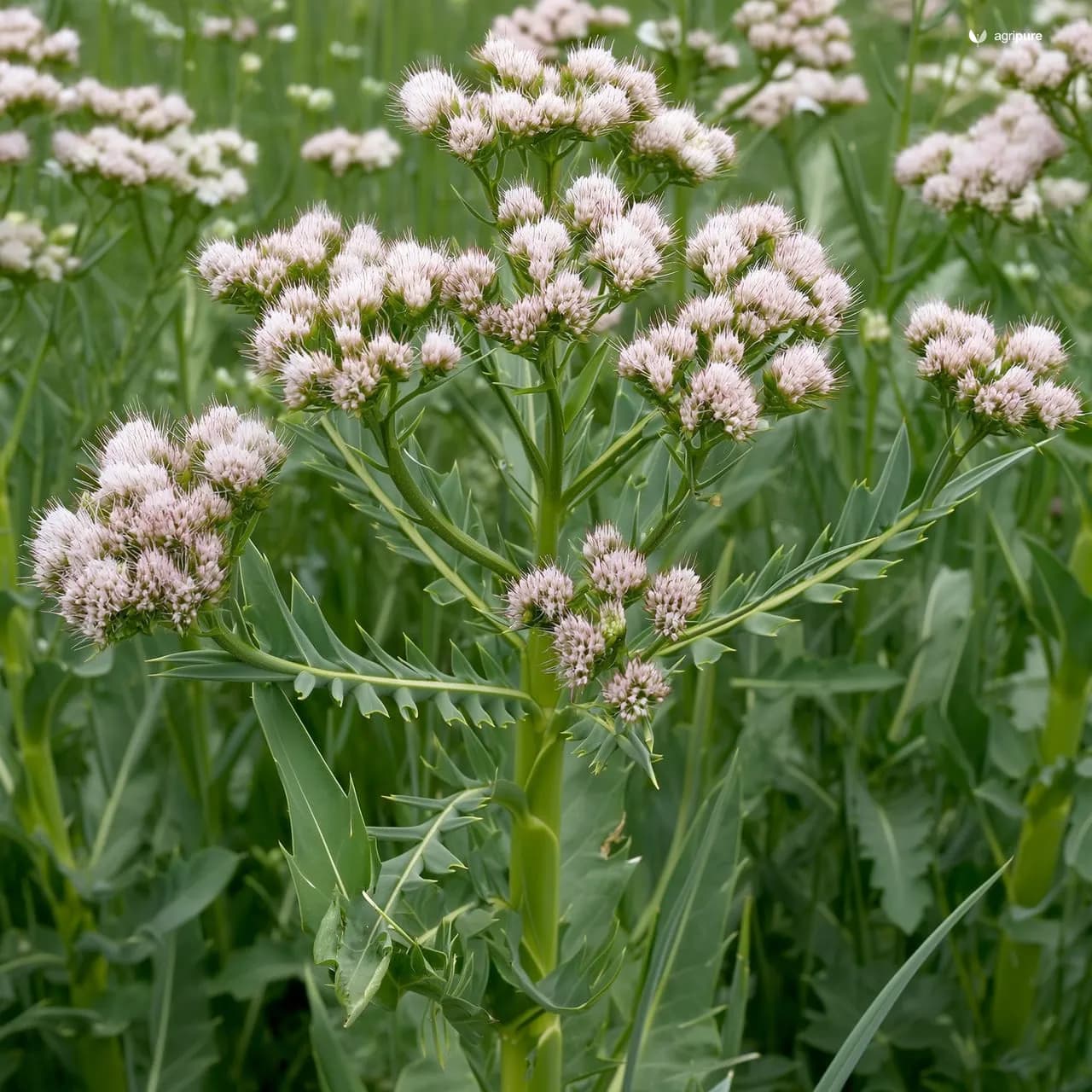
Buckwheat has a distinctive set of field cues that make it easy to recognize once it is in flower:123
- Stems: upright, branching, and red-tinged, only slightly hairy or nearly hairless.
- Leaves: alternate, arrowhead- to heart-shaped, with smooth or slightly wavy margins.
- Flowers: white to pink-tinged, around 5 mm across, borne in dense racemes at the shoot tips and upper leaf axils.
- Fruit/seed: a triangular achene with wing-like sides — the seeds are angular enough to look like tiny beech nuts.
Growing buckwheat
Buckwheat is grown from seed, and because it is an annual it flowers from seed within its first growing season. Give it full sun to partial sun. It is forgiving about soil, tolerating a range that includes loam, clay-loam, light sand, and even muck, and it does best in moist to mesic conditions. One source notes the established plant will tolerate dry periods, while the cover-crop guidance still characterizes its preferred site as moist to mesic — so think of it as drought-tolerant once up, but happiest with steady moisture. It also grows quickly in heat.
As for timing, one extension trial seeded in mid-May bloomed from mid-July through early August, and another source notes that buckwheat matures quickly from seed and begins flowering even at a small size. The supplied sources do not give a firm plant-spacing figure or a precise days-to-harvest number, so those are intentionally left out rather than stated with false precision.
Harvest and uses
Buckwheat can be grown as a field crop for its seed or as a cover crop, and its triangular seeds are harvested for flour and grain use. Ground into buckwheat flour, the seed is naturally gluten-free, which is the main culinary draw.
Beyond the kitchen, buckwheat is a workhorse in the garden system. It is widely used as a cover crop and green manure, putting on growth fast and covering bare soil. Its flowers are also a strong draw for beneficial insects: they attract bees and hoverflies, and one source records bees and ants visiting the blooms for nectar. That combination (quick ground cover plus a pollinator-friendly bloom) is what makes it such a useful catch crop between main plantings. The supplied sources do not give a reliable numeric yield figure, so no yield number is claimed here.
Safety and cautions
Buckwheat is a food plant, but the sourced research flags two real cautions worth knowing.
- Fagopyrism in animals: the foliage can cause a photosensitivity condition called fagopyrism in light-skinned animals that eat it and are then exposed to sunlight, producing swelling of the head and neck, blistering of the skin, and seizures. Keep this in mind if you graze or feed buckwheat foliage to light-skinned livestock.
- Human allergy: some people experience allergic reactions after eating buckwheat flour or after handling the foliage. Anyone with a suspected buckwheat allergy should avoid it.
The supplied sources do not identify specific drug interactions or pregnancy-related cautions, so none are stated here.
Sources
- Fagopyrum esculentum (Buckwheat) – First Nature
- Buckwheat (Fagopyrum esculentum) – NatureSpot
- Common Buckwheat, Fagopyrum esculentum – Midwest Cover Crops Council
- Buckwheat (Fagopyrum esculentum) – Michigan State University Extension