secondary
Sacred Fig
pipal
Ficus religiosa
Also known as Pipal (Pakistan), Peepal (India), Bodhi Tree (United States, Australia, Middle East & North Africa).
- punjab plains
- sindh coast
International hardiness
- USDA 10-12
- RHS H1c
- AU: Tropical, Subtropical
Where it grows — regional guide
| Zones / rating | Regional notes |
|---|---|
USDA 10-12 | Large shade tree; aggressive roots damage masonry, fruit is not human food, and medicinal use lacks safety data. |
| Zones / rating | Regional notes |
|---|---|
H1c (5 to 10C) | No region-specific data yet |
| Zones / rating | Regional notes |
|---|---|
Tropical, Subtropical | Large shade tree; aggressive roots damage masonry, fruit is not human food, and medicinal use lacks safety data. |
| Zones / rating | Regional notes |
|---|---|
USDA 10-12 (USDA scale) Canada uses its own zone system; Canadian zones run roughly one lower than USDA. | No region-specific data yet |
| Zones / rating | Regional notes |
|---|---|
Punjab plains, Sindh coast | Pakistan:Large shade tree; aggressive roots damage masonry, fruit is not human food, and medicinal use lacks safety data. India:Large shade tree; aggressive roots damage masonry, fruit is not human food, and medicinal use lacks safety data. |
The sacred fig (Ficus religiosa) is a large, fast-growing fig tree in the mulberry family (Moraceae), known across its range as the bodhi tree, bo tree, peepul, pipal, or ashvattha. It is native to the Indian subcontinent and Indochina, with a natural range running from the Himalayan foothills through Bangladesh, Nepal, India, and Pakistan into northern Thailand, Myanmar, Vietnam, and southwestern China. For a homesteader in a warm, frost-free climate, it is best understood as a long-lived shade tree rather than a fruit crop: it grows quickly and feeds wildlife, but its appetite for space and its aggressive roots mean it earns a spot only where a genuine giant belongs.
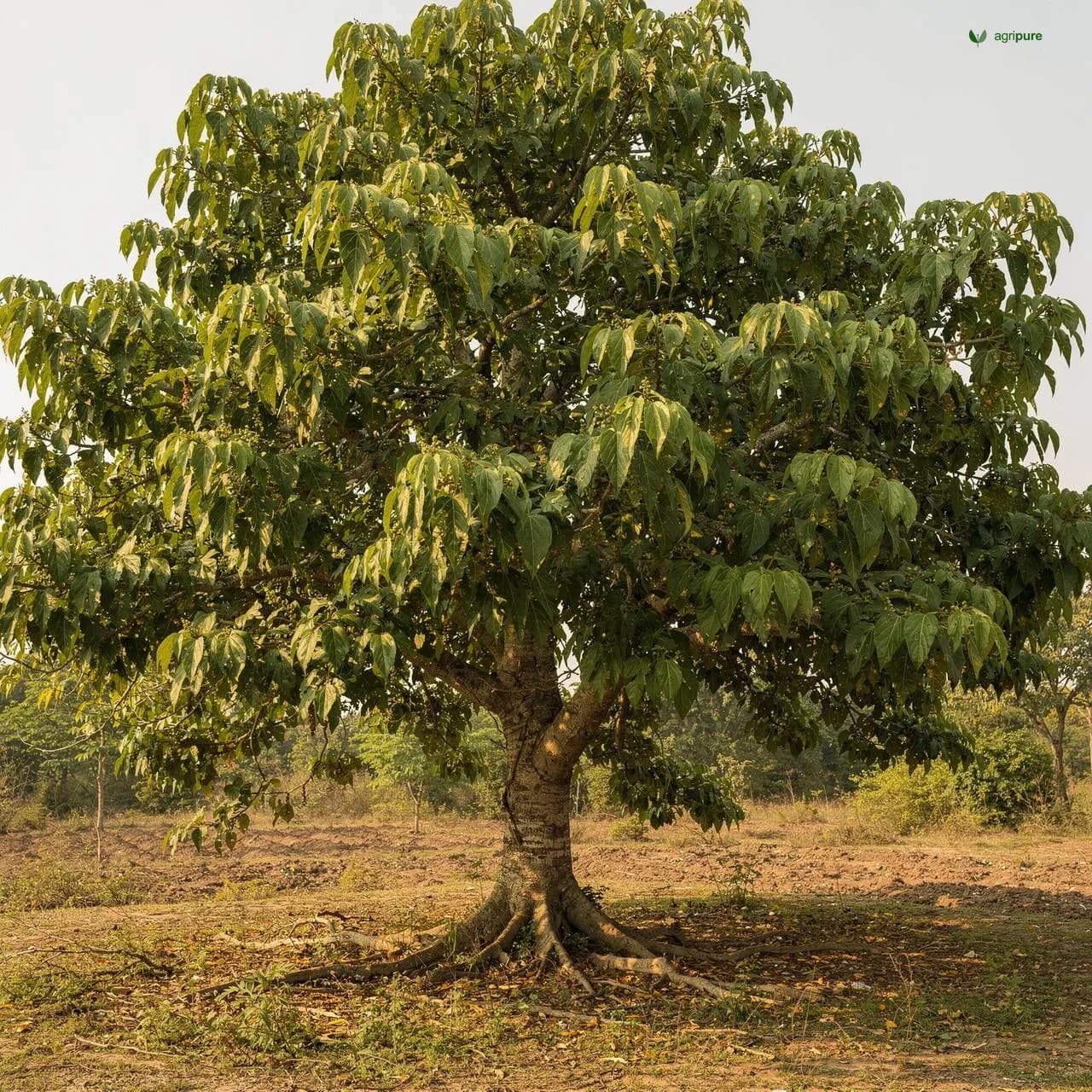
This is a large tree, commonly reaching 20 to 30 m tall with a crown that can spread just as wide, and it is noted for a very fast growth rate. Depending on climate it behaves as a dry-season deciduous or semi-evergreen tree, dropping its leaves through the dry or cool season. The most reliable field cue is the foliage: leaves are broadly heart-shaped (cordate) and glossy, ending in a long, narrow, tail-like “drip tip” that makes the species easy to recognise even at a distance. Like other figs, it has no showy flowers; the tiny blooms are sealed inside the fig itself (a syconium), and the small dark figs are borne near the new growth.
Growing sacred fig
Sacred fig is undemanding about soil. It tolerates a wide range of soil types and performs well even in semi-arid regions, and once established it is notably drought-resistant. Its main climatic limit is cold: the species is resistant to heat and drought but sensitive to severe frost, succeeding in warm lowland areas but failing in cold, high-elevation sites. The primary sources do not assign a numeric USDA hardiness rating. The University of Florida IFAS assessment records the tree in several south and central Florida counties (Hillsborough, Miami-Dade, the Monroe Keys, and Pinellas), corresponding roughly to **USDA zones 9b to 11**; with its frost sensitivity and tropical origin, that points to best performance in frost-free tropical and subtropical climates. Treat that range as an inference from climate matching, not a figure stated outright in the literature.
The sources here describe the tree’s biology but do not give reliable propagation steps, sowing temperatures, spacing, or time to maturity, so those figures are intentionally omitted rather than invented. What the sources do make clear is that, like many figs, the species can begin life as an epiphyte or strangler: young plants commonly germinate and grow on other trees, walls, or structures before rooting to the ground. That habit, paired with a very invasive root system capable of damaging pavements and structures, is the single most important siting consideration. Plant it well clear of buildings, walls, drains, and paving, and leave room for a crown that may eventually span 20 m or more.
Harvest and uses
Sacred fig is not grown for food. The figs are small, soft, and juicy, ripening from purple to deep burgundy and often produced in pairs near the young leaves; they can drop in quantity and make a mess underfoot. Edible use of the fruit is limited and mainly as animal fodder rather than human food. The tree’s real value on a homestead is in service: it is cultivated chiefly as a shade and ceremonial tree, and it also supports lac and silk production and is widely used in traditional medicine.
The species depends on a host-specific fig wasp to set fruit, so it is an ecological anchor only where that pollinator is present. Beyond its native range the tree is widely cultivated across tropical Asia and has been introduced to Iran (Balochistan), Florida, and Venezuela, naturalising locally where its wasp occurs.
How to identify it
Confirm a sacred fig by this combination: a large, fast-growing tree with light gray, often irregularly sculpted bark; glossy, broadly heart-shaped leaves ending in a long, tail-like drip tip and turning golden-brown before leaf-drop; small purple-to-burgundy figs borne in pairs near the new growth; and, in young plants, the fig habit of starting life as an epiphyte on other trees, walls, or buildings.
Safety and cautions
Sacred fig has a long record of use in traditional and folk medicine across its native range, but the sources here are explicit that safety data for the plant are poor. Because of that, any internal medicinal use should be approached cautiously, especially by people with existing medical conditions or those taking medication. This profile describes traditional use only, makes no medical claim that the plant treats or cures any condition, and gives no dosages; seek qualified medical advice before any internal use. Separately, treat the tree as a structural hazard: its very invasive roots can damage pavements and foundations, and self-sown seedlings readily colonise walls and structures, so siting discipline matters as much as any safety note.
Sources
- Ficus religiosa (sacred fig tree) – CABI Compendium
- Ficus religiosa – Wikipedia
- Ficus religiosa – Ilan Nursery
- Ficus religiosa – iNaturalist
- Ficus religiosa Assessment – University of Florida IFAS
Sourcing notes
Raise from thick hardwood cuttings off a local tree in the warm season, or transplant a self-sown seedling; both root easily. Site it as a permanent canopy anchor well clear of walls and drains, since the roots and volunteers are aggressive.