secondary
Fennel
saunf
Foeniculum vulgare
Also known as Saunf (Pakistan).
- punjab plains
- pothohar
- kpk hills
International hardiness
- USDA 5-10
- RHS H5
- AU: Warm temperate, Cool temperate, Mediterranean
Where it grows — regional guide
| Zones / rating | Regional notes |
|---|---|
USDA 5-10 | Hardy perennial herb grown in full sun for aromatic seeds and leaves; it self-seeds aggressively and is invasive in California. |
| Zones / rating | Regional notes |
|---|---|
H5 (-15 to -10C) | Hardy perennial herb grown for aromatic foliage and seed; self-seeds aggressively and can become an invasive weed. |
| Zones / rating | Regional notes |
|---|---|
Warm temperate, Cool temperate, Mediterranean | Hardy perennial herb grown for aromatic foliage and seed; self-seeds aggressively and can become an invasive weed. |
| Zones / rating | Regional notes |
|---|---|
USDA 5-10 (USDA scale) Canada uses its own zone system; Canadian zones run roughly one lower than USDA. | Hardy perennial herb grown for aromatic foliage and seed; self-seeds aggressively and can become an invasive weed. |
| Zones / rating | Regional notes |
|---|---|
Punjab plains, Pothohar, KPK hills | Pakistan:Hardy perennial herb grown for aromatic foliage and seed; self-seeds aggressively and can become an invasive weed. India:Hardy perennial herb grown for aromatic foliage and seed; self-seeds aggressively and can become an invasive weed. |
Grows alongside
Species that appear with Fennel in 35 of our published guides — a starting list for a guild, not a planting plan.
Fennel (Foeniculum vulgare) is a hardy, aromatic perennial herb in the carrot family (Apiaceae), grown for its feathery leaves, tender stems, bulb-like stem base, and intensely flavored seeds. It is native to southern Europe and the Mediterranean region, where it grows wild on dry coastal soils and riverbanks, and it has since naturalized across much of the temperate world, including North America. For a homesteader, fennel earns its keep several times over: a single planting supplies a kitchen herb, a spice crop, and one of the best insectary plants you can put in the ground, all from a plant that asks for little once established.
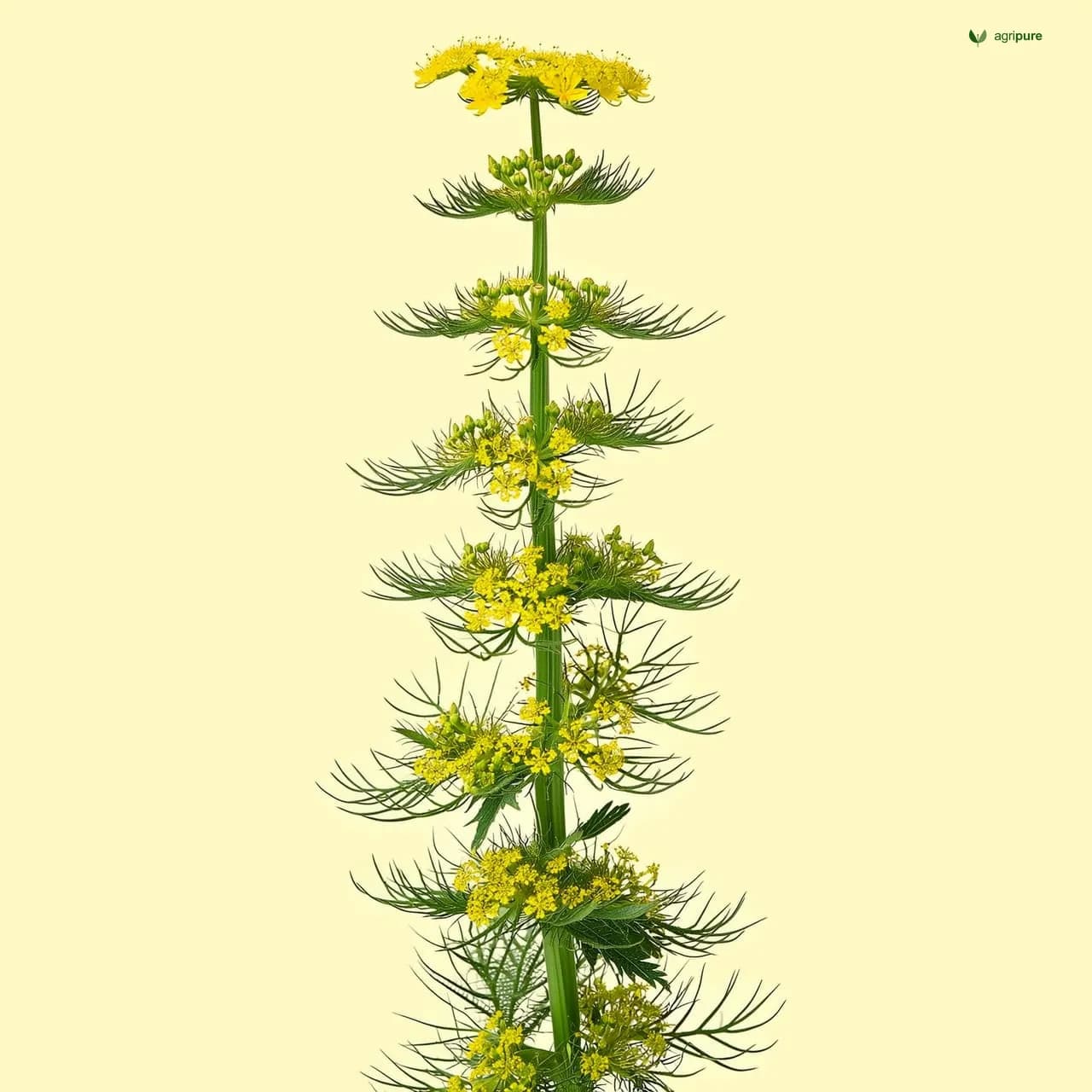
Fennel is easy to recognize once you know the cues. It forms an erect, branching, bush-like plant that typically reaches 3 to 5 ft (about 0.9 to 1.5 m) tall in the garden, with hollow stems and an overall glaucous, bluish-green cast. The leaves are fragrant and finely dissected into threadlike (filiform) segments only about half a millimetre wide, giving the whole plant a soft, needle-like, feathery look. Crush any part and you get an unmistakable anise or licorice scent and flavor — the surest field test for fennel. In summer it throws large, flat-topped umbels of tiny yellow flowers, and the aromatic “fennel seeds” (botanically schizocarps) that follow are the spice the plant is famous for.
Growing fennel
Fennel is grown from seed, and it could hardly be easier: sow it directly in the garden in spring and it germinates readily. Give it full sun and a moist, organically rich, well-drained soil for the best growth, though the plant is more adaptable than that ideal suggests. In the wild it turns up on dry, rocky ground near the sea and on riverbanks, so it tolerates poorer and coastal soils, will cope with both clay and sandy ground, and once established it stands up to drought. In cultivation it does best with medium, steady water; the main thing to avoid is the opposite extreme, since overly wet, poorly drained soil invites stem and root rot.
Mature plants stand 3 to 5 ft tall and spread roughly 2 to 3 ft across, so allow them room — a spacing of about 18 to 24 in (45 to 60 cm) between plants suits that mature width (the spacing figure is inferred from the listed spread rather than taken from a specific guideline). Fennel is grown as a hardy perennial and succeeds across a wide USDA range, from roughly zones 4a to 9b, performing best in Mediterranean and similar temperate or coastal climates. The cited references do not give firm days-to-maturity figures, so rather than invent one, treat it by use: pick leaves and young shoots fresh through the growing season, and let plants flower and set seed when you are after the spice.
Harvest and uses
Fennel is a genuinely multipurpose crop. The fragrant feathery leaves and young shoots are cut fresh during the growing season for the kitchen, carrying the same sweet anise note as the seed. After flowering, the plant produces aromatic seeds that are dried and used as a spice. A distinct cultivated form, Florence fennel or finocchio (var. azoricum), has been selected for a swollen, bulb-like stem base that is eaten as a vegetable, so if you want the crisp “fennel bulb” of the produce aisle, grow that variety specifically.
Beyond the kitchen, fennel pulls real ecological weight. Its large, showy umbels of yellow flowers are very attractive to bees, butterflies, and other pollinators, which makes a flowering stand a reliable magnet for beneficial insects in a garden or orchard understory.
Keeping it from taking over
The same vigor that makes fennel easy to grow can make it a nuisance if you ignore it. The plant self-seeds freely and readily escapes cultivation, and in some regions it spreads from root and crown as well as seed. In California it has persisted for well over a century and behaves as an established invasive, particularly on disturbed soils. The practical control is simple: deadhead and remove spent flower heads before they shed seed wherever you do not want volunteers, and keep an eye on the crown of established clumps. Where it is already a known invasive, check local guidance before planting and consider growing it in a contained or regularly managed bed.
Sources
- Wild Fennel, Foeniculum vulgare – Eat The Weeds
- Foeniculum vulgare – UC Irvine Invasive Species Handbook
- Foeniculum vulgare (Fennel) – NC State Extension Plant Toolbox
- Foeniculum vulgare Mill. – GBIF
- Foeniculum vulgare – NatureServe Explorer