support
Stocks’ Saltwort (Lana)
lana
Haloxylon stocksii
- sindh coast
- punjab plains
- balochistan highlands
International hardiness
- USDA 9-11
- RHS H2
- AU: Arid / semi-arid
Where it grows — regional guide
| Zones / rating | Regional notes |
|---|---|
USDA 9-11 | No region-specific data yet |
| Zones / rating | Regional notes |
|---|---|
H2 (1 to 5C) | No region-specific data yet |
| Zones / rating | Regional notes |
|---|---|
Arid / semi-arid | No region-specific data yet |
| Zones / rating | Regional notes |
|---|---|
USDA 9-11 (USDA scale) Canada uses its own zone system; Canadian zones run roughly one lower than USDA. | No region-specific data yet |
| Zones / rating | Regional notes |
|---|---|
Sindh coast, Punjab plains, Balochistan highlands | Pakistan:Native salt-tolerant desert shrub of saline playas; harvested for industrial soda ash and camel browse, but it is not edible. India:Native halophyte of saline tracts and salt marshes; grazed by camels and burned for soda ash, but it is not an edible plant. |
Stocks’ saltwort (Haloxylon stocksii) is a small, woody, twiggy shrub of the amaranth family, Amaranthaceae, at home on the hot, dry, often salt-laden ground of arid Asia. Botanists have reassigned it to the accepted name Soda stocksii (Boiss.) Akhani, but the older name Haloxylon stocksii remains in wide use across regional floras and agricultural writing, so you will meet both. Its native range runs from eastern Afghanistan eastward to north-western India, taking in the arid lowlands of Pakistan and the dry country of Punjab and Rajasthan. For a homesteader working baked or salt-affected land, the practical appeal is simple: this is a tough, low-input desert shrub that holds ground where conventional crops will not establish, and it carries a long regional history as browse and as a source of alkaline ash.
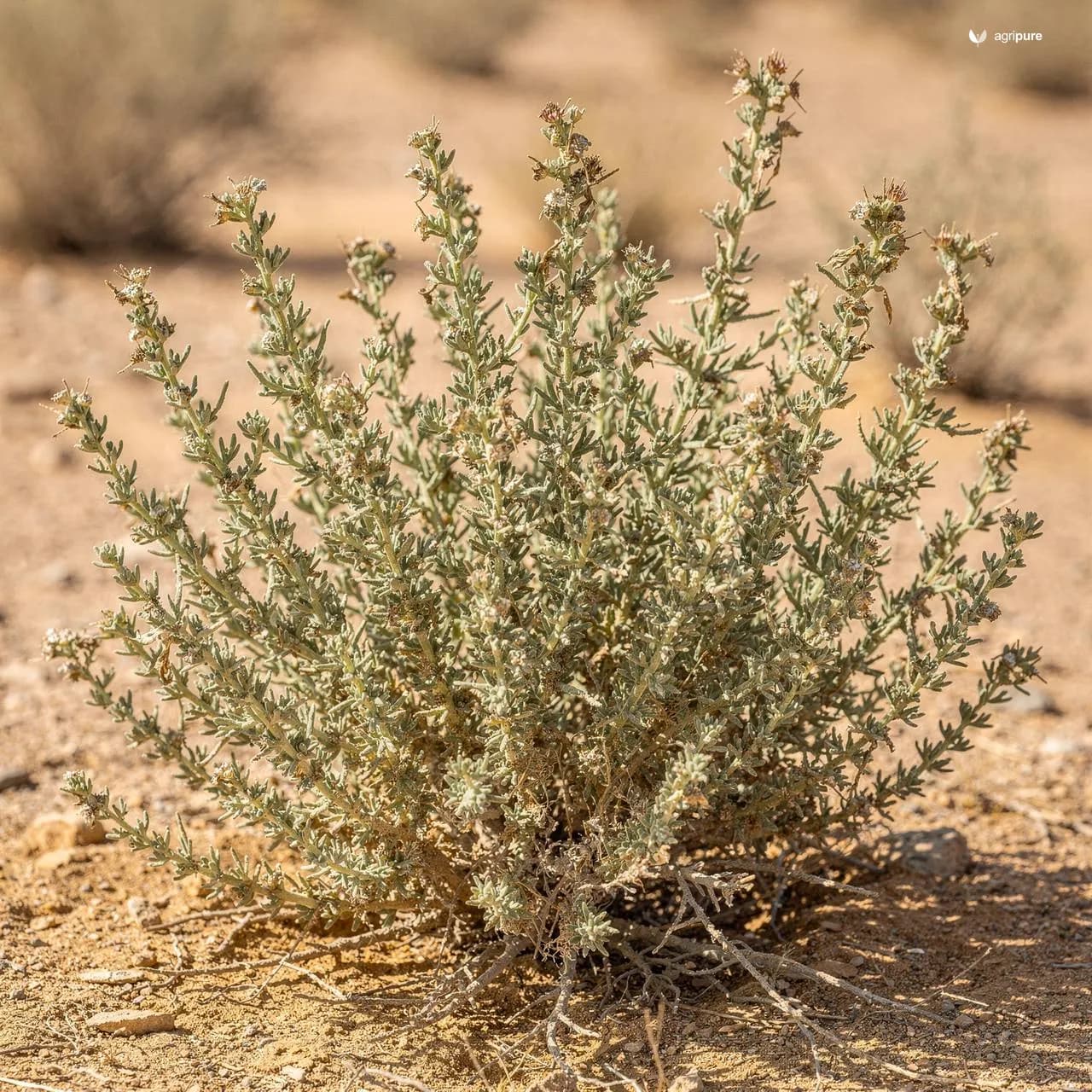
It is best recognised as a low, much-branched shrub, very variable in habit and growing up to about 90 cm tall, often straggling rather than upright. The stems and branches are hairless and dark brown, carrying a waxy, frosted bloom (pruinose), and the plant is paniculately branched, with spreading, stiff or backward-curving twigs that end in slender spikes 5 to 15 cm long. The leaves are small and almost succulent-looking: distinct but tiny, usually about 5 to 8 mm long and 1 to 2 mm wide (young leaves can reach 25 mm), three-angled or half-cylindrical in cross-section, sessile, with blunt or pointed tips. Overall it reads in the field as a fine-textured, grey-green to dark-brown twiggy shrub of arid, open settings.
Growing Stocks’ saltwort
This is a plant of harsh, open ground rather than a pampered garden subject. Kew’s Plants of the World Online records that it grows primarily in the desert or dry shrubland biome, and the Flora of Pakistan associates it with arid regions on the saline, dry, often alkaline soils typical of lowland deserts and semi-deserts. Across its native belt (eastern Afghanistan, the arid parts of Pakistan, and north-western India), conditions are hot and arid to semi-arid, with high summer temperatures and low rainfall. The sensible read for a grower is that it wants full sun, free-draining sandy or stony ground, and dry rather than wet conditions; it suits marginal, salt-touched, low-fertility corners, not rich, moist beds.
Beyond habitat and use, very little formal agronomic detail has been published for this species. The available literature describes its ecology and traditional uses rather than managed cultivation schedules, and the botanical sources here do not document a propagation protocol, sowing dates, plant spacing, or a time-to-maturity figure. Rather than state those numbers with false precision, this profile leaves them out. What can be said is that it is a desert-adapted shrub for hot, dry, saline-prone sites: keep it lean and dry, give it sun and sharp drainage, and do not waste fertile, irrigated ground on a plant whose advantage lies in surviving where better crops fail.
Harvest and uses
The Flora of Pakistan records two long-standing regional uses for Stocks’ saltwort. The dried plants are harvested and burned to produce barilla, locally called “sajji” — the alkaline ash recovered from burning the shrub, traditionally valued as a source of soda (alkali). The same source notes its use as camel fodder, consistent with its role as browse on arid, saline land where little else grows. These are the uses the botanical literature supports; the sources here document no culinary or medicinal use, so none is claimed.
For timing, the one phenological cue in the literature is flowering. In the Flora of Pakistan treatment, flowering is reported from October to December, with small flowers borne in the leaf axils and arranged in interrupted spikes along the terminal branches. The fruiting structure is a persistent, winged floral envelope (perianth) around the seed, about 6 mm across including the wings and papery (scarious) in texture — a useful detail for collecting ripe material in season.
How to identify it
Several features together separate Stocks’ saltwort from look-alike desert shrubs:13
- Habit and stems: A low, much-branched woody shrub up to roughly 90 cm tall, often straggling; hairless, dark brown branches with a waxy, frosted (pruinose) bloom, spreading and stiff or recurved, ending in slender spikes 5 to 15 cm long.
- Leaves: Small, distinct, almost succulent — about 5 to 8 mm long (rarely to 25 mm when young), three-angled to half-cylindrical, sessile, with blunt or pointed tips.
- Flowers and fruit: Inconspicuous axillary flowers in interrupted spikes; the fruiting perianth is winged, about 6 mm across, and papery in texture.
Sources
- Haloxylon stocksii — Flora of Pakistan (eFloras)
- Haloxylon — Wikipedia
- Soda stocksii (Boiss.) Akhani — Plants of the World Online, Royal Botanic Gardens, Kew
- Haloxylon stocksii — GBIF
- Haloxylon stocksii — International Plant Names Index (IPNI)
Sourcing notes
Collect ripe seed in late autumn from established Sindh or Balochistan stands; viability falls fast in storage, so sow fresh. Nursery-raise and transplant where direct-seeding fails on bare salt flats.