pioneer
Barley
jau
Hordeum vulgare
Also known as Jau (Pakistan).
- punjab plains
- pothohar
- kpk hills
- balochistan highlands
International hardiness
- USDA 8-10
- RHS H4
- AU: Cool temperate, Warm temperate, Mediterranean
Where it grows — regional guide
| Zones / rating | Regional notes |
|---|---|
USDA 8-10 | Hardy cool-season annual grain and cover crop; provides malting grain and animal forage, but contains gluten unsafe for celiac diets. |
| Zones / rating | Regional notes |
|---|---|
H4 (-10 to -5C) | Grown as a cool-season cereal for malting and livestock feed; it tolerates cold and poor ground, but contains gluten unsafe for celiac diets. |
| Zones / rating | Regional notes |
|---|---|
Cool temperate, Warm temperate, Mediterranean | Grown across winter rainfall grain belts as a drought- and salt-tolerant cereal; harvested grain contains gluten unsafe for celiac. |
| Zones / rating | Regional notes |
|---|---|
USDA 8-10 (USDA scale) Canada uses its own zone system; Canadian zones run roughly one lower than USDA. | Major short-season annual grain crop across the prairie provinces; tolerates cold soils and salinity, but contains gluten unsafe for celiac. |
| Zones / rating | Regional notes |
|---|---|
Punjab plains, Pothohar, KPK hills, Balochistan highlands | Pakistan:Staple winter rabi cereal across rainfed and saline plains; yields grain and livestock feed, but contains gluten unsafe for celiac diets. India:Cultivated across northern drylands as a salt-tolerant rabi cereal; provides nutritious grain, but contains gluten unsafe for celiac. |
Grows alongside
Species that appear with Barley in 16 of our published guides — a starting list for a guild, not a planting plan.
Barley (Hordeum vulgare) is an annual, cool-season cereal grass and one of the first grains humanity ever brought into cultivation. It was domesticated from its wild ancestor Hordeum spontaneum in the Fertile Crescent roughly 10,000 years ago and is now grown across most temperate regions of the world, including much of North America and Eurasia. Grown for human food, livestock feed, and malting, barley earns its place on a homestead as a hardy small grain that tolerates cold, drought, and poor ground better than most cereals, making it a dependable choice where wheat struggles.
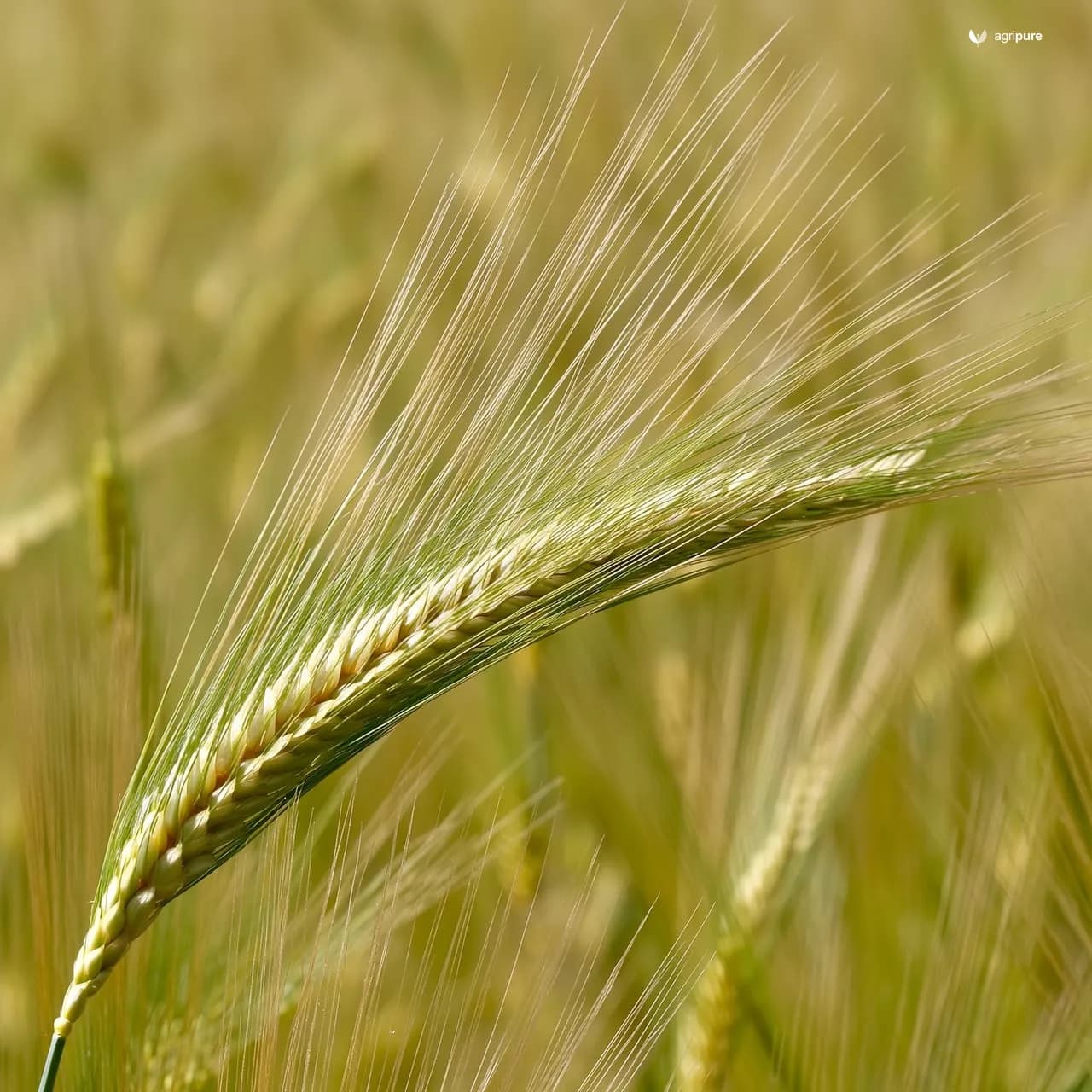
Barley grows as an upright, cool-season bunchgrass, typically 50 to 100 cm (about 20 to 40 inches) tall, with hollow, jointed stems (culms) whose nodes and internodes are hairless. Its leaves are alternate and flat, arising from the stem above ground level, with smooth, tapered surfaces and margins. A reliable way to tell barley from wheat or oats is the leaf collar, which carries two overlapping auricles that clasp the stem. The seed head is a spike 2 to 10 cm (about three-quarters of an inch to four inches) long, with spikelets borne in clusters of three, each often tipped with a long bristle, or awn. Cultivated types are commonly described as two-row or six-row barley, a reference to how the spikelets are arranged along the central axis of the spike. The grain itself is a typical cereal caryopsis, and seed-identification guides note its elongated florets with adherent paleas and lemmas.
Growing barley
Barley is propagated exclusively by seed (the grain itself), and the agronomic practices used on a field scale translate readily to a smaller homestead plot. It is a cool-season crop that performs best in cool, dry conditions; it can be grown in hot climates but becomes more susceptible to disease under hot, humid weather. Its cold hardiness is considerable, and it is cultivated throughout temperate regions, even at high latitudes north of the Arctic Circle in Scandinavia and Siberia. Just as usefully for marginal ground, barley is often more tolerant of drought and salinity than other small grains, which suits it to semi-arid and lower-quality soils.
Sowing time is the main decision, and it depends on whether you are growing spring or winter barley and on your local climate. In the southeastern United States, winter barley is seeded from September through November, or as early as mid-August if it is to be used for winter pasture. Across the southern Great Plains, spring barley is sown from March to early May and winter barley from late January into February. In the Northeast and New England, spring barley goes in from March through June, and in the Great Basin and Pacific Northwest spring barley is sown from mid-March through the end of April. The common thread is to time the crop so that grain fill avoids the worst summer heat, which barley handles poorly.
Climate and adaptability
Barley is one of the most widely adapted cereals on the planet. It is grown from the Arctic Circle to the tropics, where in warm regions it is confined to highlands or cooler zones. In North America it has been recorded across 48 U.S. states and most of Canada, and it can volunteer in fields and disturbed sites after cultivation. Formal hardiness ratings are rarely assigned to annual cereals, but its success from Alaska and Arctic Scandinavia through the continental United States points to a practical range spanning roughly USDA zones 3 to 9, with sowing dates shifted between spring and winter types to dodge heat stress. One quirk worth knowing: cultivated barley does not occur as a truly wild plant. The USDA notes that H. vulgare “does not exist in the wild” and persists only in cultivation or as short-lived volunteers, while genuinely wild populations belong to the separate species H. spontaneum.
Harvest and uses
Barley is a triple-purpose grain, valued for human food, animal feed, and malting. As food it can be cooked whole, milled into flour, or processed into a range of products, and malted barley is the backbone of the brewing and distilling trades. A large share of the world crop also goes to livestock as a high-energy feed grain. Its early maturity, cold tolerance, and willingness to grow on drought-prone or saline ground make it a practical staple and cover option for homesteaders working marginal land where other cereals would fail.
Safety and cautions
Barley is edible and wholesome for most people, but it is not gluten-free. It contains gluten and can cause problems for anyone with celiac disease or a gluten or wheat allergy, who should avoid it and its malted and flour-based products. Treat any traditional food or wellness use of barley as ordinary diet rather than medicine, and consult a qualified professional before relying on it where a gluten-related condition or allergy is a concern.
Sources
- “On the Origin of Cultivated Barley (Hordeum vulgare)” – Molecular Biology and Evolution (Oxford Academic)
- “Barley” – Wikipedia
- “Hordeum vulgare” – Ensembl Plants
- “Hordeum vulgare (Barley) Biology Profile” – Alaska Center for Conservation Science, University of Alaska Anchorage
- “Barley (Hordeum vulgare) Plant Guide” – USDA NRCS
- “Hordeum vulgare L. subsp. vulgare” – Seed Identification Guide