climax
Mahua
mahua
Madhuca longifolia
- punjab plains
- sindh coast
International hardiness
- USDA 10-12
- RHS H1a
- AU: Tropical, Subtropical
Where it grows — regional guide
| Zones / rating | Regional notes |
|---|---|
USDA 10-12 | No region-specific data yet |
| Zones / rating | Regional notes |
|---|---|
H1a (above 15C, heated glasshouse) | No region-specific data yet |
| Zones / rating | Regional notes |
|---|---|
Tropical, Subtropical | No region-specific data yet |
| Zones / rating | Regional notes |
|---|---|
USDA 10-12 (USDA scale) Canada uses its own zone system; Canadian zones run roughly one lower than USDA. | No region-specific data yet |
| Zones / rating | Regional notes |
|---|---|
Punjab plains, Sindh coast | Pakistan:Planted in frost-free plains and dry woodlands of Punjab and Sindh for shade and traditional uses; food use should be restricted to the edible flowers. India:A large deciduous tree of Central Indian dry forests valued for its edible fallen flowers; edibility of other parts is unconfirmed and needs caution. |
Mahua (Madhuca longifolia) is a large tropical tree in the sapodilla family, Sapotaceae, best known for its musky-scented flowers that open at night and drop by dawn. It is native to India and the neighbouring lowland tropics of South Asia, growing across the central, southern, and northern Indian plains and forests as well as Bangladesh, Nepal, Myanmar, and Sri Lanka. For a homesteader working a hot, dryland site, its appeal is straightforward: it is a long-lived, drought-adapted shade tree whose flowers double as an edible harvest, so it earns a place as a slow-growing canopy anchor rather than a quick crop.
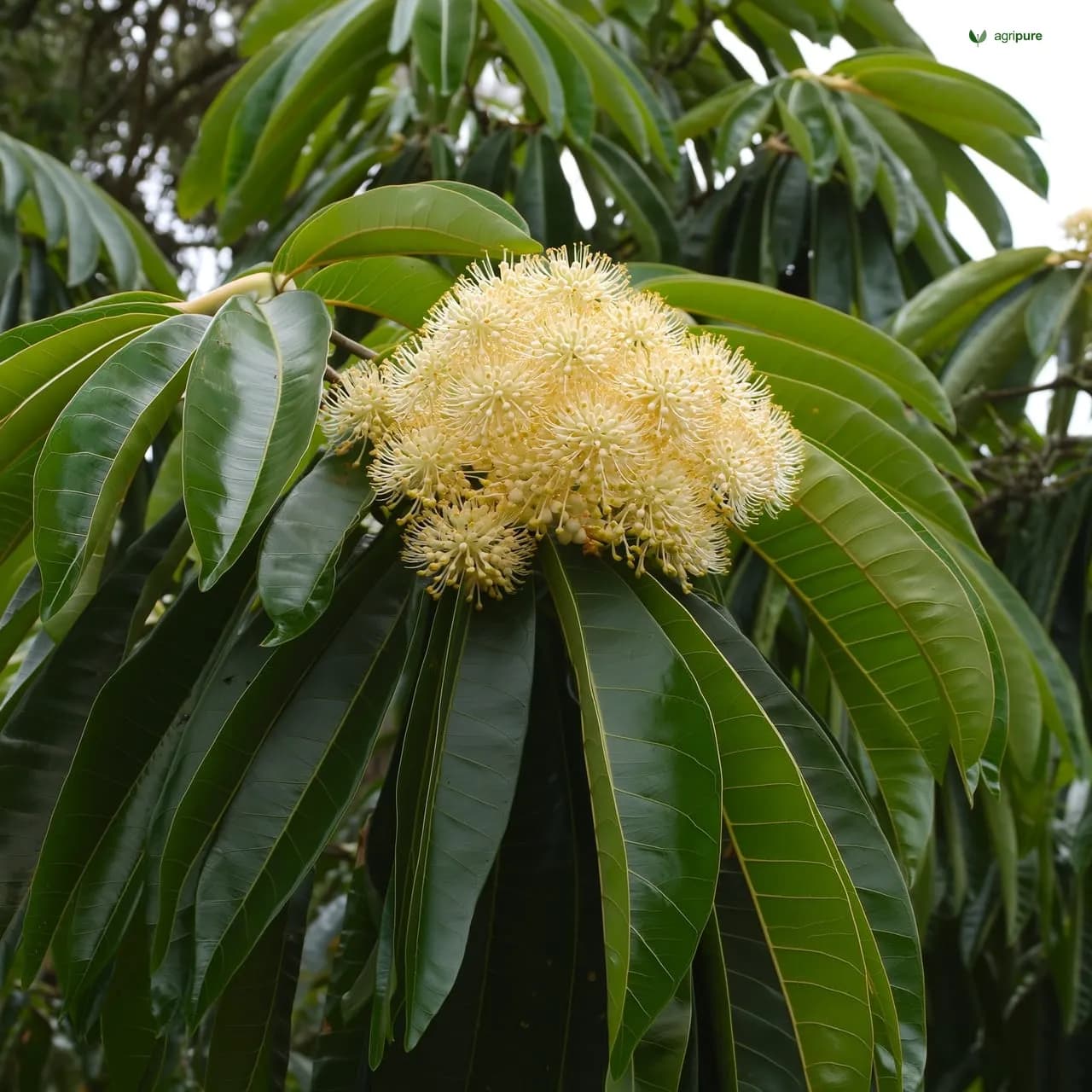
Mahua is a substantial deciduous tree, reaching roughly 20 m tall, with foliage that ranges from evergreen to semi-evergreen depending on conditions. The most reliable field cue is the bark: it is thick and grey, vertically cracked and wrinkled along the trunk. The tree sheds most of its leaves between February and April, and its flowers appear when the canopy is largely bare — they are fleshy, musky-scented, bloom at night, and have usually fallen to the ground by dawn. The fruit follows the flowers by a couple of months: a fleshy green berry containing one to four shiny brown seeds.
Growing mahua
Mahua is a tree of the warm, lowland tropics. Within its native South Asian range it grows in tropical mixed deciduous forest and is described as adaptable to arid environments, which is what makes it interesting for dryland and seasonally dry sites. That adaptability to hot, dry conditions, together with its forest habit, tells you the broad strokes of where it belongs: a frost-free or near-frost-free climate with a pronounced dry season, planted with the space a 20 m canopy tree eventually needs.
Beyond that, the honest answer is that detailed cultivation figures are not well documented in the reliable sources available for this profile. Specific propagation methods, soil preferences, sun and water requirements, spacing, and time-to-maturity are not stated in those sources, so this profile deliberately leaves them out rather than invent precise numbers. Treat mahua as a long-term planting: a slow, large canopy tree for warm, dry-tolerant systems, sited where it will not be crowded and where its leaf drop and flower fall become an asset rather than a nuisance.
Harvest and uses
The flowers are the headline harvest. Because they open at night and drop to the ground by morning, they are gathered at dawn from beneath the tree rather than picked from the branches. They are described as a delicious and nutritive food and have long been an important article of diet for people in Central India. A key practical trait is storage life: the flowers can be kept almost indefinitely, which is precisely why they have endured as a valuable harvested forest product rather than a fleeting seasonal treat.
The fruit ripens about two months after flowering, opening to release its one to four seeds. Ecologically, mahua’s role is that of an important component of tropical mixed deciduous forest, and its tolerance of arid conditions makes it a sensible candidate for dryland tree systems where many species struggle. Reliable quantitative yield figures are not given in the sources here, so none are stated; the value of the tree is better understood through its long productive life and the storability of its flower harvest than through a per-tree number.
How to identify it
A mature mahua can be recognised by this combination of features:12
- Habit: A large tropical tree to about 20 m, deciduous to semi-evergreen.
- Bark: Thick and grey, vertically cracked and wrinkled — a dependable identifying mark.
- Leaf behaviour: Most leaves fall between February and April, leaving the tree largely bare at flowering.
- Flowers: Fleshy and musky-scented, opening at night on a near-leafless tree and dropping by dawn.
- Fruit: A fleshy green berry holding one to four shiny brown seeds, ripening a couple of months after bloom.
Safety and cautions
The sources available for this profile describe traditional uses of mahua rather than a modern toxicology assessment, so the safety notes below are deliberately conservative. A few grounded points:
- The flowers are the part most clearly supported as food: they are explicitly described as edible, nutritive, and a staple article of diet in parts of Central India. The sources do not confirm the edibility of other parts, so the flowers are the safest assumption for any food use.
- Traditional medicinal uses are recorded for several parts of the tree: the bark, flowers, and fruit have each been used in folk practice for various ailments. These are historical accounts of traditional use, not clinical evidence, and this profile makes no claim that any part treats or cures any condition.
- The available sources do not provide a modern safety evaluation: no dose limits, drug-interaction data, or pregnancy and lactation cautions are documented here. As with any plant used medicinally, anyone considering such use should seek qualified guidance rather than self-administer.
Sources
- Mahua (Madhuca longifolia) — Flowers of India
- Madhuca longifolia — Wikipedia
- Madhuca longifolia var. latifolia — eFlora of India
- Madhuca longifolia — iNaturalist