secondary
Cassava
kasava
Manihot esculenta
Also known as Yuca (United States), Tapioca (India).
- sindh coast
- punjab plains
International hardiness
- USDA 10-12
- RHS H1b
- AU: Tropical, Subtropical
Where it grows — regional guide
| Zones / rating | Regional notes |
|---|---|
USDA 10-12 | Tender tropical shrub grown in frost-free zones or long warm seasons; raw roots and leaves contain toxic cyanogenic compounds and require thorough cooking. |
| Zones / rating | Regional notes |
|---|---|
H1b (10 to 15C) | No region-specific data yet |
| Zones / rating | Regional notes |
|---|---|
Tropical, Subtropical | Grown as a hardy tuber crop in tropical and subtropical regions; all raw parts contain toxic cyanogenic compounds that require peeling and thorough boiling. |
| Zones / rating | Regional notes |
|---|---|
USDA 10-12 (USDA scale) Canada uses its own zone system; Canadian zones run roughly one lower than USDA. | No region-specific data yet |
| Zones / rating | Regional notes |
|---|---|
Sindh coast, Punjab plains | Pakistan:Planted in coastal Sindh and southern Punjab as an experimental drought-hardy starch root; raw tubers and foliage carry cyanogenic toxins and must be cooked. India:A major commercial tuber crop in southern states; raw roots and foliage contain toxic cyanogenic glycosides and must be peeled, washed, and thoroughly boiled. |
Grows alongside
Species that appear with Cassava in 11 of our published guides — a starting list for a guild, not a planting plan.
Cassava (Manihot esculenta) is a perennial tropical shrub in the spurge family (Euphorbiaceae), grown both for its starchy underground storage roots and its edible leaves. It is native to tropical South America — particularly regions of present-day Brazil, Paraguay, and parts of the Andes and Amazon basin — and is now cultivated across the humid and sub-humid tropics of Africa, Asia, and the Americas, roughly between 30 degrees north and 30 degrees south of the equator. For a warm-climate homesteader, the appeal is its toughness: cassava tolerates poor soils and drought and still banks a heavy crop of calorie-dense roots, which is exactly why it has become a food-security staple in so much of the tropics. The important catch is that every raw part contains cyanide-releasing compounds and must be processed and cooked correctly before it is eaten.
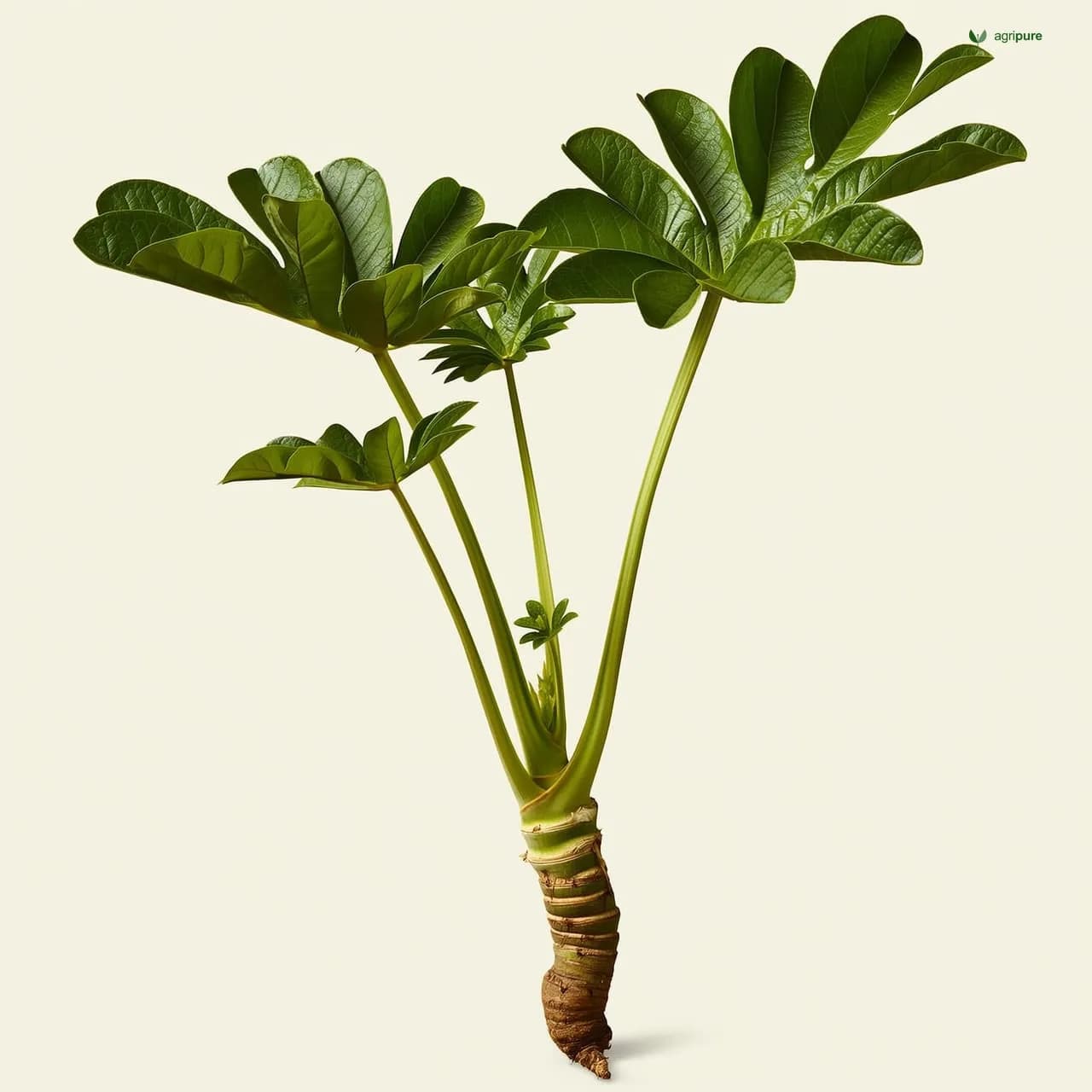
The plant is a woody to semi-woody shrub, typically growing up to about 2 to 3 m (around 10 ft) tall in cultivation and sometimes taller in ideal tropical conditions. The leaves are alternate, simple, and palmately lobed (usually with five to nine deep, hand-shaped lobes), carried on long petioles, with individual blades about 15 to 30 cm long. Stems are green to brown, becoming woody with age, and the plant exudes a milky latex typical of the spurges. Flowers are inconspicuous: small, yellowish to cream, white, or pinkish, with separate male and female flowers borne on the same plant, and they are not grown for ornament. The fruits are six-angled, globose capsules holding brown-to-gray seeds with darker patches. Below ground, the plant forms clusters of elongated, swollen tuberous storage roots with a thin brown peel and white (occasionally yellow-tinged) starchy flesh: the “cassava” of commerce and the kitchen.
Growing cassava
Cassava is a tropical plant that needs heat and a long, frost-free season. It grows as an evergreen perennial outdoors in roughly USDA hardiness zones 10 to 12, but it is highly frost-sensitive, so a frost that kills the top growth before the roots have matured can prevent any usable harvest. Because of that sensitivity it is often grown as a warm-season annual, and it can be raised as an annual or container crop in warm zone 9b and similar climates provided it gets roughly 8 to 12 frost-free months to make a root. It thrives in hot climates with a pronounced rainy season and dry season and is notably drought-tolerant, though yields improve with adequate moisture.
In practice, growing it well comes down to a few sourced essentials:
- Propagation: Cassava is normally grown from woody stem cuttings rather than seed. Cuttings are typically about 30 cm (around 1 ft) long, taken from mature, woody portions of the stems, and planted with the correct end up — set vertically or at a slight slant directly into the soil. The plant does produce seeds inside its six-angled capsules, but seed propagation is mainly used for breeding; reliable homestead production relies on stem cuttings.
- Soil: It prefers moist, fertile, sandy, well-drained soil, but it tolerates very poor soils and dry conditions — one of the main reasons it is a food-security crop. Good drainage matters, as prolonged waterlogging reduces growth and yield.
- Sun: Cassava grows best in full sun but will tolerate partial shade.
- Water: It needs moderate, consistent moisture for good yields. Once established it is drought-tolerant and keeps filling its roots with starch even through dry spells, although harvest weight is higher with regular rainfall or irrigation.
Exact plant spacing and time-to-harvest figures vary widely by system and cultivar and are not given consistently in these sources, so they are left out here rather than stated with false precision. The dependable signal is the season length: give cassava the better part of a year of frost-free warmth, plant cuttings into warm, well-drained ground, and keep it clear of low spots that stay wet.
Harvest and uses
The harvest is the cluster of swollen tuberous roots that form beneath the plant. These elongated storage roots have a thin brown peel and white or sometimes yellow-tinged starchy flesh, and they are the main food and starch source once properly processed and cooked. Cassava is a dietary staple for a very large share of the world’s population, which is why it is so widely cultivated across Africa, Asia, and the Americas. The leaves are also eaten as a cooked leafy green where the plant is grown, but — like the roots — they must be cooked correctly first because of their cyanogenic content. For the homesteader, cassava is best understood as a high-calorie root staple plus a secondary leaf vegetable, not a fresh-eating crop.
Safety and cautions
Cassava carries a genuine and well-documented safety caution: all raw parts of the plant contain cyanide-releasing (cyanogenic) compounds and are not safe to eat raw. Both the roots and the leaves must be properly processed and cooked — for example by peeling, soaking, and thorough cooking — before they are consumed, and this processing is a standard, non-optional part of preparing the crop wherever it is a staple food. A few grounded points for any grower:
- Do not eat cassava roots or leaves raw, and do not treat the plant like a casual fresh vegetable; correct preparation is what makes it food.
- Treat the requirement to peel, soak, and cook as essential rather than a refinement — it is the difference between a safe staple and a toxic one.
- If you grow cassava, learn the established preparation method for the cultivars you have before relying on it as food, and handle the milky latex and trimmings with the same care you would give any toxic plant material.
This profile describes cassava’s food use and its toxicity as documented in the sources below; it does not provide medical, dosing, or detoxification instructions. Anyone intending to make cassava a dietary staple should follow established local processing practice for the specific cultivars grown.
Sources
- Manihot esculenta – NC State Extension Gardener Plant Toolbox
- Cassava – Wikipedia
- Cassava (Manihot esculenta Crantz): A Systematic Review – PMC, National Library of Medicine
- Manihot – Atlas of Florida Plants, University of South Florida