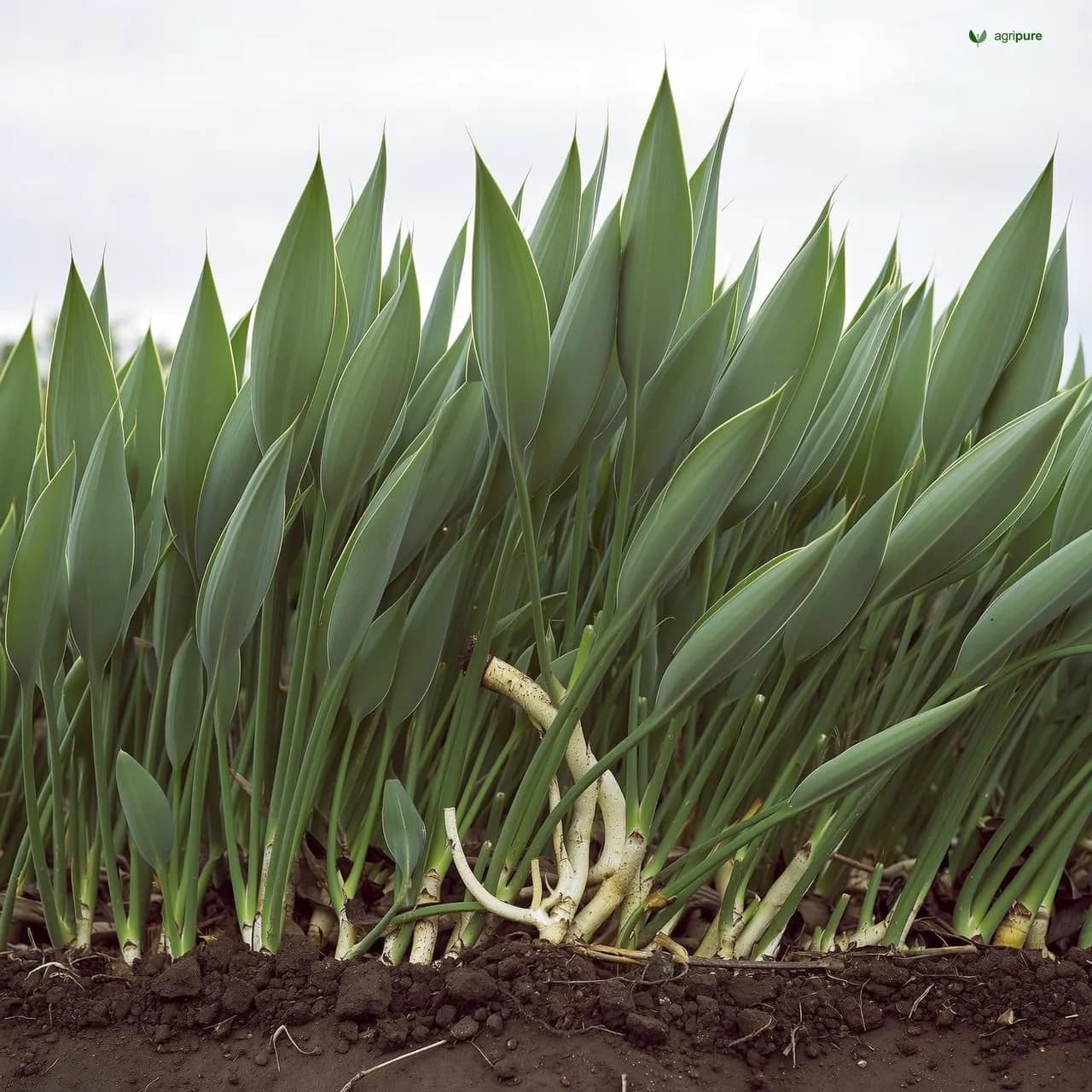
secondary
Arrowroot
arrowroot
Maranta arundinacea
- sindh coast
- punjab plains
International hardiness
- USDA 9-11
- RHS H2
- AU: Tropical, Subtropical, Warm temperate
Where it grows — regional guide
| Zones / rating | Regional notes |
|---|---|
USDA 9-11 | Tender perennial rhizome for frost-free southern gardens or container culture; confirm species identity as Maranta arundinacea to avoid unrelated toxic plants. |
| Zones / rating | Regional notes |
|---|---|
H2 (1 to 5C) | No region-specific data yet |
| Zones / rating | Regional notes |
|---|---|
Tropical, Subtropical, Warm temperate | Grown for starch in warm temperate, subtropical and tropical zones in partial shade; ensure plants are verified Maranta arundinacea to avoid toxic lookalikes. |
| Zones / rating | Regional notes |
|---|---|
USDA 9-11 (USDA scale) Canada uses its own zone system; Canadian zones run roughly one lower than USDA. | No region-specific data yet |
| Zones / rating | Regional notes |
|---|---|
Sindh coast, Punjab plains | Pakistan:Cultivated in frost-free sheltered gardens of Sindh and Punjab; ensure true botanical stock is planted as unrelated species sold as arrowroot can be harmful. India:Grown in humid tropical and subtropical tracts for digestible starch; verified botanical stock is essential to avoid misidentification with inedible plants. |
Grows alongside
Species that appear with Arrowroot in 2 of our published guides — a starting list for a guild, not a planting plan.
Arrowroot (Maranta arundinacea) is a clump-forming, rhizomatous perennial in the prayer-plant family (Marantaceae), grown for the starchy underground rhizomes that yield one of the most digestible, gluten-free starches in the kitchen. It is native to the American tropics, where NatureServe places its range from southern Mexico through Central America, the West Indies, and South America as far south as northern Argentina. From that home base it has spread into cultivation across the Caribbean — St. Vincent and the Grenadines being the classic production center — and on into parts of Africa and Southeast Asia as a starch crop. For a homesteader in a hot, frost-free climate, the appeal is straightforward: it is a low-fuss shade-tolerant perennial that banks carbohydrate underground for a slow, mechanical-free harvest.
Arrowroot is an erect herbaceous plant, described in rainforest habitats as a large perennial herb. It forms spreading clumps from rhizomes that creep horizontally just below the soil surface, sending up reed- or cane-like shoots — a habit caught in the species name arundinacea, meaning “reed-like.” The leaves are broad and typical of the Marantaceae. The edible part is the rhizome: long, pointed, and sheathed in papery bracts, containing roughly 20 percent starch, of which 20 to 30 percent is amylose. One important caution before you plant: the name “arrowroot” is attached to several unrelated species, so for food use you should start from verified stock genuinely labeled Maranta arundinacea rather than buying on the common name alone. Variegated forms such as M. arundinacea ‘Variegata’ exist, but these are ornamental selections of the same species, not the field crop, and not a different plant.
Growing arrowroot
Arrowroot wants a tropical, hot, and moist environment to develop a proper crop, and it is not frost-tolerant — references treat it as a perennial in roughly USDA zones 10 to 11, grown only as a warm-season annual or as a container plant brought indoors in colder areas. It prefers temperatures around 18 to 27 degrees Celsius (65 to 80 F) and does not tolerate prolonged spells below about 15 C (60 F) or above about 29 C (85 F). Crucially, it needs a long, uninterrupted warm season: plant it so that it has 10 to 11 months of hot, moist weather to mature.
- Propagation: Vegetative, by rhizome pieces or suckers — there are no reliable production sources here for growing it from seed, so plan on rhizome propagation only. The standard agronomic method plants tubers or suckers about 6 inches (15 cm) deep, spaced roughly 15 inches (38 cm) apart, in furrows about 30 inches (75 cm) apart. Established clumps can also be increased by division.
- Soil: Grow it on reasonably deep, friable ground suited to root crops, kept consistently moist but never waterlogged; none of the cited sources recommend standing water. For potted plants the guidance is a well-draining mix kept moist but not soggy.
- Light: Arrowroot prefers bright, indirect light, and direct sun can scorch the leaves, so filtered sun or light shade suits it well — a useful trait for the herb or groundcover layer beneath a partial canopy, especially in very hot regions.
- Water: Keep the soil consistently moist through the long growing season, but ensure it drains freely; the plant tolerates damp ground, not flooding.
Because it asks for a 10-to-11-month warm run to bulk up its rhizomes, time your planting for the start of the season’s reliable heat and keep the bed moist right through to maturity.
Harvest and uses
The harvest is the rhizome, dug at the end of that long warm season once the plant has had its full run of growth. Washed, peeled, and wet-milled, the rhizome yields the fine white starch arrowroot is prized for — a starch that is widely valued as highly digestible and gluten-free, which is the whole reason the plant is grown as a food crop. With about 20 percent starch in the rhizome and an amylose fraction of 20 to 30 percent, it produces clear, smooth gels well suited to thickening, and its starch granules are distinctive enough to be a textbook subject of starch microscopy. In the homestead system it slots into the shadier, lower stratum as a starch reserve you can lift by hand and replant from the same crop.
How to identify it
Use this combination of features, and verify your planting stock by name before relying on it for food:135
- Family and habit: A monocot in the Marantaceae (order Zingiberales); a large, clump-forming perennial herb that spreads from horizontal underground rhizomes.
- Shoots: Erect, reed- or cane-like stems, echoing the epithet arundinacea (“reed-like”).
- Leaves: Broad, typical prayer-plant foliage; variegated ornamental selections exist but are the same species, not a separate plant.
- Rhizomes: Long, pointed, and enclosed in papery bracts — the starchy edible part, around 20 percent starch.
Safety and cautions
Arrowroot is grown and eaten as a starch crop, and the cited sources do not flag the rhizome itself as toxic. The real caution here is one of identity, not poison: because several unrelated plants share the common name “arrowroot,” using the wrong species for food is the genuine risk. Plant only stock that is reliably identified as Maranta arundinacea, and do not assume a plant sold as “arrowroot” — or an ornamental Maranta from a houseplant nursery — is the edible field crop. As with any crop entering the kitchen, confirm the species before you eat it.
Sources
- Arrowroot (Maranta arundinacea) fact sheet — Growables
- Maranta arundinacea plant care — PlantSnap
- Arrowroot starch composition and properties — PMC (National Library of Medicine)
- Arrowroot starch (book chapter) — Wiley Online Library
- Maranta arundinacea — NatureServe Explorer
- Arrowroot starch granules — Nikon MicroscopyU