pioneer
Alfalfa
lucern
Medicago sativa
Also known as Lucerne (UK & Ireland, Australia, India), Lusan (Pakistan).
- punjab plains
- pothohar
- balochistan highlands
International hardiness
- USDA 3-11
- RHS H7
- AU: Arid / semi-arid, Warm temperate, Cool temperate, Mediterranean, Subtropical
Where it grows — regional guide
| Zones / rating | Regional notes |
|---|---|
USDA 3-11 | A deep-rooted perennial forage that yields repeated cuttings; grown as a high-value hay and livestock pasture crop. |
| Zones / rating | Regional notes |
|---|---|
H7 (below -20C) | RHS rating H7: a deeply rooted, fully hardy perennial legume grown on well-drained, non-acid soils for livestock feed and soil nitrogen enrichment. |
| Zones / rating | Regional notes |
|---|---|
Arid / semi-arid, Warm temperate, Cool temperate, Mediterranean, Subtropical | Widely grown across mediterranean and temperate zones as a deep-rooted perennial pasture; valued for grazing and soil fertility. |
| Zones / rating | Regional notes |
|---|---|
USDA 3-11 (USDA scale) Canada uses its own zone system; Canadian zones run roughly one lower than USDA. | A deep-rooted perennial forage naturalized across cold regions; grown for hay, haylage, and soil building. |
| Zones / rating | Regional notes |
|---|---|
Punjab plains, Pothohar, Balochistan highlands | Pakistan:A primary perennial rabi and multi-cut fodder in Punjab, Pothohar and Balochistan; sown for nutritious livestock feed and nitrogen fixation. India:Grown across northern India as a deep-rooted perennial forage; provides multiple cuttings of high-value livestock feed through the growing season. |
Grows alongside
Species that appear with Alfalfa in 24 of our published guides — a starting list for a guild, not a planting plan.
Alfalfa (Medicago sativa), also called lucerne, is a perennial herbaceous legume in the pea family (Fabaceae), grown chiefly as a forage crop. It is native to southwestern Asia and the broader Eurasian–Mediterranean region — sources place its origin around Asia Minor, Transcaucasia, and Iran, with natural occurrence spanning the Mediterranean, North Africa, the Middle East, most of Europe, Siberia, northern India, and China. Today it is cultivated and naturalized worldwide. For a homesteader, the appeal is straightforward: it is a deep-rooted, long-lived legume that you sow once and cut repeatedly for several seasons of high-value livestock feed, while it improves the ground it grows in.
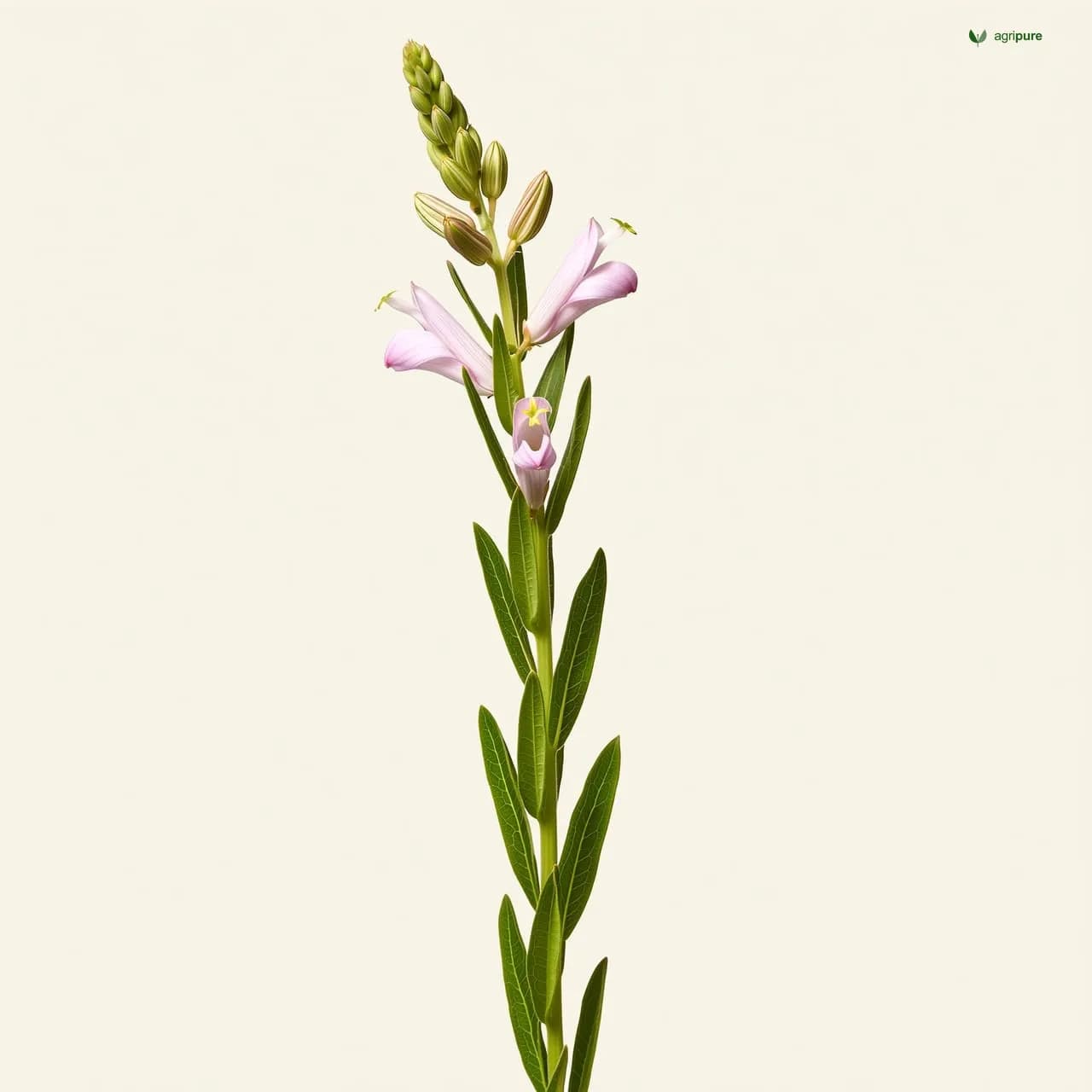
The plant grows as a perennial forb with multiple erect stems rising from a thick, somewhat woody crown, anchored by a deep taproot. Its leaves are trifoliate, with serrated leaflets, and it carries typical pea-type flowers. The seeds are a useful identification cue: they are kidney-shaped and angular. The USDA PLANTS database records alfalfa as annual or perennial in duration, since it behaves differently across growing regions, but on the homestead it is best treated as a stand-forming perennial.
Growing alfalfa
Alfalfa is grown from seed as a crop plant. The two soil factors that matter most are drainage and pH. It performs best in well-drained soils and is very sensitive to soil acidity; Mississippi State Extension recommends maintaining soil pH around 6.5, so acid ground should be limed before sowing.
For establishment, Mississippi State Extension recommends seeding at 15 to 20 lb per acre, sown 1/4 to 1/2 inch deep into a well-prepared bed, ideally with a cultipacker-seeder to give firm seed-to-soil contact. Specific sun-exposure and irrigation figures are not given in these sources, so they are left out rather than stated with false precision; in practice, alfalfa is an open-field crop grown on free-draining ground rather than in shade or on waterlogged sites.
It is a long-lived perennial, though stand persistence varies widely by region — under Mississippi conditions a stand commonly lasts 2 to 3 years. Once established, the same planting yields forage repeatedly across the season rather than being resown each year.
Harvest and uses
Alfalfa is cut for forage multiple times per season, with harvest taken at the bloom stage. Mississippi State Extension notes that as many as six cuttings may be possible in the southern part of that state, illustrating how productive a well-managed stand can be in a long growing season. The supplied sources do not give a general numeric yield-per-acre figure, so none is stated here.
The harvested forage is used as hay, haylage, and silage, and it can also be dehydrated and processed into meal or pellets. Alfalfa is one of the major livestock forage crops, valued as a feed that can be stored and traded in several forms.
Beyond feed, alfalfa earns its place in a cropping system. It is planted for pasture and grazing-land improvement, for erosion control, and as a rotation crop that contributes to soil structure and nitrogen, making it a natural fit ahead of heavier-feeding crops in a rotation.
How to identify it
Alfalfa is recognizable in the field by this combination of features:12
- Habit: A perennial herb with several erect stems growing from a thick, woody crown over a deep taproot.
- Leaves: Trifoliate (three leaflets), with serrated leaflet margins.
- Flowers: Typical pea-family flowers.
- Seeds: Kidney-shaped and angular — a reliable distinguishing detail.
Safety and cautions
The sources provided here do not state that Medicago sativa is poisonous, nor do they identify any poisonous parts, so no claim of toxicity is made. Equally, these sources describe alfalfa specifically as a forage and crop plant — they do not establish a culinary use or a medicinal use for the species, and they provide no dosing, drug-interaction, or contraindication guidance. Because that evidence is absent from the supplied research, this profile does not present alfalfa as a food to eat or an herb to self-administer; it is documented here purely as the livestock-forage and soil-building crop the sources support. Anyone considering other uses should seek information from additional, qualified sources first.
Sources
- Medicago sativa (alfalfa) — Go Botany, Native Plant Trust
- Medicago sativa L. plant profile — USDA PLANTS Database
- The Biology of Medicago sativa L. (Alfalfa) — Canadian Food Inspection Agency
- Alfalfa (Medicago sativa) — Mississippi State University Extension
- Medicago sativa ssp. sativa biology — Alaska Center for Conservation Science, University of Alaska Anchorage