support
Black Medick
maina
Medicago lupulina
- punjab plains
- pothohar
International hardiness
- USDA 3-9
- RHS H7
- AU: Cool temperate, Warm temperate, Mediterranean
Where it grows — regional guide
| Zones / rating | Regional notes |
|---|---|
USDA 3-9 | A hardy self-seeding annual or short-lived perennial for pasture and soil cover; foliage contains anti-nutritional compounds and can harm livestock in excess. |
| Zones / rating | Regional notes |
|---|---|
H7 (below -20C) | RHS rating H7: fully hardy low-growing legume for grassy borders and green manure; leaves carry anti-nutritional factors and are not suitable for raw eating. |
| Zones / rating | Regional notes |
|---|---|
Cool temperate, Warm temperate, Mediterranean | Naturalized in cool and warm temperate pastures as a winter cover; large intakes or moldy hay can trigger livestock toxicity and foliage is unsafe to eat raw. |
| Zones / rating | Regional notes |
|---|---|
USDA 3-9 (USDA scale) Canada uses its own zone system; Canadian zones run roughly one lower than USDA. | Fully hardy self-seeding legume across cold northern pastures; plant parts contain anti-nutritional compounds and must not be consumed raw or in large amounts. |
| Zones / rating | Regional notes |
|---|---|
Punjab plains, Pothohar | Pakistan:Self-seeds across Punjab plains and Pothohar field edges during the cool rabi season; foliage contains anti-nutritional compounds and is hazardous if fed moldy. |
Grows alongside
Species that appear with Black Medick in 2 of our published guides — a starting list for a guild, not a planting plan.
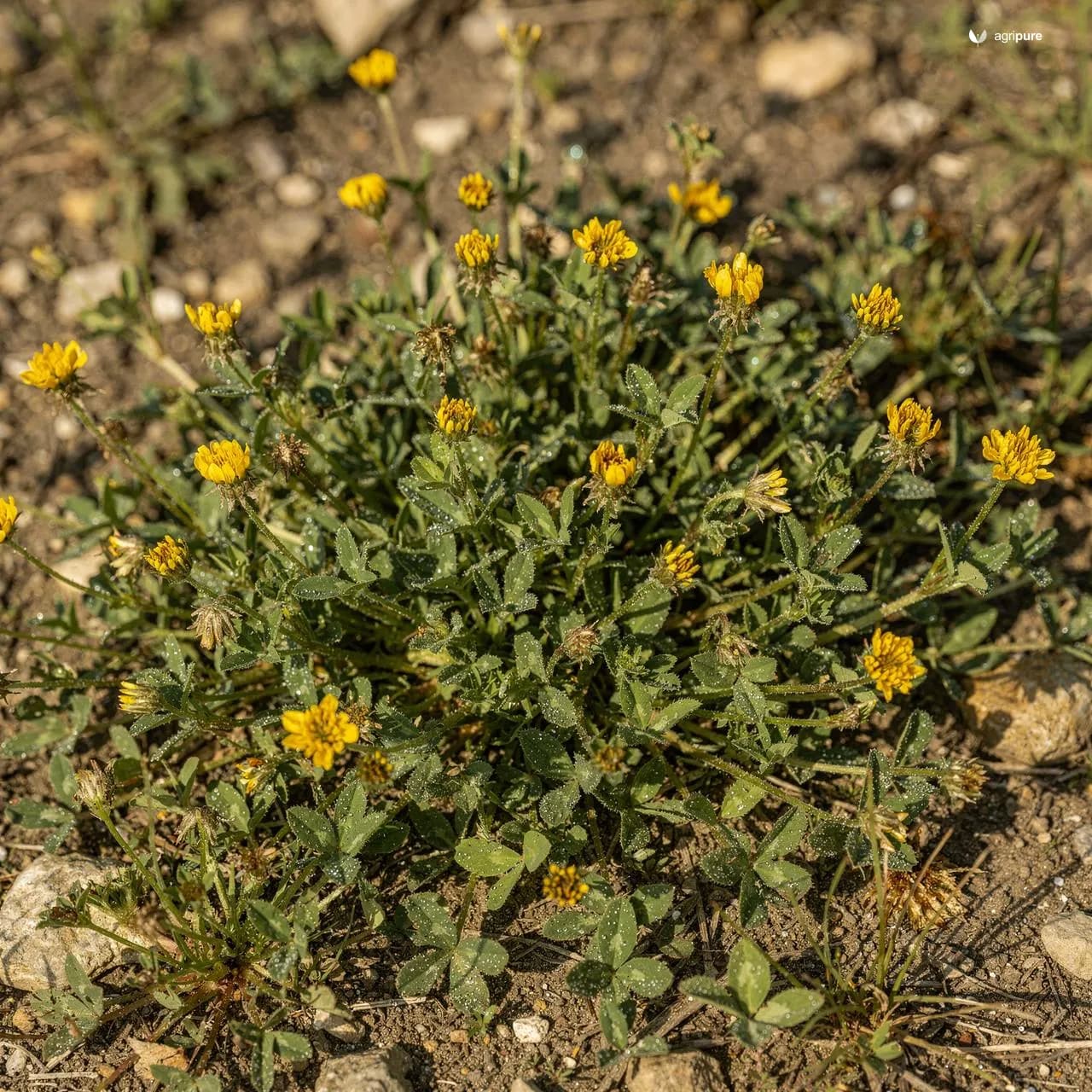
Black medick (Medicago lupulina) is a small, low-growing legume in the bean family (Fabaceae), easily spotted by its clover-like trifoliate leaves and tight, rounded heads of bright yellow flowers. It is native to the Old World (Europe, north Africa, the Near East, and most of temperate Asia, including India, China, and Korea) and was carried to North America as a forage plant, where it has naturalized so thoroughly that it now turns up across the United States and southern Canada in lawns, fields, and disturbed ground. For a homesteader, the hook is simple: this tough, self-seeding, nitrogen-fixing plant volunteers on exactly the poor, dry, low-fertility ground where you most want a soil-builder: the same biology that makes it a lawn “weed” makes it a useful cover crop and groundcover when you grow it on purpose.
Black medick can behave as a summer or winter annual or as a short-lived perennial. It forms low, prostrate-to-slightly-ascending stems that knit into mats up to roughly 2 to 2.5 feet across, rising from a thick, shallow root that carries nitrogen-fixing nodules built in symbiosis with rhizobia bacteria. The leaves are trifoliate (three leaflets) like clover, but the central leaflet sits on a small terminal “spur” or short stalk (a key field mark), and the leaflets are finely toothed along the upper half of the margin. Its small, pea-like yellow flowers cluster in dense, rounded heads at the ends of stalks rising from the leaf axils, each head typically carrying 10 to 50 flowers. Each flower ripens into a small, kidney-shaped pod that turns black as it matures, the source of the common name. The seeds are small and hard, and can persist in the soil seed bank for years.
Growing black medick
Most of what is written about black medick treats it as a weed to control, but the same biology applies when you grow it deliberately as a cover crop or living groundcover. The standard method is from seed: it propagates primarily by seed in summer and fall, with seedlings emerging in spring or fall depending on the climate.
- Propagation: Grow from seed — this is the plant’s primary and natural means of spread.
- Soil: It tolerates loam, clay-loam, and gravelly soils, and is well known for thriving in nutrient-poor, dry soils where nitrogen is low — the kind of ground where richer legumes struggle.
- Sun: It grows best in full sun to partial sun.
- Water: It handles dry to mesic moisture regimes and is characteristically a plant of dry sites.
Because it is naturalized across most of North America, from the cold winters of southern Canada to the warm-temperate United States, it tolerates a wide span of conditions — roughly USDA zones 3 to 9. That range is a conservative estimate inferred from where the plant is documented to grow, not a figure from a controlled hardiness trial; the sourced floras and extension publications do not assign a precise zone. Detailed sowing temperatures, plant spacing, and time-to-maturity figures are not consistently documented in the general sources here, so they are intentionally left out rather than stated with false precision.
Harvest and uses
Black medick is grown as a function more than a harvest. Its main value is as a nitrogen-fixing legume: rhizobia in its root nodules convert atmospheric nitrogen into a plant-available form, so a stand builds soil fertility rather than mining it — the central reason to grow it as a cover crop on poor ground. As a low, mat-forming plant that establishes readily on bare, disturbed, nutrient-poor sites, it doubles as a living groundcover, and it earned its place in North America as an introduced forage plant. The leaves and seeds are edible in moderation when cooked, but they contain anti-nutritional compounds, so it is not a casual salad green.
How to identify it
The most reliable way to separate black medick from the true clovers (Trifolium species) it grows alongside is to check three features together:12
- Flowers: Bright yellow heads, where many lawn clovers are white or pink-red.
- Pods: Small, single-seeded pods that turn black at maturity, rather than the multi-seeded, non-black heads of many clovers.
- Leaves: Trifoliate, with a distinctive small “spur” or short stalk on the central leaflet and fine teeth along the upper half of the leaflet margins.
Safety and cautions
Black medick is edible only in moderation and only cooked: the leaves and seeds carry anti-nutritional compounds, so it is not a free-eating wild green. People with lupin or legume allergies, hormone-sensitive conditions, or on anticoagulant medication have reason to be cautious, and livestock toxicity is possible if the plant is eaten in large quantities or fed as moldy hay. None of this is a medical claim; it reflects the cautions noted in the sources. As with any volunteer legume, identify it positively before eating, cook it, and keep grazing animals off spoiled or moldy material.
Sources
- Black Medic (Medicago lupulina) – University of Wisconsin-Madison Division of Extension
- Medicago lupulina – North Carolina Extension Gardener Plant Toolbox (NC State Extension)
- Black Medic (Medicago lupulina): Identification and Control – Utah State University Extension
- Medicago lupulina – Wikipedia
Sourcing notes
Sow as a fresh-harvested local seed lot in autumn; black medick self-seeds readily, so one well-established stand on a Punjab or Pothohar field-margin can supply your own seed thereafter.