secondary
Royle’s Mint
podina
Mentha royleana
Also known as Podina (Pakistan).
- punjab plains
- kpk hills
- pothohar
International hardiness
- USDA 5-9
- RHS H7
- AU: Cool temperate, Warm temperate
Where it grows — regional guide
| Zones / rating | Regional notes |
|---|---|
USDA 5-9 | No region-specific data yet |
| Zones / rating | Regional notes |
|---|---|
H7 (below -20C) | RHS rating H7: a fully hardy Himalayan mountain mint for boggy ground and pond margins; spreading rhizomes require containment and medicinal safety data are sparse. |
| Zones / rating | Regional notes |
|---|---|
Cool temperate, Warm temperate | No region-specific data yet |
| Zones / rating | Regional notes |
|---|---|
USDA 5-9 (USDA scale) Canada uses its own zone system; Canadian zones run roughly one lower than USDA. | No region-specific data yet |
| Zones / rating | Regional notes |
|---|---|
Punjab plains, KPK hills, Pothohar | Pakistan:An indigenous Himalayan perennial herb growing along damp watercourses of KPK, Pothohar and Punjab; rhizomes spread readily and medicinal use requires care. India:Native to Himalayan streams and damp mountain meadows; running underground rhizomes spread rapidly and therapeutic ingestion lacks modern clinical data. |
Grows alongside
Species that appear with Royle’s Mint in 2 of our published guides — a starting list for a guild, not a planting plan.
Royle’s mint (Mentha royleana) is a strongly aromatic, perennial mint in the dead-nettle family (Lamiaceae), originally a Himalayan plant whose native range runs through eastern Afghanistan, Pakistan, Kashmir, northwest India, Nepal, and into Tibet. It has since spread beyond those mountains and is now found across parts of northwest Asia and Europe and grown in some areas of China. For a homesteader it offers the classic mint package in a tough, high-elevation form: a vigorous, self-spreading perennial that yields fresh, fragrant culinary leaf and has a long history as a traditional medicinal herb.
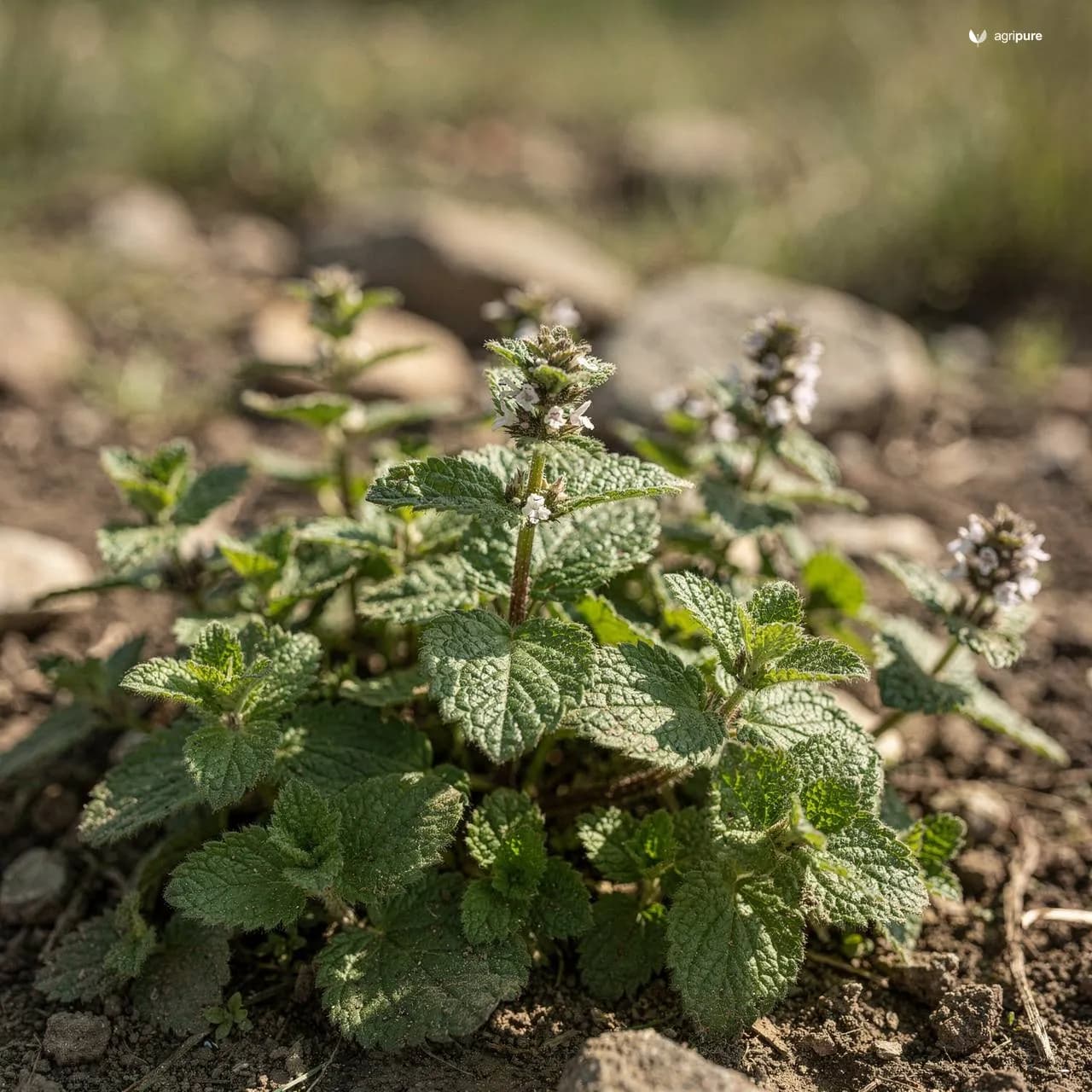
It is a herbaceous perennial that runs on a creeping rhizome, forming clonal patches rather than a single tidy clump. Stems are erect to creeping and typically 40 to 120 cm tall, with a habit generally more slender than its close relative M. longifolia. Flora of Pakistan calls it “the commonest mint in our area” and notes that some authors have reduced it to varietal rank under M. longifolia. The whole plant carries a strong, fresh mint to peppermint-like aroma, the quickest way to confirm it in the field.
How to identify Royle’s mint
Use this combination of features to tell it apart from other wild mints:425
- Habit: Aromatic, rhizomatous perennial forming spreading clonal patches; stems erect to creeping, 40 to 120 cm tall, slender.
- Leaves: Oblong-elliptical to lanceolate, usually narrowly oblong-elliptic, about 5 to 10 cm long and 1.5 to 3 cm broad. Often discolorous, green to grey-green above and white or white-woolly (villous) beneath, with surfaces thinly to densely hairy, and shortly stalked on a petiole up to about 8 mm.
- Flowers: Small, 3 to 5 mm long, lilac, purplish, or white, set in whorls (verticillasters) that form slender flower spikes, often interrupted toward the base. The calyces are about 1.5 to 2 mm, bell-shaped and sharply five-toothed, the corolla four-lobed, with four stamens protruding.
- Fruit: Small nutlets, typical of the mint family.
Against M. longifolia, the key contrasts are its more slender habit and its slender, interrupted flower spikes with the whorls well separated rather than crowded. Narrow, discolorous leaves that are white-woolly beneath, the strong mint scent, and the rhizomatous spread are the most reliable field marks.
Growing Royle’s mint
Like most mints, this is a plant of damp ground. In the wild it grows frequently in wet places (along watercourses, in damp meadows, and similar moist habitats), which tells you where it will be happiest on a homestead: the wet, low, or part-shaded corners where many crops struggle. It is naturally a high-elevation plant, typically recorded between about 2,700 and 3,350 m (roughly 9,000 to 11,000 ft) in the Himalaya, with some reports up to around 3,650 m. That mountain origin implies tolerance of cold winters and cool summers given ample moisture.
For propagation, lean on the plant’s own biology. As a rhizomatous perennial that forms clonal patches, it is naturally increased by lifting and dividing the rooted rhizomes and replanting them in moist ground; over time it knits into a dense, self-renewing mat.
The available botanical sources do not give species-specific figures for sowing dates, spacing, fertiliser, or time to harvest, so those are left out rather than stated with false precision. The sourced guidance is simple: treat it as a moisture-loving, cold-tolerant perennial mint, plant it in damp ground, and let the rhizomes do the work.
Harvest and uses
The aromatic leaf is the product. Royle’s mint is used as a culinary herb like other mints, and its leaves are generally regarded as edible. Because it is a perennial that spreads by rhizome and forms persistent patches, an established stand is a standing supply you cut from rather than a crop you resow each year. Beyond the kitchen it is also an important traditional medicinal plant across its native range, valued for the same pungent, aromatic foliage.
It flowers in summer into autumn, roughly July to October in Pakistan, producing the small lilac-to-white spikes described above, which, like other mint flowers, draw pollinating insects. Leaving some flowering stems uncut at the end of the season adds a pollinator resource alongside the culinary value.
Safety and cautions
While the leaves are generally regarded as edible like other mints, internal medicinal use should be approached cautiously. The sources note there are no modern clinical safety data specific to this species, and that mint oils can interact with some conditions and medications. Traditional medicinal use is well documented, but that is not the same as a proven, safe treatment; this profile makes no medical claims and gives no dosages. As a general principle, anyone pregnant or breastfeeding, or taking prescription medication, should seek qualified medical advice before using it medicinally. The other caution is horticultural: like other rhizomatous mints it spreads readily, so site it where you want it to run or contain it at a bed’s edge.
Sources
- Mentha royleana — Kiddle (summarising botanical databases)
- Mentha royleana — Flora of Pakistan (eFloras.org)
- Mentha royleana — Selina Wamucii plant profile
- Mentha royleana var. royleana — eFlora of India
- Kashmir Horsemint (Mentha royleana) — Flowers of India
Sourcing notes
The easiest start is a few rhizome divisions from an existing wild or garden stand, which are common across Punjab and the hills; plant into moist, part-shaded ground and it establishes quickly.