pioneer
Watercress
jal kumbhi
Nasturtium officinale
- pothohar
- kpk hills
International hardiness
- USDA 6-11
- RHS H5
- AU: Cool temperate, Warm temperate, Subtropical
Where it grows — regional guide
| Zones / rating | Regional notes |
|---|---|
USDA 6-11 | Hardy perennial aquatic green for cold clean springs; wild gathering near livestock carries dangerous liver fluke and bacterial contamination risks. |
| Zones / rating | Regional notes |
|---|---|
H5 (-15 to -10C) | RHS rating H7: traditional culinary salad herb grown in flowing watercress beds; never harvest from wild water near grazing stock due to liver fluke parasite risks. |
| Zones / rating | Regional notes |
|---|---|
Cool temperate, Warm temperate, Subtropical | Grown in clean garden water features and temperate aquatic beds; wild stream harvesting near sheep or cattle risks liver fluke parasite contamination. |
| Zones / rating | Regional notes |
|---|---|
USDA 6-11 (USDA scale) Canada uses its own zone system; Canadian zones run roughly one lower than USDA. | No region-specific data yet |
| Zones / rating | Regional notes |
|---|---|
Pothohar, KPK hills | Pakistan:Found along cool mountain streams and irrigation channels in KPK and Balochistan; avoid gathering downstream from livestock to prevent liver fluke infection. |
Grows alongside
Species that appear with Watercress in 14 of our published guides — a starting list for a guild, not a planting plan.
Watercress (Nasturtium officinale) is a perennial, aquatic herb in the mustard family, Brassicaceae, the same family as cabbage, mustard, and rocket. It grows rooted in fresh, flowing water and is harvested as a peppery leafy vegetable. The species is native to much of Europe and Asia and has spread far beyond that range, naturalising across North America, sub-Saharan Africa, the Americas and Caribbean, Australia, New Zealand, and some Pacific islands, often after being introduced deliberately as a salad green. For a homesteader with a clean spring, seep, or gently moving stream, it turns running water into a free, fast-regenerating crop that needs no bed and no tillage.
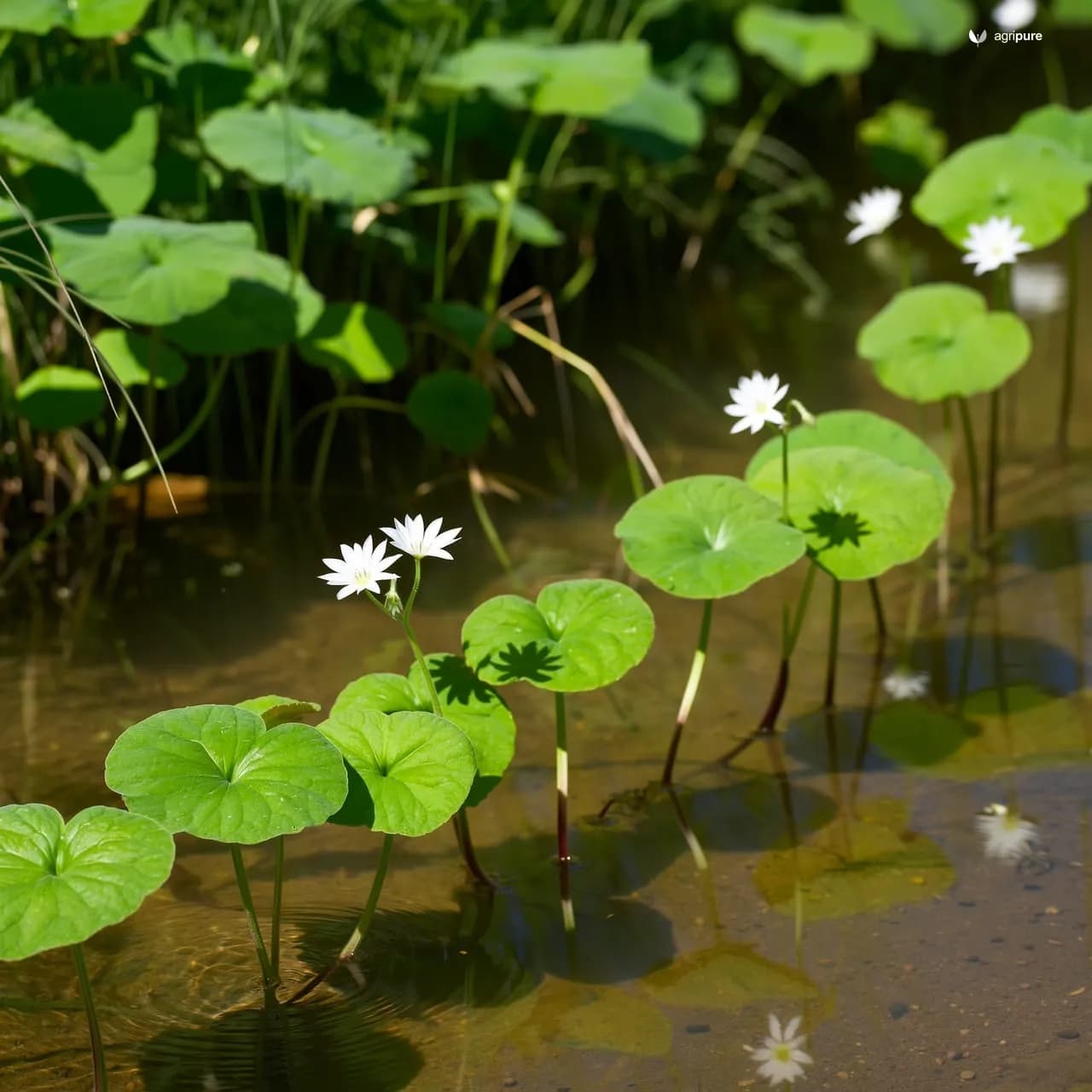
Watercress is a rooted, creeping-to-floating emergent perennial that forms dense mats along and within streams, springs, ditches, and other cool, flowing waters, sometimes spreading right across the surface. Plants typically stand 10 to 40 cm tall, reaching about 60 cm in the best conditions. The stems are hollow, round in cross-section, and branching, rooting readily at submerged nodes, which is what lets the plant float and spread so quickly. The leaves are pinnate and compound, made up of paired small oval to obovate leaflets with a larger terminal leaflet; they are dark green with rounded, sometimes bluntly toothed edges, may stand erect above the water or lie flat on the surface, and give off a pungent “cress” smell when crushed. From spring into autumn the plant carries small white four-petalled flowers, each up to about 4 mm across, in terminal racemes, followed by slender elongated pods (siliques) holding many tiny spherical seeds.
Growing watercress
Watercress is propagated very easily, which is much of its appeal. The most reliable route is vegetative: stems root at the nodes in water and detached pieces readily form new plants, so a handful of cuttings dropped into the right spot will establish on their own. Home and commercial growers commonly start it this way, rooting cuttings or bunches bought at the market. It can also be grown from seed, the small seeds produced in the long thin pods being sown into saturated soil or in trays kept standing in shallow water.
Water quality and movement matter more than soil for this crop. Watercress requires fresh, cool, well-aerated water and is found in springs, seeps, streams, wet ditches, and along shallow pond edges where the water moves gently over silty bottoms; it will not thrive in stagnant water. It is characteristic of clear, unpolluted streams and springs and does not tolerate heavy pollution. Because it overwinters in cold regions and behaves as a perennial in temperate climates, it is best understood as a cool-season, frost-tolerant aquatic perennial. Its documented distribution runs through all 48 contiguous U.S. states and north into Alaska, implying a broad hardiness range of roughly USDA zones 3 to 10 wherever suitable water is available; this zone span is inferred from its recorded occurrence rather than a formal zone listing.
Harvest and uses
Watercress is grown and foraged as a leafy vegetable, eaten for its sharp, peppery, mustard-family flavour. Because it grows as a fast-spreading mat that re-roots from its stems, a healthy stand gives a continuous cut-and-come-again supply through the cool season rather than a single harvest, and that vigour is why it is treated as a fast-growing weed where it has naturalised. The sources here do not give specific harvest dates, leaf size at cutting, or yield figures, so those are left out rather than invented.
How to identify it
Watercress is recognisable in and beside cool running water by a clear combination of features: a creeping, mat-forming aquatic perennial 10 to 40 cm tall (occasionally to about 60 cm); hollow, round, branching stems that root at submerged nodes; pinnate compound leaves with paired oval to obovate leaflets and a larger terminal leaflet, dark green with rounded, sometimes bluntly toothed edges and a pungent “cress” smell when crushed; small white four-petalled flowers up to about 4 mm across in terminal clusters from spring into autumn; and slender elongated seed pods. It is always found in gently moving, unpolluted water (springs, seeps, streams, wet ditches, and shallow pond edges) and never in stagnant water.
Safety and cautions
Watercress is a food plant, but harvesting it from the wild carries real cautions worth respecting.
- Waterborne contamination: The edible leaves sit in whatever water the plant grows in, so foraged watercress carries a risk of waterborne parasites and should only be gathered from clean, unpolluted sources; the plant does not tolerate heavy pollution, so murky or contaminated water is reason enough to leave a stand alone.
- Interactions: Sources note drug-interaction cautions associated with watercress, so anyone taking prescription medication should treat large or regular quantities with care and seek qualified advice.
- Invasiveness: This is a vigorous spreader, classified as invasive and recommended for eradication in some regions, so it should be grown in contained or managed water and never introduced to a wild waterway.
Sources
- Watercress (Nasturtium officinale) — Minnesota Wildflowers
- Foraging Guide: Watercress — The Foraging Course Company
- Watercress (Nasturtium officinale) Identification Guide — Totally Wild UK
- Ecological Risk Screening Summary: Watercress — U.S. Fish & Wildlife Service
- Watercress — Wikipedia
- Watercress — Missouri State University, Darr College of Agriculture