secondary
Catmint
billi booti
Nepeta cataria
Also known as Catnip (United States, UK & Ireland, Canada, Australia), Billi Booti (Pakistan).
- pothohar
- kpk hills
International hardiness
- USDA 3-9
- RHS H7
- AU: Cool temperate, Warm temperate, Mediterranean
Where it grows — regional guide
| Zones / rating | Regional notes |
|---|---|
USDA 3-9 | Fully hardy perennial across USDA zones 3 to 9; protects young plants from cats attracted to nepetalactone, and cut back spent flowers to limit self-seeding. |
| Zones / rating | Regional notes |
|---|---|
H7 (below -20C) | RHS rating H7: fully hardy perennial for cottage borders and bee forage; protect seedlings from neighbourhood cats that roll in it, and deadhead to curb spread. |
| Zones / rating | Regional notes |
|---|---|
Cool temperate, Warm temperate, Mediterranean | Grown in cool and warm temperate herb beds; nepetalactone attracts cats that can damage young plants, and deadheading is advised to prevent patch spread. |
| Zones / rating | Regional notes |
|---|---|
USDA 3-9 (USDA scale) Canada uses its own zone system; Canadian zones run roughly one lower than USDA. | A rugged, fully winter-hardy perennial dieback herb; protect small clumps from cats excited by nepetalactone, and trim seed heads to control garden spread. |
| Zones / rating | Regional notes |
|---|---|
Pothohar, KPK hills | Pakistan:Cultivated in cool Pothohar and KPK gardens as a hardy aromatic herb; protect new plantings from cats drawn to nepetalactone, and trim to keep clumps contained. |
Grows alongside
Species that appear with Catmint in 5 of our published guides — a starting list for a guild, not a planting plan.
Catnip (Nepeta cataria), also called catmint, is a short-lived perennial herb in the mint family (Lamiaceae) best known for the response it provokes in domestic cats. It is native to southern and eastern Europe, the northern Middle East, and Central Asia, and has naturalized widely across northern Europe, North America, and New Zealand, where it turns up on roadsides, field edges, woodland margins, and other disturbed ground. For a homesteader it is an undemanding, drought-tolerant herb that earns its place in the herb layer as a bee magnet, a folk tea plant, and the source of the aromatic leaves cats cannot resist — a tidy little cash and curiosity crop for the kitchen garden.
Description and identification
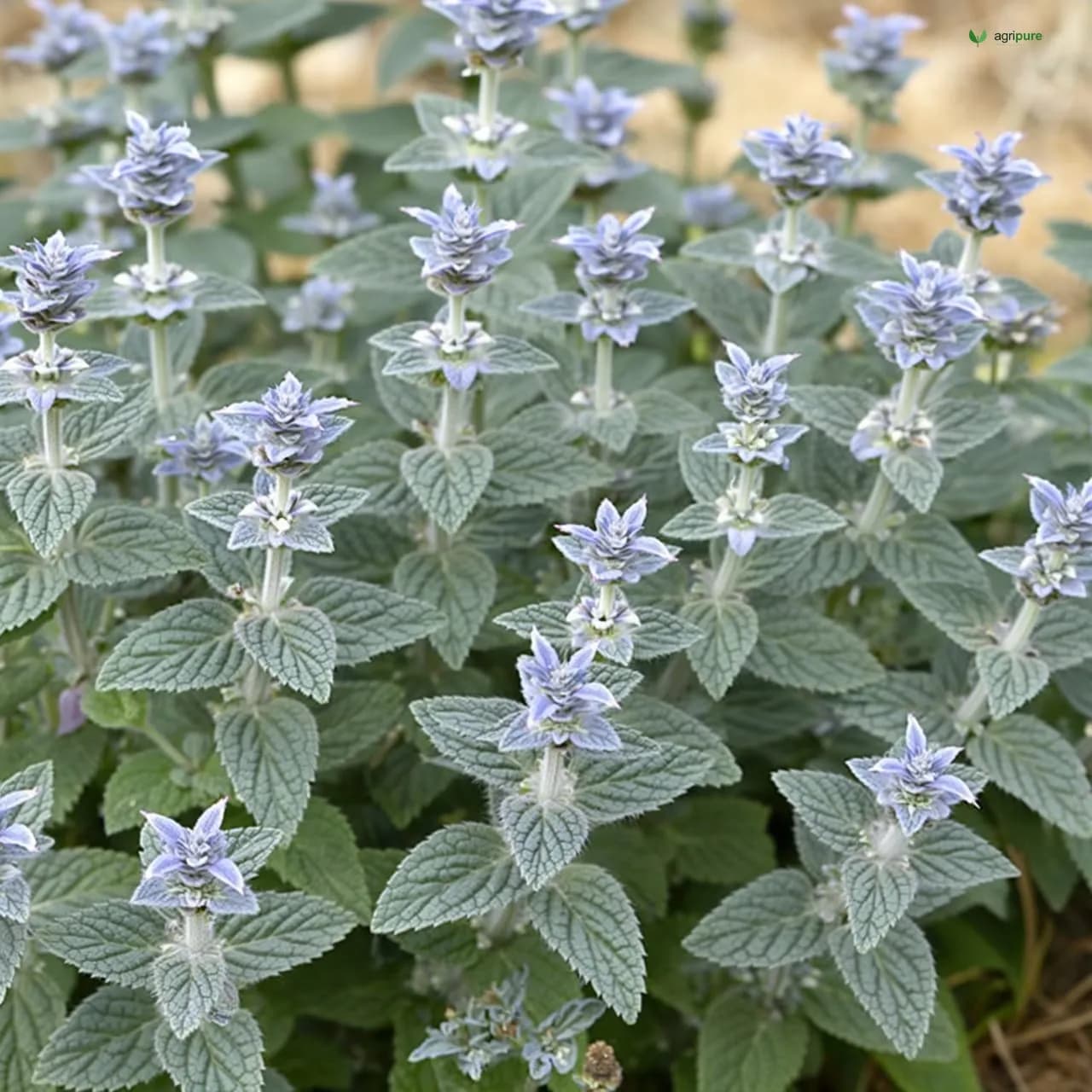
Catnip is a loosely branching, somewhat weedy plant that typically stands 30 to 100 cm (12 to 39 in) tall. Like other mints it has square stems, finely downy with soft hairs. The leaves are borne in opposite pairs, are greyish-green, heart-shaped to ovate with toothed margins, and are hairy — especially on the undersides — releasing a minty, herbal scent when crushed. The flowers form in terminal and upper-axillary spikes or branched cylindrical clusters about 2 to 4 inches long; each bloom is small, tubular, and two-lipped, usually white or pale lavender with small purple spots, and the plant flowers from late spring into early fall. Below ground it is a rhizomatous perennial that can spread from the rootstock. The combination of square stems, opposite grey-green toothed leaves, and pale spotted tubular flowers separates true *N. cataria from the showier blue-violet ornamental catmint cultivars.
Growing catnip
Catnip is hardy across roughly USDA zones 3 to 9, where it persists as a perennial that dies back in winter and regrows from the crown. It prefers full sun to partial shade and adapts to a wide range of soils — clay, loam, sandy, and rocky ground all work — provided drainage is good, since standing moisture invites root rot. Once established it is genuinely drought-tolerant, though it still appreciates a drink during long dry spells; let the soil dry slightly between waterings rather than keeping it constantly wet. Good air circulation around the plants helps keep fungal disease in check.
The easiest way to start a patch is from seed. Sow indoors 6 to 8 weeks before the last frost, or direct-sow outdoors once frost danger has passed. Use a well-draining seed-starting mix, scatter seed on the surface and cover it lightly with a thin layer of soil or vermiculite, and hold the mix at 65 to 70 °F (18 to 21 °C) with steady but not waterlogged moisture; germination usually follows in 7 to 10 days. Move seedlings outdoors once they have several true leaves. An established clump can also be divided in spring or fall: lift a mature plant, shake off loose soil, split the root mass so each piece carries both roots and foliage, and replant the divisions at their original depth. Set or thin plants to 18 to 24 in (45 to 60 cm) apart, as mature plants form bushy clumps roughly 2 to 3 ft (60 to 90 cm) tall and wide.
Harvest and uses
Harvest the leaves and flowering tops once plants are established; catnip is most fragrant when the foliage is crushed, and the same aromatic chemistry drives both its kitchen and feline uses. The plant’s signature compound is nepetalactone, the volatile responsible for the well-known behavioral response in many domestic cats. Dried leaves are the form most people associate with cat toys, while fresh or dried foliage has a long folk history as a mild, minty herbal tea. Beyond the house cat, the pale flower spikes are valuable forage: blooming from late spring into early fall, they offer a long, steady window of nectar and pollen for bees and other pollinators, which makes a few plants on a bed edge double as an insectary station. Because catnip reseeds readily and spreads from its rhizomes, shearing the flower spikes also keeps a patch from wandering further than you want.
Safety and cautions
Catnip’s defining trait is its effect on animals rather than people: the nepetalactone in its foliage triggers a strong behavioral response in many domestic cats. Site plantings with that in mind, as rolling, chewing cats will flatten young plants. The leaves have a long traditional use as a mild herbal tea, but this profile makes no medical claims for the plant and offers no dosage; anyone who is pregnant or breastfeeding, or who takes prescription medication, should seek qualified guidance before using any aromatic herb medicinally. Treat it as the gentle culinary-and-pollinator herb the sources describe, and let cats — not people — be its biggest fans.
Sources
- Catnip (Nepeta cataria) — Minnesota Wildflowers
- Catnip (Nepeta cataria) — Wikipedia
- Nepeta cataria, Catnip — First Nature
- Nepeta — NC State Extension Gardener Plant Toolbox
- Nepeta (Catmint) — University of California Agriculture & Natural Resources