secondary
Indian Wood-Sorrel (Yellow Sorrel)
khatti booti / amrul
Oxalis corniculata
Also known as Creeping Yellow Sorrel (UK & Ireland), Khatti Booti (Pakistan).
- punjab plains
- kpk hills
- pothohar
International hardiness
- USDA 4-11
- RHS H5
- AU: Tropical, Subtropical, Arid / semi-arid, Warm temperate, Cool temperate, Mediterranean
Where it grows — regional guide
| Zones / rating | Regional notes |
|---|---|
USDA 4-11 | A cosmopolitan, rapidly spreading weed in gardens; manage to prevent takeover, and eat only sparingly as soluble oxalates can contribute to kidney stones. |
| Zones / rating | Regional notes |
|---|---|
H5 (-15 to -10C) | RHS rating H5: aggressively spreading perennial weed of lawns; prevent garden takeover, and eat sparingly as oxalic acid can contribute to kidney stones. |
| Zones / rating | Regional notes |
|---|---|
Tropical, Subtropical, Arid / semi-arid, Warm temperate, Cool temperate, Mediterranean | Rapidly spreading creeping weed in gardens; manage stolons and seeds to prevent takeover, and eat sparingly as oxalates can trigger kidney stones. |
| Zones / rating | Regional notes |
|---|---|
USDA 4-11 (USDA scale) Canada uses its own zone system; Canadian zones run roughly one lower than USDA. | A persistently spreading weed across southern Canada; manage to prevent takeover, and avoid consuming in quantity due to soluble oxalates. |
| Zones / rating | Regional notes |
|---|---|
Punjab plains, KPK hills, Pothohar | Pakistan:A ubiquitous wild, aggressively spreading groundcover in moist orchards; prevent garden takeover, and eat leaves in strict moderation due to toxic oxalates. |
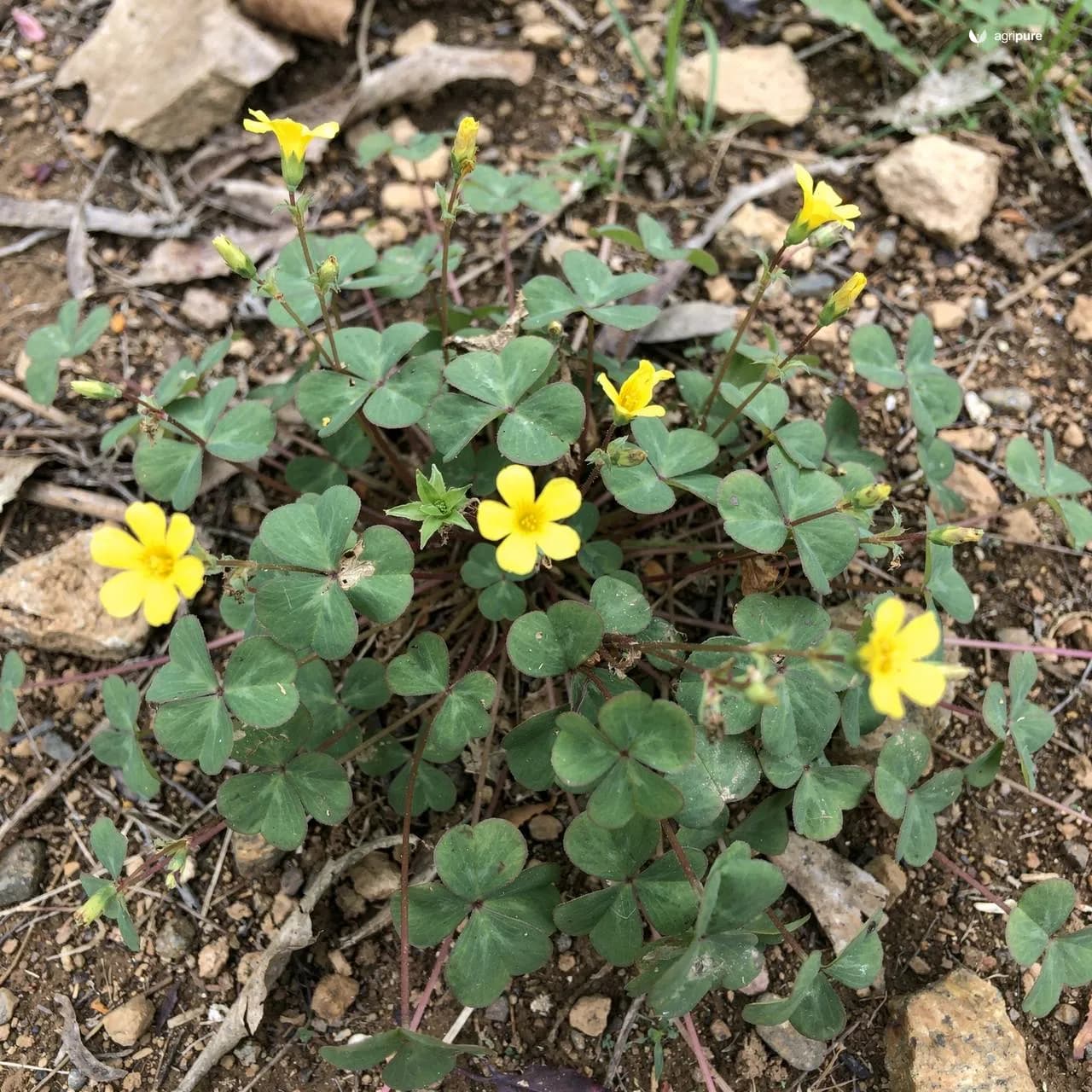
Creeping wood-sorrel (Oxalis corniculata), also called Indian wood-sorrel or creeping yellow wood-sorrel, is a low, mat-forming herb that turns up uninvited in gardens, lawns, paths, and damp corners almost everywhere people grow things. It is widely treated as a cosmopolitan weed of disturbed, open, and urban ground, and in North America it is introduced and naturalized rather than native, growing through most of the United States and Canada. For a homesteader the practical reality is twofold: it is a persistent volunteer you will likely never have to plant, and its lemon-tart leaves are a familiar nibble for foragers — though, as with all wood-sorrels, only in small amounts.
It is easy to recognize once you know the combination of traits. The plant is prostrate and creeping, sending out stolons that root at the nodes so a single plant slowly knits into a dense patch. The leaves are trifoliate: three small, heart-shaped leaflets that fold along a central crease, and the foliage ranges from green to a distinctive reddish-purple. The flowers are small and yellow, typically with five petals, and they are followed by the feature that gives the species its name: slender, elongated, cylindrical-to-horn-shaped seed capsules (corniculata meaning “little horned”). It is generally described as a perennial, though in disturbed settings it may behave as an annual or short-lived perennial.
Growing creeping wood-sorrel
It is worth being honest about what this plant is: the reliable references treat Oxalis corniculata as a weed rather than a deliberately sown crop, so there is no agronomic playbook of sowing dates, spacing, or harvest intervals to repeat. Rather than invent numbers, here is what the sources actually establish about how it grows and spreads.
- Propagation: It spreads two ways at once — vegetatively by stolons and rhizomes that root at the nodes, and by seed. The ripe capsules split and fling seed, which is a large part of why it appears in pots, seed trays, and cracks in paving without being planted.
- Site and soil: It is most at home in yards, gardens, lawns, and damp open ground, and on disturbed sites generally. It is adaptable across a wide range of open habitats, recorded from gardens and turf up into subalpine settings.
- Light and water: The provided sources do not give a dependable species-specific sun or watering requirement, so none is stated here rather than guessed.
- Hardiness: No reliable USDA hardiness zone is given for this species in the sources, so no zone is assigned; in practice its near-worldwide distribution reflects a broad tolerance of climates.
For most growers the question is not how to start it but how to live with it. Because it roots at the nodes and reseeds freely, hand-pulling catches the easy plants but leaves rooted fragments behind, so it tends to return — keep it out of seedling trays and nursery pots, where it competes hardest with young plants.
Harvest and uses
The edible parts are the leaves and flowers, which carry a bright, sour, lemony tang and are used in small quantities in salads and as a tart potherb. For a forager, one of the conveniences of this plant is its long season: the leaves and flowers are available for much of the year across its range. The sources do not provide verifiable cultivated-yield figures, so none are claimed — this is a wild green you gather, not a crop you measure by the basket.
Beyond the kitchen, the plant has a small record of other uses in the references. Indigenous use of the floral parts to make a yellow dye is documented. On the medicinal side, parts of the plant have been used in modern herbal practice for anti-inflammatory and anti-bacterial purposes, and there are ethnobotanical reports of indigenous use for complaints including hookworms, nausea, blood disorders, and wounds. These are traditional-use reports recorded in the sources, not evidence that the plant treats or cures anything, and they should be read that way.
Safety and cautions
The same compound that gives wood-sorrel its pleasant sourness is also the reason to eat it sparingly. Oxalis species, including creeping wood-sorrel, are considered low-toxicity poison plants because they can contain oxalic acid and soluble calcium oxalates. The grounded points from the sources:
- Toxic parts: Toxic potential is attributed to essentially the whole plant — the flowers, fruits, leaves, roots, sap or juice, seeds, and stems. One reference states that all parts have toxic potential and that serious effects are usually associated with large ingestions.
- Why moderation matters: The oxalates in the leaves and flowers can interfere with calcium absorption, and larger quantities may be harmful; USDA Forest Service guidance on a related Oxalis notes that eating large amounts may contribute to kidney stones.
- Who should be careful: People prone to rheumatism, arthritis, gout, or kidney stones may be affected adversely by oxalates and should be especially cautious.
The sensible takeaway is the one foragers already apply to wood-sorrels: a few tart leaves as a trailside nibble or a salad garnish are fine for most people, but it is not a green to eat by the bowlful, and anyone with oxalate-sensitive conditions should treat it with extra care. Any medicinal use should be approached cautiously for the same reason, and the sources here do not provide reliable, species-specific safety or interaction guidance to go further.
Sources
- Oxalis corniculata — North Carolina Extension Gardener Plant Toolbox (NC State Extension)
- Creeping Woodsorrel (Oxalis corniculata) — Hortsense, Washington State University Extension
- Oxalis (Wood-sorrel), Plant of the Week — USDA Forest Service
- Oxalis corniculata, Creeping Yellow Wood-sorrel — 10,000 Things of the Pacific Northwest
- Oxalis corniculata, Creeping Woodsorrel — Southwest Desert Flora
Sourcing notes
Volunteers freely in irrigated orchards, lawns, and shaded beds; no need to source it, and self-sown plants are easily lifted and moved into an understorey where you want the cover.