secondary
Jicama
jicama
Pachyrhizus erosus
Also known as Yam Bean (United States, Australia), Sankalu (India).
- punjab plains
- sindh coast
International hardiness
- USDA 10-12
- RHS H1c
- AU: Tropical, Subtropical
Where it grows — regional guide
| Zones / rating | Regional notes |
|---|---|
USDA 10-12 | Vigorous frost-sensitive climbing vine grown as a summer annual for crisp roots; above-ground seeds, pods, stems and leaves are poisonous and must never be eaten. |
| Zones / rating | Regional notes |
|---|---|
H1c (5 to 10C) | No region-specific data yet |
| Zones / rating | Regional notes |
|---|---|
Tropical, Subtropical | Grown as a warm-season root crop in tropical and subtropical gardens; only the peeled underground root is edible, while all leaves, pods and seeds are poisonous. |
| Zones / rating | Regional notes |
|---|---|
USDA 10-12 (USDA scale) Canada uses its own zone system; Canadian zones run roughly one lower than USDA. | No region-specific data yet |
| Zones / rating | Regional notes |
|---|---|
Punjab plains, Sindh coast | Pakistan:A warm-season climbing legume suited to the long hot summers of Punjab and Sindh; eat only the crunchy peeled tuber as all above-ground foliage and pods are toxic. India:Cultivated in tropical kitchen gardens for its juicy crunchy tuber; ensure all above-ground parts including pods, seeds and leaves are kept away from food as they are toxic. |
Grows alongside
Species that appear with Jicama in 1 of our published guides — a starting list for a guild, not a planting plan.
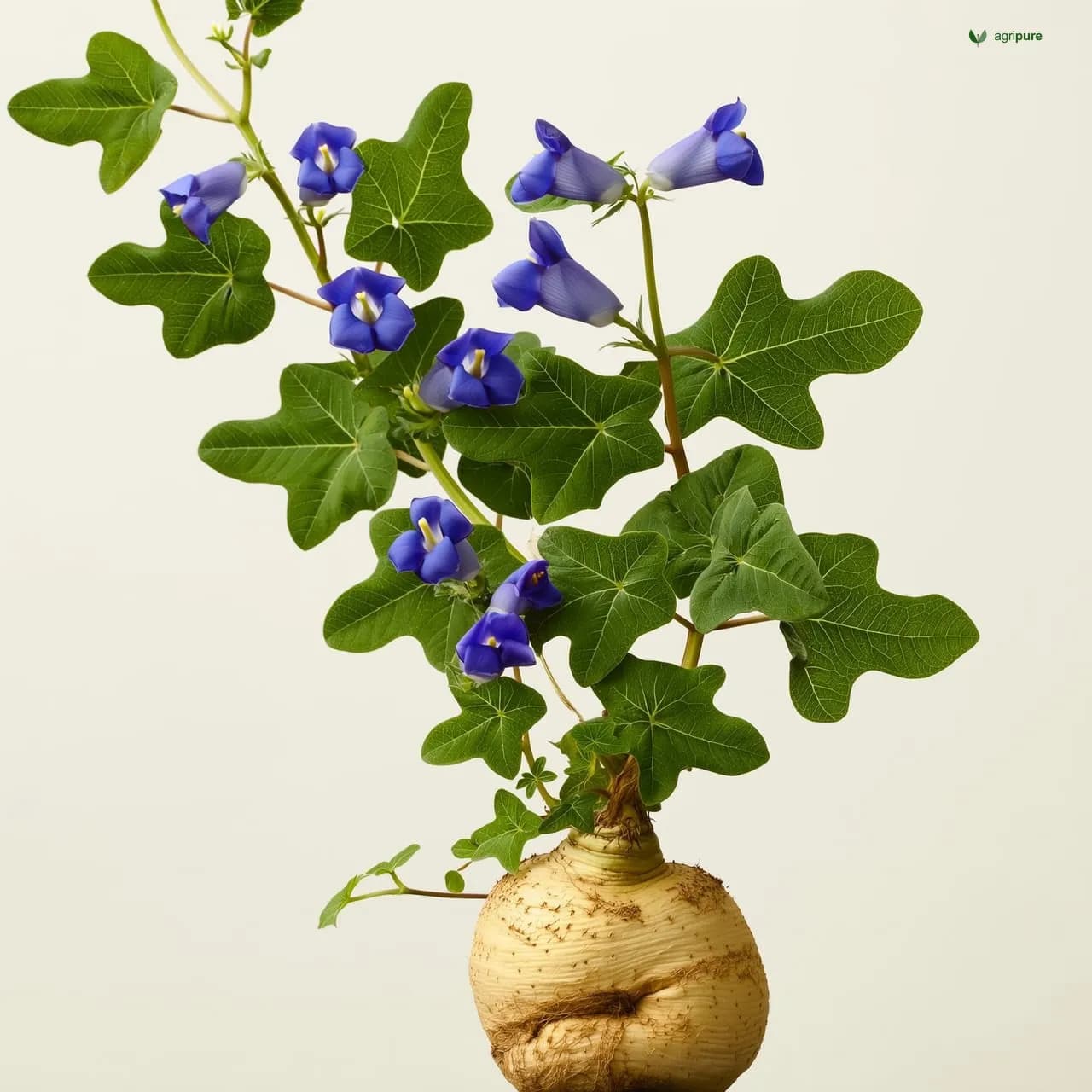
Jicama (Pachyrhizus erosus), also called yam bean, is a warm-season, frost-sensitive climbing legume in the family Fabaceae, grown for its large, crisp, edible tuberous root. It originated in the semi-arid tropics of Central America and Mexico and is Mesoamerican in origin, where it has long been a kitchen-garden root crop. From those origins its cultivation has since spread across much of tropical Asia and the warmer Americas. For a homesteader in a long, hot, frost-free season, the appeal is a single vigorous vine that yields one outsized starchy root prized for being eaten raw, crunchy and lightly sweet, much like a sweeter water chestnut.
Botanically, jicama is a vigorous perennial climbing herb, usually grown as an annual for its root, with twining stems and compound leaves. On fully developed plants the flowers are blue or white and are followed by pods resembling those of lima beans. Growers recognise two cultivated forms of the root: “jícama de agua,” a top-shaped to oblate root with translucent juice that is the form preferred in markets, and “jícama de leche,” an elongated root with milky juice. Only the starchy, crisp white root is the edible part; it is eaten raw or cooked. The seeds, pods, leaves, and stems are poisonous and must not be eaten.
Growing jicama
Jicama is a crop of warm, humid, tropical to subtropical climates, grown from sea level up to about 1,400 m altitude. It performs best with an optimal temperature range of about 20 to 28°C and moderate rainfall of roughly 1,500 mm a year, and it is sensitive to frost. Primary agronomic sources do not assign USDA hardiness zones directly; based on its frost sensitivity and its 20 to 28°C optimum, it corresponds to frost-free, warm-season conditions typical of roughly USDA zones 10 to 12 for year-round growth, and it can be grown as a summer annual in the warmer parts of about zones 8 to 9 wherever a five-to-nine-month frost-free period is available. This zoning is an informed climatic match, not a figure taken from the agronomic literature itself.
The crop is most commonly grown from seed, which needs about five to nine months of warm weather to produce large roots. There is a faster route: mature roots may be produced after roughly three months if the plant is started from small whole roots rather than from seed. Because jicama is a crop of warm, humid regions with moderate rainfall, it needs well-drained ground that does not waterlog, though the cited sources do not specify exact soil texture or pH ranges. Likewise, the reviewed sources describe it as a vigorous open-field and garden crop of warm climates but do not state a precise sun or spacing requirement, so no specific figure is given here beyond its adaptation to open, warm-climate cultivation. For water, it prefers areas of moderate rainfall, around 1,500 mm a year, and does best in a warm climate with that steady, moderate moisture.
Harvest and uses
Time to maturity depends on how the plant was started: about five to nine months from seed, or as little as three months from small whole roots. The roots are remarkably large. Under favourable conditions, in about five months they may reach 6 to 8 feet long and weigh 50 lb or more. The harvested portion is the crisp white root, which is eaten raw or cooked; raw, it is the form most people know, but it also takes well to cooking. The “jícama de agua” form, with its translucent juice, is the one preferred in markets, while the milky-juiced “jícama de leche” is the more elongated type.
Safety and cautions
Jicama carries an important edibility caution: only the root is safe to eat. The seeds, pods, leaves, and stems of the plant are poisonous and must not be eaten. When harvesting, keep the above-ground parts and the seeds well away from food and out of reach of children and livestock, and use only the peeled white root in the kitchen. Treat any seed saved for replanting strictly as planting stock, never as food.
Sources
- “Jicama (Pachyrhizus erosus).” – FooDB
- “Jicama (Pachyrhizus erosus).” – Growables
- Review of Pachyrhizus erosus – National Center for Biotechnology Information (PMC)
- “Pachyrhizus erosus.” – Wikipedia
- “Pachyrhizus erosus” (topic overview) – ScienceDirect