support
Blue Panic Grass
gharam / ghirib
Panicum antidotale
Also known as Bansi Ghaas (Pakistan).
- punjab plains
- sindh coast
International hardiness
- USDA 9-12
- RHS H2
- AU: Arid / semi-arid, Subtropical, Tropical
Where it grows — regional guide
| Zones / rating | Regional notes |
|---|---|
USDA 9-12 | Warm-season perennial bunchgrass for arid and subtropical rangelands; vigorous running rhizomes can invade cultivated ground, and use is restricted to animal feed. |
| Zones / rating | Regional notes |
|---|---|
H2 (1 to 5C) | No region-specific data yet |
| Zones / rating | Regional notes |
|---|---|
Arid / semi-arid, Subtropical, Tropical | Robust perennial forage grass for arid and tropical pastoral zones; spreads aggressively via deep rhizomes and is grown strictly for livestock grazing, not human food. |
| Zones / rating | Regional notes |
|---|---|
USDA 9-12 (USDA scale) Canada uses its own zone system; Canadian zones run roughly one lower than USDA. | No region-specific data yet |
| Zones / rating | Regional notes |
|---|---|
Punjab plains, Sindh coast | Pakistan:An established drought- and salt-hardy rangeland fodder grass across Punjab and Sindh plains; spreads strongly via rhizomes and is strictly for grazing livestock. India:Grown in semi-arid and saline pasture improvement trials in western plains; spreading rhizomes can invade cropland and the grass is grown solely for animal feed. |
Grows alongside
Species that appear with Blue Panic Grass in 1 of our published guides — a starting list for a guild, not a planting plan.
Blue panic grass (Panicum antidotale) is a robust, rhizomatous perennial grass grown chiefly as a forage crop in hot, dry, and salt-affected places. It is reported as native to the Indian subcontinent and to parts of Afghanistan, Iran, and Yemen, and it has since naturalized well beyond that range — in Australia, Brazil, northern Argentina, Hawaii, and the southern United States. For a homesteader working warm, difficult ground, it earns its place as a high-bulk, perennial pasture and rangeland grass that keeps producing where the heat and salinity defeat softer feed.
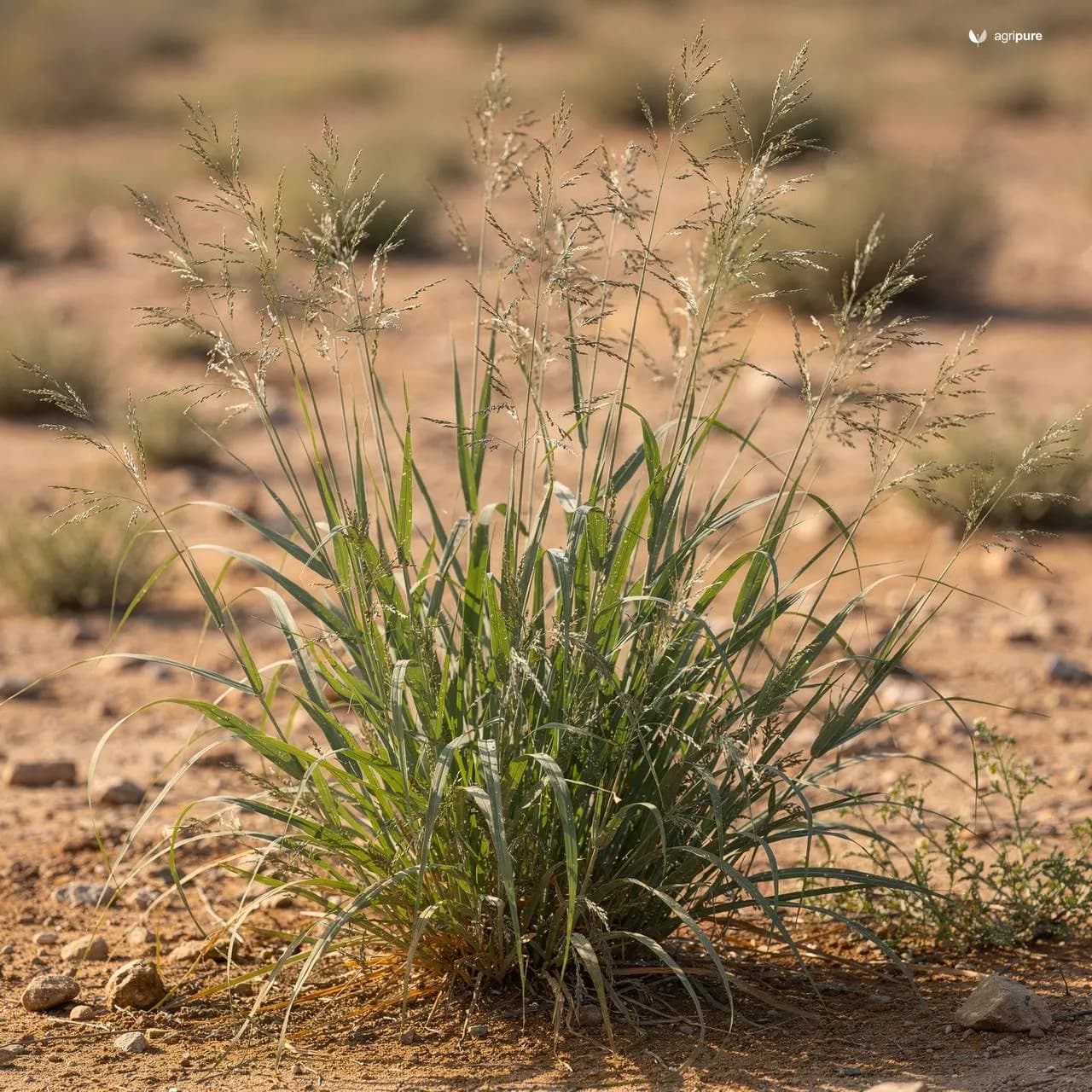
The plant is tall and clump-forming, reaching about 3 metres in height. Its culms are bluish and glabrous (hairless) with conspicuously swollen nodes, and it carries broad, lanceolate leaves. The seedhead is a branched panicle bearing small spikelets. Its rhizomatous, spreading habit is part of what makes it both a persistent perennial and a vigorous coloniser of open ground.
Growing blue panic grass
Blue panic grass is a warm-season perennial suited to hot and saline regions, which is the climate niche it is most often planted into. It can be propagated two ways: from seed, or vegetatively by dividing and planting its rhizomes. Nursery guidance reports that it prefers heavy, fertile, well-drained soils, and it is grown specifically for irrigated pastures and for rangeland improvement. In the wild and in cultivation it turns up in open, disturbed sites — roadsides, fields, irrigated pastures, and irrigation waterways — which is consistent with a grass that tolerates and even favours disturbed, actively managed settings.
The reputable sources gathered here do not give species-specific figures for sun exposure, plant spacing, or time to maturity for blue panic grass, so those details are deliberately left out rather than guessed at. Its repeated association with full-sun, open, irrigated ground does, however, point to a grass that wants warmth, light, and managed moisture rather than shade.
Harvest and uses
Blue panic grass is grown above all as fodder. It is described as an important forage crop and is noted as highly palatable to livestock. When it comes to cutting, the key lever on quality is growth stage: a feed-value study found that the crop’s quality and yield are both affected by maturity, and it recommends cutting the grass before flowering to improve yield and quality together under the conditions tested. In practical terms that means harvesting the stand while it is still leafy and pre-flower, rather than letting it run up to seed, to keep the best feed value.
The sources collected here do not supply a verifiable, species-specific numeric yield figure for blue panic grass, so none is invented. Beyond cut-and-carry or grazed forage, its main documented role is ecological and agronomic: it has clear potential for irrigated pastures and for improving rangelands, and it is valued precisely because it holds up under stress conditions such as heat and salinity where many pasture grasses fail. No reliable culinary, material, or medicinal use for this species is documented in the sources gathered, so those uses are not claimed here.
Where it grows and how to recognise it
To tell blue panic grass apart in the field, look for the combination of a tall, perennial clump up to roughly 3 metres, bluish hairless stems, distinctly swollen nodes, broad lance-shaped leaves, and an open, branched seed panicle of small spikelets. Its preference for warm, open, often-irrigated and disturbed ground — field edges, roadsides, channel banks, and managed pastures — is itself a useful habitat clue. Because it spreads by rhizome as well as seed, an established stand forms a persistent, sod-binding patch rather than scattered individual tufts.
Safety and cautions
Across the reputable sources reviewed here, there is no reliable report of toxicity or poisonous parts for Panicum antidotale. Equally, no species-specific medicinal use or human-safety data — dosages, interactions, or contraindicated groups — is documented in these sources, so none is stated. Because this plant is grown and discussed essentially as a forage grass rather than a food or medicine, any human-use claim should be treated with caution unless backed by direct food or toxicology data for this exact species. Note too that its vigorous rhizomatous spread and its readiness to colonise disturbed and irrigated ground mean it is recorded as naturalised well outside its native range; site it where a permanent, spreading grass is wanted rather than alongside clean-tilled beds.
Sources
- California Department of Food and Agriculture. “Panicum antidotale (blue panicgrass) Plant Risk Profile.” CDFA.
- Field Crops. Feed-value study of blue panic grass (Panicum antidotale). Journal of Field Crops.
- Native Seed Group. “Blue Panicgrass (Panicum antidotale).”
- EDDMapS. “Panicum antidotale (blue panicgrass).” Early Detection & Distribution Mapping System.
- NatureServe Explorer. “Panicum antidotale.”
Sourcing notes
Blue panic is an established rangeland fodder in Pakistan; seed and rooted slips are available through provincial range-management and livestock departments and from canal-bank stands.