pioneer
Desert Bunch Grass (Du’a Grass)
murat / gharam
Panicum turgidum
Also known as Murat (Pakistan), Thamam (Middle East & North Africa).
- sindh coast
- balochistan highlands
International hardiness
- USDA 9-11
- RHS H2
- AU: Arid / semi-arid
Where it grows — regional guide
| Zones / rating | Regional notes |
|---|---|
USDA 9-11 | No region-specific data yet |
| Zones / rating | Regional notes |
|---|---|
H2 (1 to 5C) | No region-specific data yet |
| Zones / rating | Regional notes |
|---|---|
Arid / semi-arid | No region-specific data yet |
| Zones / rating | Regional notes |
|---|---|
USDA 9-11 (USDA scale) Canada uses its own zone system; Canadian zones run roughly one lower than USDA. | No region-specific data yet |
| Zones / rating | Regional notes |
|---|---|
Sindh coast, Balochistan highlands | Pakistan:An indigenous drought- and salt-tolerant perennial bunchgrass of Sindh and Makran dunes; binds shifting desert sands and provides hardy livestock grazing. India:Native to the arid Thar desert tracts of Rajasthan; forms deep-rooted sand-binding tussocks that withstand prolonged drought and provide emergency forage. |
Grows alongside
Species that appear with Desert Bunch Grass (Du’a Grass) in 2 of our published guides — a starting list for a guild, not a planting plan.
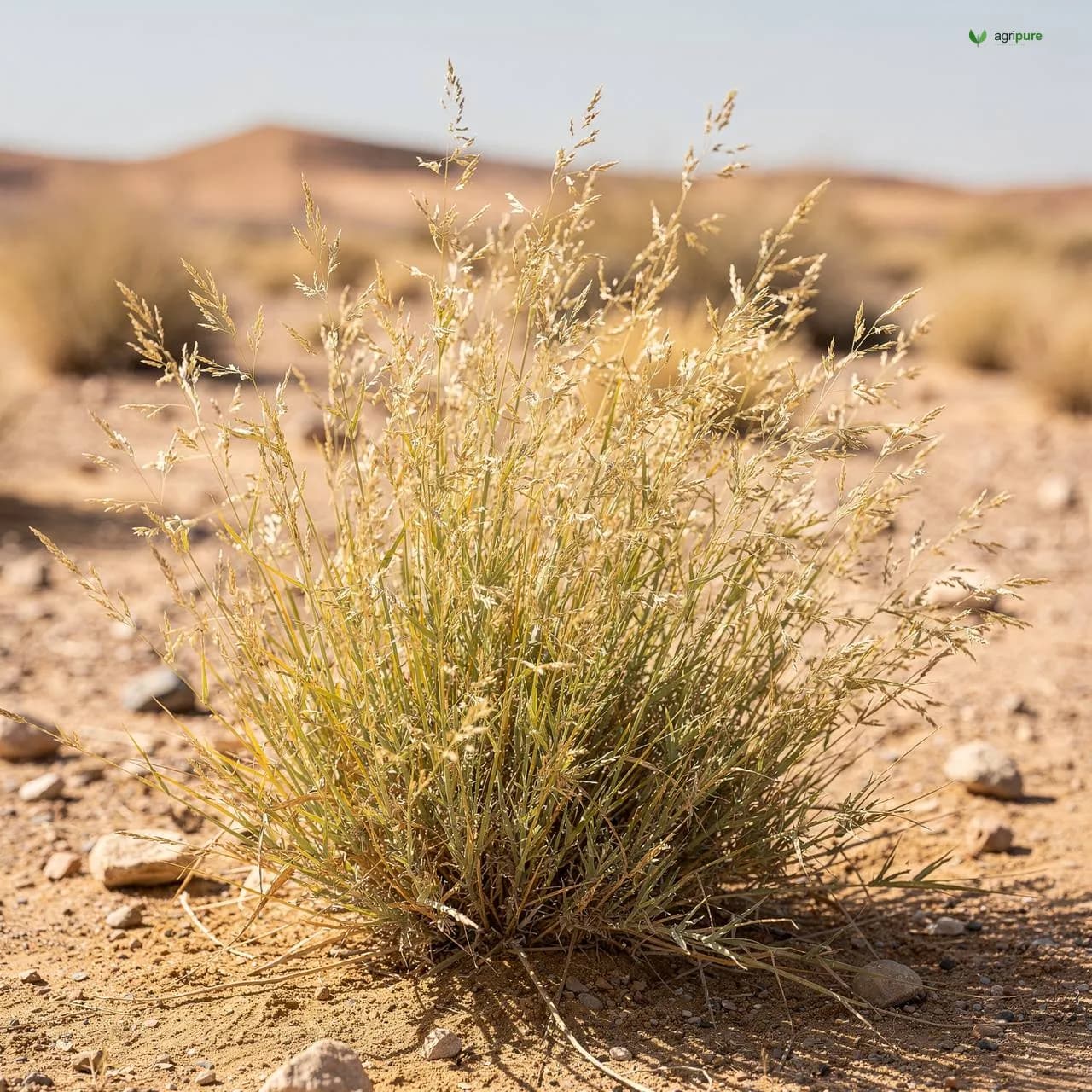
Desert bunch grass (Panicum turgidum), known by local names such as du’a, thamam, and taman, is a perennial, drought- and salt-tolerant grass of the hot deserts, often described as an old-world clumping desert bunchgrass. Its natural range runs from Mauritania and Senegal eastwards across the Sahara and Sahel to Sudan, Ethiopia, and Somalia, and on through northern Africa and western Asia as far as Pakistan and India. It is a defining plant of the Sahara and Arabian deserts, where it forms dense tussocks that catch blown sand and build hummocks, sometimes in nearly pure stands. For a homesteader working dry, sandy, or salty ground, it is a tough pioneer grass that anchors loose soil, feeds stock, and has even served as a famine grain.
It is a much-branched perennial that forms rounded tussocks, typically 1 to 1.5 metres tall and roughly as wide, occasionally reaching about 2 metres. The stems are long-jointed, hard, and polished, carry few leaves, and resemble bamboo shoots, while the plant is glaucous, with a bluish-green, waxy bloom. The inflorescence is a terminal panicle up to about 10 cm long, bearing solitary spikelets roughly 3 to 4 mm long. Below ground it has a thick rootstock and fibrous roots reaching up to 2 metres deep, covered in fine hairs to which sand adheres, giving them a felted look.
Growing desert bunch grass
This is an arid-climate grass, not a cold-hardy pasture species, so treat it as a tool for hot, dry, marginal ground. It is extremely drought tolerant and grows where annual rainfall is only about 200 to 250 mm or less, occurring naturally up to about 3,200 metres in altitude. It is both drought- and salt-tolerant, acting as an efficient salt excluder. No source assigns it a USDA hardiness zone; based only on its native range in hot deserts and its tolerance of low rainfall and high heat, it is best treated as suited to mild, frost-prone desert climates rather than cold ones, with no data available on its minimum temperature tolerance.
For soil, it favours sandy deserts and semi-deserts and sandy pockets within rocky outcrops, and it is also found on seashores and on latosols (deep, weathered tropical soils). It tolerates saline soils and catches moving sand to form hummocks. The practical takeaway is to give it open, well-drained, sandy ground and full desert sun, and not to expect it to perform on heavy or waterlogged sites.
Propagation is most reliably from seed: the plant produces panicles with spikelets and is used as a grain crop, which confirms it sets viable seed. Its thick rootstock and tussock-forming habit also make division of clumps plausible, though this is a horticultural inference rather than a documented method. The sources give no sowing protocol (depth, pre-treatments, germination time) and no consistent figures for spacing or time to maturity, so those are deliberately omitted rather than invented.
Harvest and uses
Desert bunch grass earns its keep several ways at once. Its most valued role is ecological: it is an important sand-catching plant that forms hummocks and is widely used for sand binding, making it a natural choice for holding shifting dunes and rehabilitating loose ground. Because it tolerates saline soils and excludes salt efficiently, it is specifically recommended for developing rangeland in saline, arid areas where more conventional forage grasses fail.
It is also livestock fodder on the dunes and plains where it dominates. On the human side, it is notable as a traditional famine grain: its seed has been gathered and eaten, which is unusual among desert grasses and worth knowing for anyone interested in resilient, low-input food plants. The hard, polished, bamboo-like stems are also used for thatch. In short, it is a multi-purpose desert grass: a soil stabiliser first, a fodder and thatch source second, and an emergency grain in hard years.
How to identify it
Several features combine to make Panicum turgidum recognisable among desert grasses:12
- Habit: A perennial, much-branched bunchgrass forming rounded tussocks about 1 to 1.5 metres tall and wide, sometimes to 2 metres.
- Stems: Long-jointed, hard, and polished, with few leaves, distinctly resembling bamboo shoots.
- Foliage: Glaucous, with a bluish-green, waxy bloom.
- Flowers: A terminal panicle up to about 10 cm long, with solitary spikelets roughly 3 to 4 mm long.
- Roots: A thick rootstock and fibrous roots to about 2 metres deep, coated in fine hairs that trap sand and look felted.
The sand-felted roots and polished, bamboo-like culms, set in nearly pure stands that build low sand hummocks, are the most reliable cues separating it from other dune grasses.
Sources
- Panicum turgidum — Wikipedia
- Panicum turgidum — PROTA (Plant Resources of Tropical Africa)
- Panicum turgidum salt tolerance study — PMC (National Library of Medicine)
- Panicum turgidum for saline rangeland — Plant Science Today
- Panicum turgidum — iNaturalist
- Panicum turgidum — Observation.org
Sourcing notes
Seed of wild desert stands is hard to source commercially in Pakistan; collect mature seed from local Sindh or Makran dune populations, or lift and divide established tussocks for revegetation work.