pioneer
Euphrates Poplar
bahan
Populus euphratica
Also known as Bahan (Pakistan).
- sindh coast
- punjab plains
International hardiness
- USDA 5-9
- RHS H6
- AU: Arid / semi-arid, Warm temperate, Cool temperate
Where it grows — regional guide
| Zones / rating | Regional notes |
|---|---|
USDA 5-9 | No region-specific data yet |
| Zones / rating | Regional notes |
|---|---|
H6 (-20 to -15C) | No region-specific data yet |
| Zones / rating | Regional notes |
|---|---|
Arid / semi-arid, Warm temperate, Cool temperate | Grown in arid and warm-temperate climates; it tolerates high heat, drought, and frost, establishing on brackish soils to provide wood and soil conservation. |
| Zones / rating | Regional notes |
|---|---|
USDA 5-9 (USDA scale) Canada uses its own zone system; Canadian zones run roughly one lower than USDA. | No region-specific data yet |
| Zones / rating | Regional notes |
|---|---|
Sindh coast, Punjab plains | Pakistan:A native riverine tree of the Sindh coast and Punjab plains; it tolerates seasonal flooding and brackish soils, providing wood and fodder on saline ground. |
Grows alongside
Species that appear with Euphrates Poplar in 1 of our published guides — a starting list for a guild, not a planting plan.
The Euphrates poplar (Populus euphratica) is a deciduous, salt- and drought-tolerant riparian tree of arid and semi-arid country, ranging from North Africa through the Middle East and Central Asia to western and north-western China. It is one of the few trees that holds its own along seasonally flooded, salty riverbanks, which is why land managers in dry regions reach for it: as fodder, timber, fuel, a soil-conservation tree, and a backbone of desert agroforestry. For anyone reclaiming a brackish floodplain or salt-scoured margin, it is a tree worth knowing.
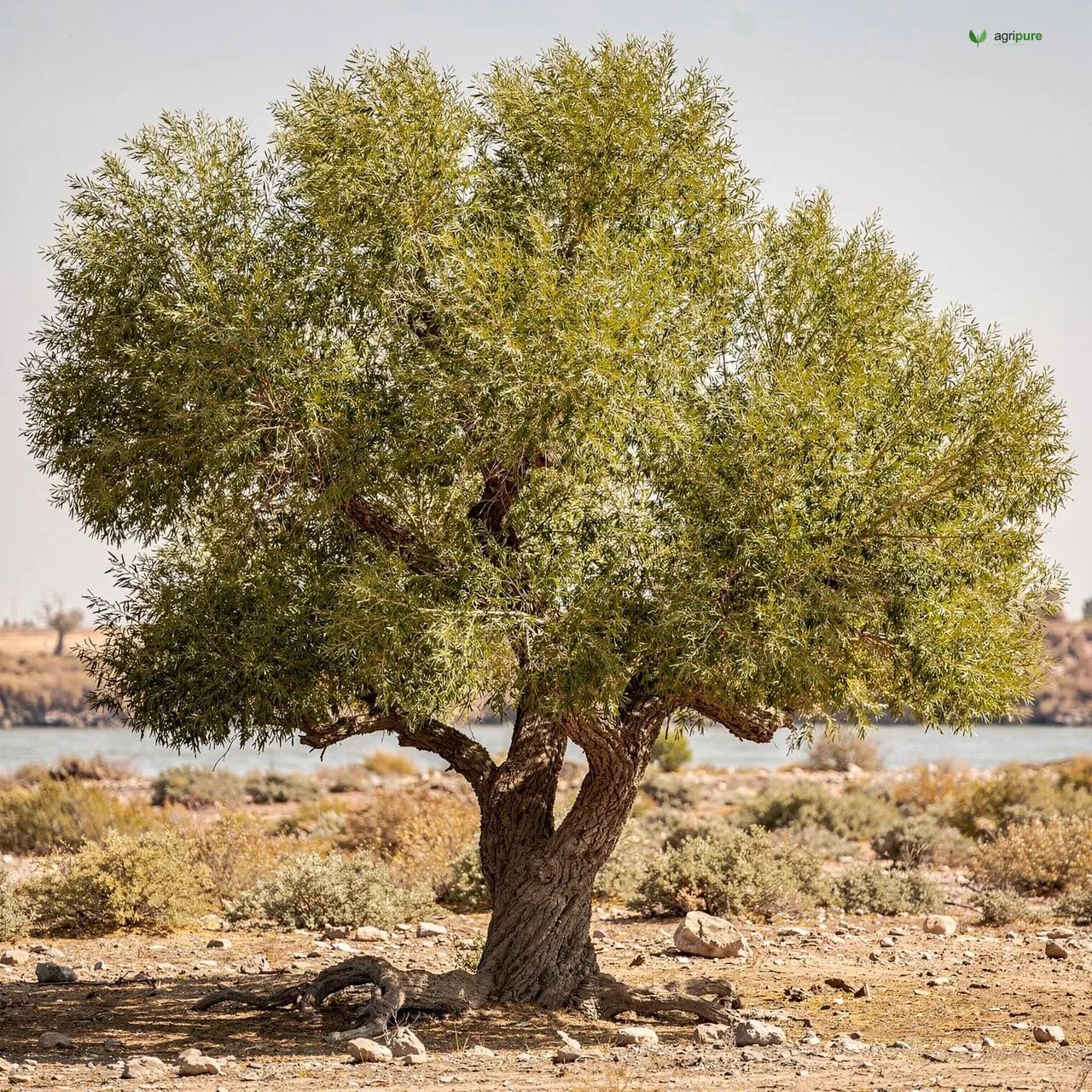
It is a medium to large tree, typically about 15 m tall and around 2.5 m in girth under favorable conditions, often with a bent, forked, or irregular stem rather than a clean trunk. Old stems carry a thick, rough, olive-green bark. The wood is distinctive: white sapwood with a red heartwood that darkens almost to black toward the center, moderately hard yet light, easy to saw, and finishing well. Its most memorable feature is the foliage: the species is “diversiform-leaved,” its leaves varying dramatically on the same tree, usually broader than long but some narrow enough to resemble eucalypt leaves in size, shape, and color. In autumn the canopy turns brilliant yellow to orange-yellow.
Growing Euphrates poplar
This is a tree of the floodplain, not the upland plot. In the wild it is the characteristic species of “Tugay” floodplain ecosystems along desert rivers, growing with willow, tamarisk, and mulberry on seasonally flooded land from the lowlands to about 4,000 m elevation. It tolerates saline and brackish water, is frequently found on saline soils, and is used to reclaim saline desert soils, setting it apart from almost any other timber tree.
It is adapted to arid and semi-arid climates with hot summers and cold winters, the continental pattern of Central Asia and interior China. At the National Arboretum Canberra, established trees tolerate frost to about -10 degC alongside high heat and drought. Primary sources do not assign explicit USDA hardiness zones; -10 degC sits roughly at the upper edge of USDA Zone 8a, and trees in the colder interior of its range likely endure lower temperatures, but precise zone ratings are not documented, so treat any zone figure as an approximation.
It helps to think about propagation the way the tree reproduces in nature. Its seeds are tiny and tufted with silky hairs for wind dispersal, but viability is short and germination rapid after they land, typical of poplars; the technical sources give no detailed nursery protocol. In the wild, regeneration happens mainly on fresh alluvial deposits along periodically flooded river margins, so the lesson is plain: this tree wants damp, freshly deposited riverine ground and a reachable water table, not a dry upland bed. Figures for spacing and time to maturity are not consistently documented, so they are left out rather than invented.
Harvest and uses
Euphrates poplar earns its keep across several roles at once. Its documented uses are fodder, timber, fuel, soil conservation, and desert agroforestry, with limited, traditional medicinal use of the bark. The moderately hard, light wood is easy to work to a good finish, making genuinely usable timber and fuelwood from a tree that establishes on ground too salty for most species. As a soil-conservation and reclamation tree, its real value is access: it makes salt-affected, flood-scoured margins productive and reclaims saline desert soils that would otherwise carry no tree. The technical sources give no yield figures, so none are stated.
How to identify it
Several features together make this poplar recognizable in the field:124
- Habit: A medium to large deciduous tree, up to roughly 15 m, often with a bent, forked, or irregular stem.
- Bark and wood: Thick, rough, olive-green bark on old stems; white sapwood over a red heartwood that darkens toward black at the center.
- Leaves: Strikingly variable on one tree, usually broader than long but sometimes narrow and willow- or eucalypt-like; yellow to orange-yellow in autumn.
- Flowers and fruit: Dioecious, with catkins on separate male and female trees, followed by small capsules holding tiny silky-haired seeds (see below).
- Setting: Found on seasonally flooded, often saline river margins in arid country, frequently with willow, tamarisk, and mulberry.
Pollination and reproduction
Euphrates poplar is dioecious, so male and female flowers occur on separate trees, borne in catkins (male 25 to 50 mm long, female 50 to 70 mm). Pollination is by wind, and fertilized female trees produce ovoid-lanceolate capsules 7 to 12 mm long, each filled with minute seeds carried on silky hairs. Because the species is dioecious, a stand needs both sexes present for seed to set, and the short seed viability means natural recruitment depends on those seeds reaching fresh, moist alluvium quickly. The tree is also described as very long-lived, with fossils of similar poplars dating back tens of millions of years, though an exact lifespan is not given.
Safety and cautions
Euphrates poplar is grown primarily for fodder, timber, fuel, and soil conservation rather than for human food, and the only medicinal application noted in the sources is a limited, traditional use of the bark. That traditional use is not a tested or standardized remedy, so the bark should not be treated as a verified medicine; the documented record gives no detailed preparation, dosage, or safety profile.
Sources
- Populus euphratica – Wikipedia
- Euphrates Poplar, Forest 74 – National Arboretum Canberra
- Populus euphratica (Euphrates poplar) – CABI Compendium
- Populus euphratica Olivier – Pl@ntNet
Sourcing notes
Propagate from hardwood cuttings off established riverine trees and plant into damp floodplain silt at the start of the growing season. Use it as a salt-tolerant bank-binder and nurse, then thin it as slower, less salt-hardy trees establish in its shelter.