climax
Wild Almond (Brahui Almond)
badam kohi
Prunus eburnea
Also known as Badam Kohi (Pakistan).
- balochistan highlands
International hardiness
- USDA 7-9
- RHS H4
- AU: Arid / semi-arid, Cool temperate
Where it grows — regional guide
| Zones / rating | Regional notes |
|---|---|
USDA 7-9 | No region-specific data yet |
| Zones / rating | Regional notes |
|---|---|
H4 (-10 to -5C) | No region-specific data yet |
| Zones / rating | Regional notes |
|---|---|
Arid / semi-arid, Cool temperate | No region-specific data yet |
| Zones / rating | Regional notes |
|---|---|
USDA 7-9 (USDA scale) Canada uses its own zone system; Canadian zones run roughly one lower than USDA. | No region-specific data yet |
| Zones / rating | Regional notes |
|---|---|
Balochistan highlands | Pakistan:A spiny, drought-hardy dwarf wild almond shrub native to the cold, stony Balochistan highlands; anchors exposed slopes and provides browse and edible kernels. |
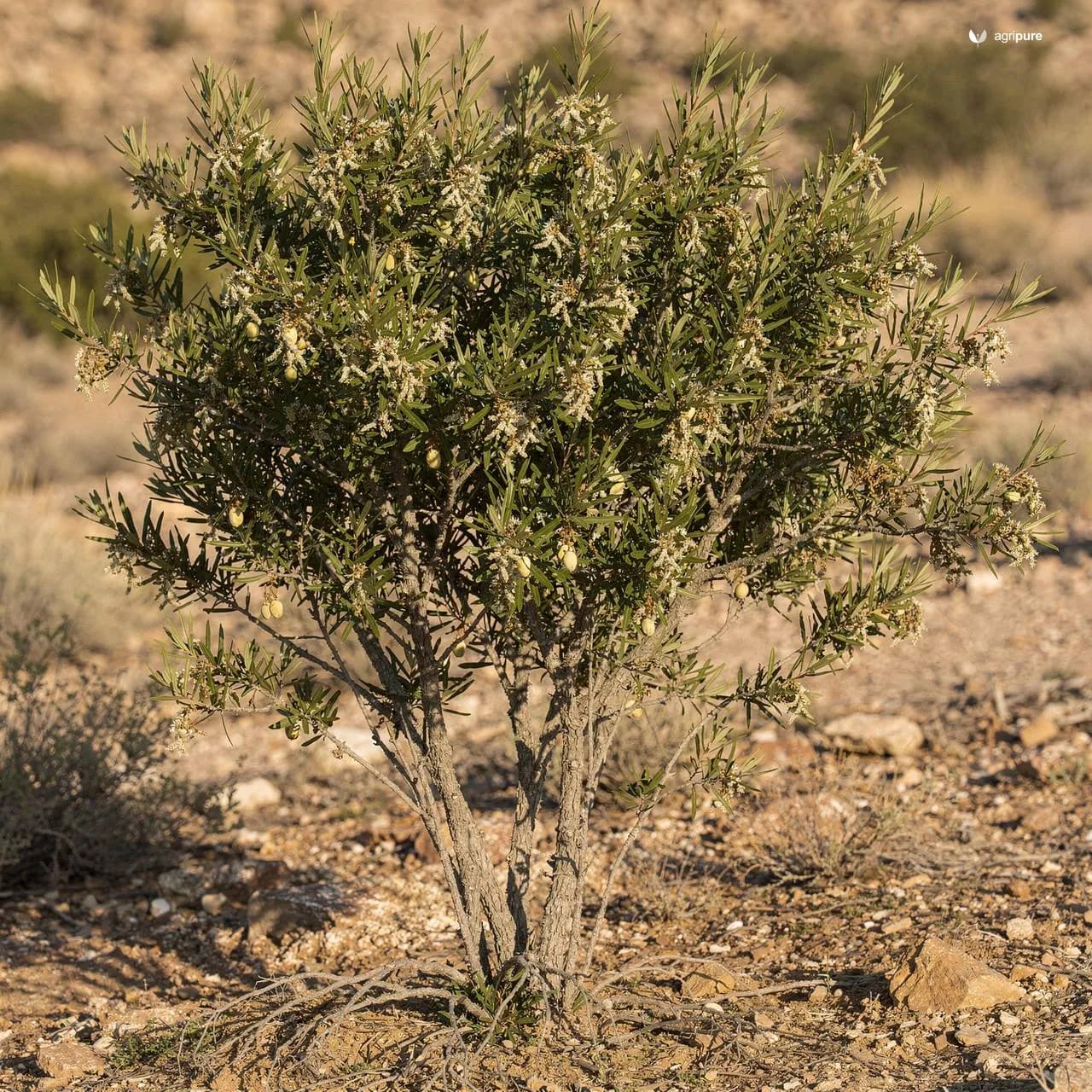
Wild almond (Prunus eburnea, badam kohi) is the spiny dwarf almond of the Balochistan uplands, scattered across the high, dry country around Ziarat and Loralai. It is a dense, low shrub of the cold highland slopes, its kernels gathered for food and its bushes browsed by stock in a landscape where little else grows. On a syntropic site in the highlands it is a climax-zone shrub: a slow, hardy component of the mature dryland community rather than a quick-return planting.
Where it thrives
Badam kohi is a wild almond native to Iran, Afghanistan, and Pakistan, accepted botanically as Prunus eburnea and first described as Amygdalus eburnea.1 It is a dense shrub, roughly 0.2 to 1.2 m tall, with grey bark and small lance-shaped leaves, built for the temperate, arid biome. In Pakistan it grows at higher elevations in Balochistan, where junipers and dwarf almonds are part of the upland scrub, on cold, dry, stony ground that defeats softer species. This is a plant of the high slopes, not of the plains or the irrigated valley floor.
Role in the system
In a highland guild, badam kohi belongs to the climax dryland scrub alongside the junipers, a slow, woody shrub that forms part of the stable upland cover rather than a pioneer you plant for an early return. Its value is its sheer toughness on cold, arid, low-fertility ground: it anchors thin soil on exposed slopes and persists where almost nothing else fruits. It carries a modest but real yield, almond kernels for people and browse for livestock, so it is a productive piece of the mature community as well as a soil-holding one. Read it as a long-horizon highland shrub: set it where the climate genuinely suits it and let it become part of the standing scrub.
Uses
The kernels are gathered and eaten, in the manner of other wild almonds of the region, and the bushes are browsed by sheep, goats, and camels on dry rangeland, while old and dead wood is fuel in a fuel-scarce landscape. Wild almonds like this are valued too as a genetic resource and a hardy rootstock relative of cultivated almond, which adds to the case for keeping the species on the land. For a highland plot, food, fodder, and fuel off a shrub that survives the cold and drought is the whole return.
Cautions
Wild almond populations in Balochistan are sparse and under pressure from deforestation and rangeland degradation, with declines noted in biodiversity assessments, and the species is treated as threatened across parts of its range. That argues for conservation alongside use: protect existing bushes from overbrowsing and overcutting, gather kernels and browse without stripping the stands, and treat any planting as restoration of the upland scrub. It is slow, so the work is patience and protection rather than a fast harvest.
Sources
- Plants of the World Online. “Prunus eburnea (Spach) Aitch.” Royal Botanic Gardens, Kew.
- Wikipedia contributors. “Prunus eburnea — description, distribution, and status.”
Sourcing notes
Badam kohi is propagated from seed collected in its Balochistan highland range. Populations are sparse and under grazing and cutting pressure, so gather seed from healthy wild stands, protect existing bushes, and treat planting as upland restoration on cold, dry sites.