climax
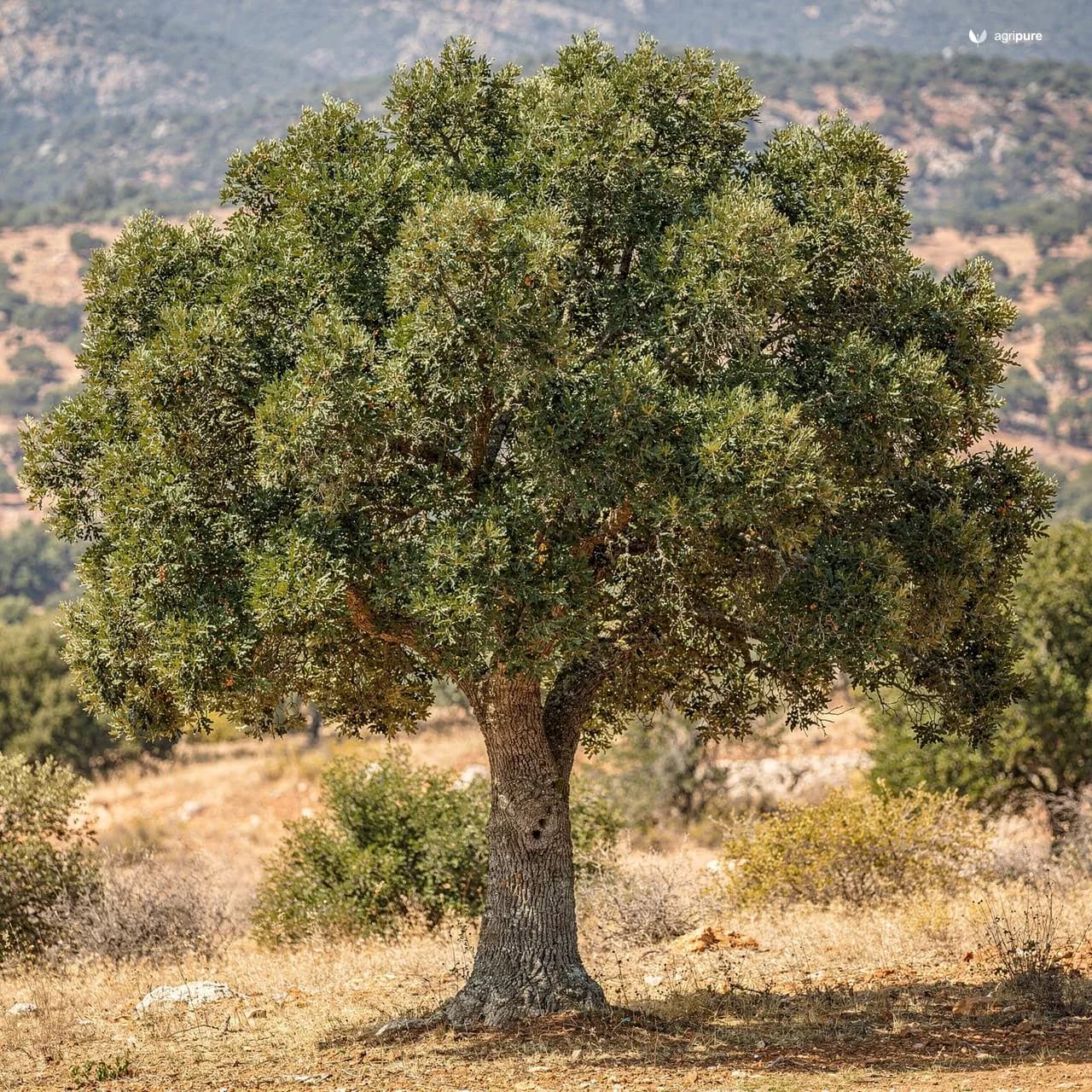
Baloot Oak (Holly Oak)
بلوط / بنج
Quercus baloot
Also known as Evergreen Oak (UK & Ireland), Holly Oak (United States), Baloot (Pakistan).
- kpk hills
- balochistan highlands
International hardiness
- USDA 7-9
- RHS H4
- AU: Arid / semi-arid, Cool temperate
Where it grows — regional guide
| Zones / rating | Regional notes |
|---|---|
USDA 7-9 | A perennial evergreen tree grown across USDA zones 7 to 9; it withstands coastal salt spray, but young acorns are toxic and mature acorns must be roasted before eating. |
| Zones / rating | Regional notes |
|---|---|
H4 (-10 to -5C) | Hardy at RHS H4 and tolerant of coastal salt spray in southern Britain; young acorns can be toxic, so roast and process only mature acorns for eating. |
| Zones / rating | Regional notes |
|---|---|
Arid / semi-arid, Cool temperate | No region-specific data yet |
| Zones / rating | Regional notes |
|---|---|
USDA 7-9 (USDA scale) Canada uses its own zone system; Canadian zones run roughly one lower than USDA. | No region-specific data yet |
| Zones / rating | Regional notes |
|---|---|
KPK hills, Balochistan highlands | Pakistan:An evergreen oak of dry temperate KPK hill tracts and Balochistan valleys; provides durable wood and fodder, but young acorns are toxic and must not be eaten raw. |
Grows alongside
Species that appear with Baloot Oak (Holly Oak) in 1 of our published guides — a starting list for a guild, not a planting plan.
Quercus baloot (Griffith’s oak, locally called baloot or banj across Chitral, Dir, Swat, Kohistan, Kurram, and Waziristan) is a slow-growing evergreen tree of the Fagaceae family native to the dry temperate Hindu Kush, Karakoram, and western Himalayan ranges at elevations between 1,200 and 3,000 metres. Reaching 8 to 15 metres in height with a dense, rounded crown and rugged grey-brown bark, it forms the foundational sclerophyllous oak woodland belt of northern Pakistan and eastern Afghanistan.
Botanical profile and dry-temperate ecology
Adapted to winter-snow and summer-drought regimes receiving 350 to 800 mm of annual precipitation (predominantly as winter and spring snow and rain), Quercus baloot develops a deep, rock-penetrating taproot that anchors fractured slate, limestone, and granite slopes. Its coriaceous, holly-like leaves (2.5 to 7 cm long) bear stiff marginal spines on juvenile and lower-canopy shoots to deter browsing, while upper-canopy foliage on mature trees is often entire or weakly toothed.
Syntropic agroforestry and mountain livelihood roles
In dry-temperate mountain farming systems across KPK, Gilgit-Baltistan, and northern Balochistan, Quercus baloot is a long-lived climax stabilizer and winter fodder bank. Properly managed on rotational lopping cycles of 3 to 4 years, mature trees provide essential winter browse for goats and cattle when alpine pastures are snowbound, alongside dense leaf litter that builds high-carbon forest-floor humus.
- Elevation and climate: Dry-temperate valleys and steep rain-shadow slopes from 1,200 m to 3,000 m; tolerates winter minima down to -15°C to -20°C (USDA Zones 7–9, RHS H5).
- Fodder management: Limit winter branch lopping to less than one-third of the live crown every 3–4 years so trees continue setting acorns and regenerating canopy foliage.
- Tannin caution: Young flush leaves and raw acorns contain hydrolysable tannins; feed lopped foliage as part of a mixed winter ration rather than the sole forage source.
- Propagation: Sow fresh acorns in autumn or early spring in deep root-trainer tubes (30 cm+ depth) because the radicle elongates rapidly before shoot emergence.
Sources
- Nasir, E. & Ali, S.I. (Eds.). Flora of Pakistan, No. 104: Fagaceae (Quercus baloot Griff.). Pakistan Agricultural Research Council / University of Karachi.
- Champion, H.G., Seth, S.K. & Khattak, G.M. (1965). Forest Types of Pakistan: Dry Temperate Forests (Quercus baloot — Pinus gerardiana belt). Pakistan Forest Institute, Peshawar.
- Royal Botanic Gardens, Kew. Plants of the World Online: Quercus baloot Griff.
Sourcing notes
Propagate from fresh acorns collected in autumn; oak does not store or transplant as easily as conifer stock, so sow promptly. Protect seedlings from grazing, which is the main barrier to regeneration in its home range.