pioneer
Golden Himalayan Raspberry
aakhe
Rubus ellipticus
Also known as Aakhe (Pakistan), Yellow Himalayan Raspberry (United States, Australia).
- kpk hills
- pothohar
International hardiness
- USDA 8-10
- RHS H4
- AU: Cool temperate, Warm temperate, Subtropical
Where it grows — regional guide
| Zones / rating | Regional notes |
|---|---|
USDA 8-10 | Restricted in Hawaii where it is a declared severe target weed; check local weed restrictions before planting, as bird-spread seeds and shoots invade native forests. |
| Zones / rating | Regional notes |
|---|---|
H4 (-10 to -5C) | No region-specific data yet |
| Zones / rating | Regional notes |
|---|---|
Cool temperate, Warm temperate, Subtropical | Suited to warm-temperate and subtropical hill gardens for edible yellow fruit; check local weed restrictions and contain roots, as it spreads rapidly into native bush. |
| Zones / rating | Regional notes |
|---|---|
USDA 8-10 (USDA scale) Canada uses its own zone system; Canadian zones run roughly one lower than USDA. | No region-specific data yet |
| Zones / rating | Regional notes |
|---|---|
KPK hills, Pothohar | Pakistan:A vigorous native bramble of the KPK hills and Pothohar clearings; bears sweet golden berries, but check local weed restrictions and manage its aggressive spread. India:Native across the temperate Himalayas; prized for sweet wild yellow fruit, but it forms thorny thickets that can spread aggressively into open and disturbed ground. |
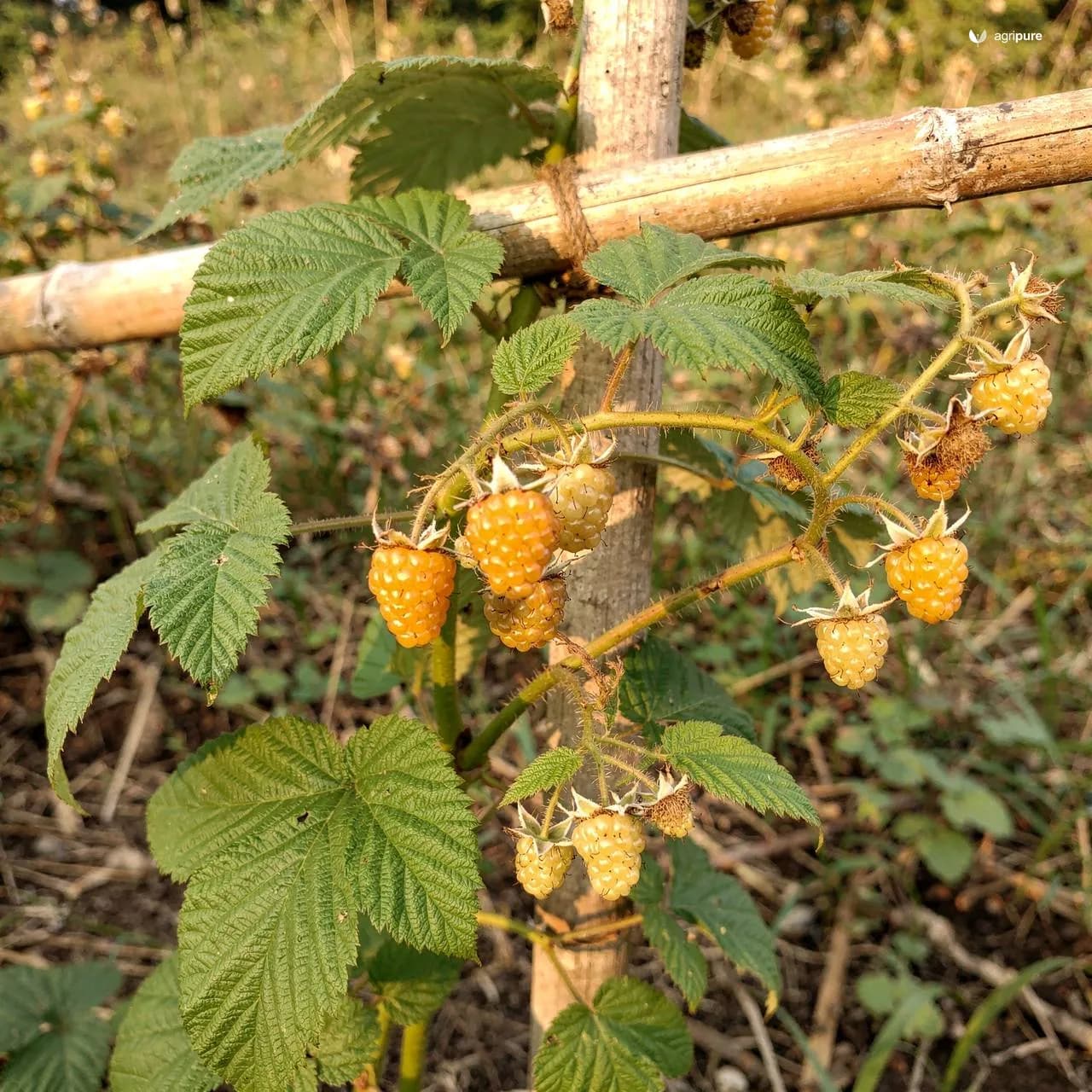
Golden Himalayan raspberry (Rubus ellipticus) is a thorny, fruit-bearing bramble in the rose family, gathered for its clusters of edible yellow raspberries. It is native to the temperate Himalayas and surrounding regions of South and East Asia, where it has a long history of use as a wild food and folk medicine. For a homesteader it is a double-edged plant: a fast, undemanding shrub that throws sweet early fruit and dense thorny cover, but one that spreads aggressively enough to be a serious weed where it escapes — so it belongs on a deliberate, managed edge.
It is a perennial, prickle-armed shrub or scrambling bramble, typically reaching about 2 m tall in the wild; some nursery sources claim larger plants, but botanical floras commonly describe it as a shrub to roughly 2 m. The stems carry prickles and reddish hairs. Leaves are alternate and compound, each with three rounded-to-blunt leaflets roughly 5–10 cm long, dark green above and distinctly paler and downy-hairy beneath; a Hawaiian weed profile describes them as elliptic to obovate, about 4–8 by 3–6 cm, with purplish-red bristles along the veins. The flowers are small and white with five petals, with flowering recorded in February–April in parts of the Himalayan range. The fruit is a true aggregate “raspberry” (a round yellow cluster of drupelets that detaches cleanly from the receptacle, just as a cultivated raspberry does) and is described as edible across multiple floristic treatments.
Growing golden Himalayan raspberry
This is a low-input plant that propagates very readily, which is both its strength and its hazard. It reproduces freely by seed, dispersed mainly by fruit-eating birds, and spreads vegetatively through underground shoots, letting it regenerate fast after disturbance including fire; a Hawaiian invasive-species profile records it as a perennial propagated both vegetatively and by direct seeding. For homestead purposes, ripe cleaned seed germinates reliably, and root suckers and layered stems are practical ways to start new plants — though no controlled germination studies are given in the sources here.
On site conditions, the sources point to a tolerant, adaptable plant:
- Soil: Prefers moist but well-drained soils; in the wild it thrives in disturbed forest soils, including volcanic ground. No specific pH optimum is given in the cited sources.
- Sun: Unusually flexible — described as adapted to complete shade as well as full sun, colonizing both forest understory and open, disturbed sites.
- Water: Its occurrence in moist forest and preference for moist-but-drained soil point to consistent soil moisture without waterlogging; it tolerates some seasonal dryness, but no precise drought figures are cited.
- Climate: Originates in the temperate Himalayas and, in Hawaiʻi, occupies mesic to wet montane forest and disturbed habitat — showing it can take warm, moist, lower-montane to subtropical conditions.
Plant spacing, sowing dates, and a firm time-to-maturity figure are not documented in the sources here, so they are left out rather than invented. The management point the sources do support is that this shrub forms dense, impenetrable thorny thickets, so plan for vigorous spread and cut it back hard rather than letting it run.
Harvest and uses
The harvest is the fruit: round, golden-yellow raspberries that come away cleanly from the receptacle when ripe — the standard cue that a raspberry is ready to pick. They are eaten fresh and valued as a wild food across the plant’s native range, and the species also carries a record of traditional medicinal use in South and East Asia, though the sources here do not detail preparations. The other practical yield is service rather than food: the dense, prickly growth makes effective thicket cover and a living thorn barrier. No reliable yield figure appears in the sources here, so none is stated.
Safety and cautions
The fruit itself is documented as edible in multiple floristic and invasive-species sources, so the berries are a recognized wild food; the real caution with this plant is ecological rather than toxicological. Its vigour is a liability outside its home range: Rubus ellipticus is a recognized aggressive invasive in several subtropical and tropical highland regions, notably Hawaiʻi, where it is treated as a target weed and managed for biocontrol. Bird-dispersed seed carries it far from the original planting, and its underground shoots let it resprout after cutting, mowing, or fire, so casual control often makes thickets denser rather than clearing them. While the species has a history of traditional medicinal use, this profile makes no medical claim and gives no dosage; treat any folk-medicine use as outside the scope of these sources. Before planting, check whether it is listed as a noxious or invasive species in your area (in many places it should not be introduced at all), and where it is permitted, keep it confined and cut back so it does not escape onto productive ground or surrounding wild land.
Sources
- Rubus ellipticus — Wikipedia
- Yellow Himalayan Raspberry — Flowers of India
- Pest of the Month: Yellow Himalayan Raspberry — University of Hawaiʻi at Hilo
- Rubus ellipticus / Rubus niveus biocontrol — Hawaiʻi DLNR, Hawaiʻi Invasive Species Council
- Rubus ellipticus — iNaturalist
Sourcing notes
Easily raised from seed or by layering and root suckers, and usually established from wild plants already growing on hill clearings in KPK and the Pothohar. Site it where its thicket-forming vigour is welcome, because it spreads readily once in.