secondary
Potato
aaloo
Solanum tuberosum
Also known as Aaloo (Pakistan).
- punjab plains
- pothohar
- kpk hills
International hardiness
- USDA 8-11
- RHS H3
- AU: Cool temperate, Warm temperate, Mediterranean, Subtropical
Where it grows — regional guide
| Zones / rating | Regional notes |
|---|---|
USDA 8-11 | Grown as a cool-season annual crop in USDA zones 3 to 11; hill plants to block sunlight from tubers, as green skins and all foliage contain poisonous solanine. |
| Zones / rating | Regional notes |
|---|---|
H3 (-5 to 1C) | Hardy to RHS H3, it is an allotment staple grown from seed tubers in spring; hill soil around stems to prevent tubers from greening and developing toxic solanine. |
| Zones / rating | Regional notes |
|---|---|
Cool temperate, Warm temperate, Mediterranean, Subtropical | Planted during cool or mild seasons across temperate and Mediterranean zones; keep tubers covered with soil or mulch to prevent poisonous solanine formation. |
| Zones / rating | Regional notes |
|---|---|
USDA 8-11 (USDA scale) Canada uses its own zone system; Canadian zones run roughly one lower than USDA. | Cultivated as a reliable cool-season staple across short northern summers; hill soil over developing tubers to stop sunlight from triggering toxic solanine accumulation. |
| Zones / rating | Regional notes |
|---|---|
Punjab plains, Pothohar, KPK hills | Pakistan:A major rabi and hill-tract staple across Punjab and the KPK hills; hill earth around tubers to prevent greening, as green parts contain toxic solanine alkaloids. India:A vital cool-season rabi field and garden vegetable; keep tubers deeply hilled to block sun exposure, since green skin and shoots carry toxic glycoalkaloids. |
Grows alongside
Species that appear with Potato in 61 of our published guides — a starting list for a guild, not a planting plan.
The potato (Solanum tuberosum) is a cool-season, tuber-forming member of the nightshade family (Solanaceae) grown around the world as a staple food crop, alongside wheat and rice. It is native to South America, specifically the Andean and Chilean regions, with a range taking in parts of Argentina, Bolivia, Chile, Peru, Colombia, Ecuador, and Venezuela; the modern cultivated plant traces back to Andean and Chilean landraces developed by pre-Columbian farmers. For the homesteader, its appeal is hard to beat: a single planting of seed tubers in cool spring soil yields a dense, storable crop of calories from a small footprint, and the cues for when to dig are read straight off the plant rather than the calendar.
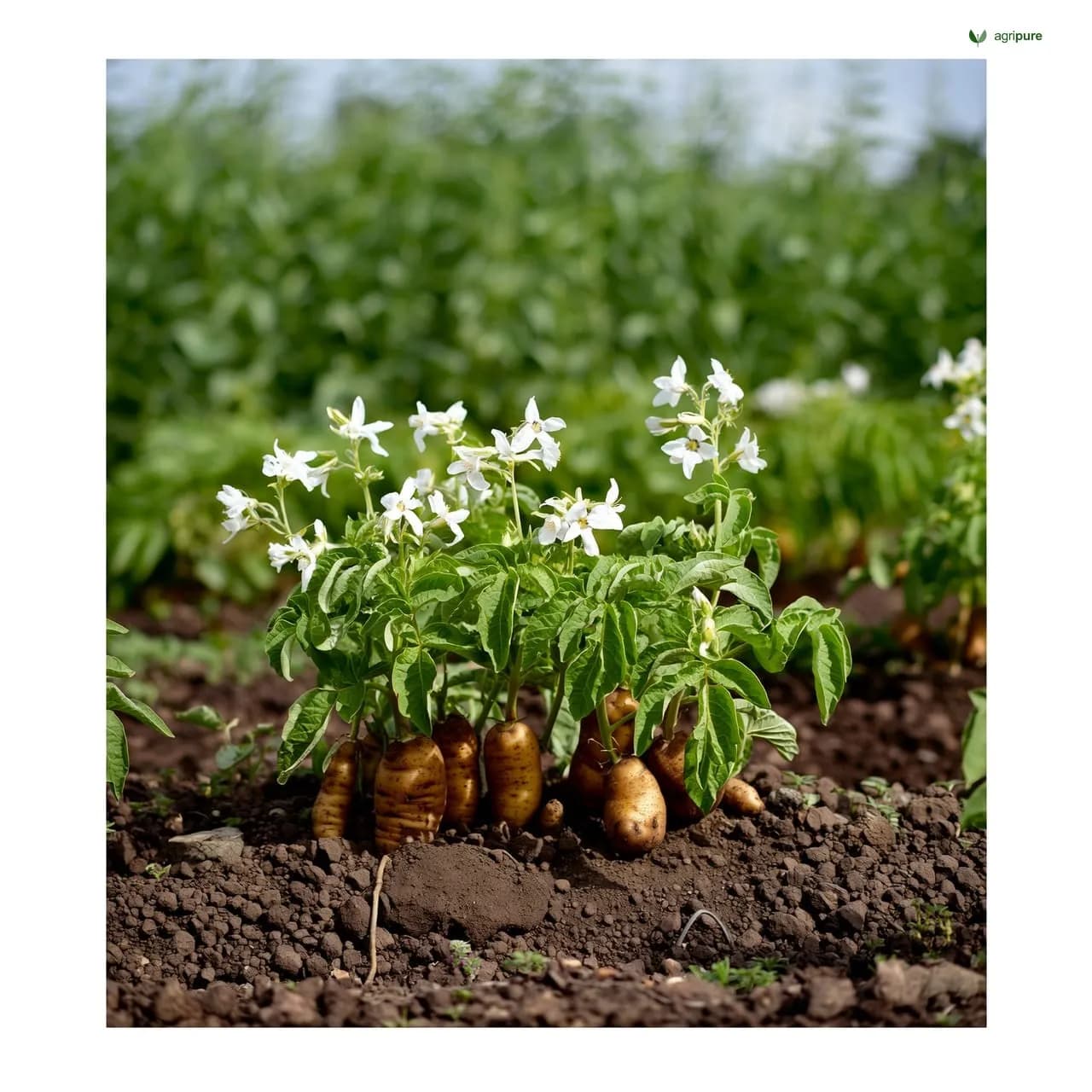
Botanically it is a herbaceous perennial, though it is almost always grown as an annual. Plants stand roughly 0.4 to 1.4 metres tall and range from erect to sprawling depending on cultivar and conditions. The stems are soft and green, and it is the underground stems, called stolons, that swell at their tips into the edible tubers. The leaves are compound, with several ovate leaflets ranged along a central rachis, giving the typical “nightshade” look; this foliage is entirely inedible because of toxic alkaloids. Flowers are usually inconspicuous in cultivated settings and vary in colour by variety, from white to pink, and are followed by small green berry-like fruits that resemble miniature green tomatoes and are highly poisonous. The tuber itself varies in skin and flesh colour, from white and yellow to red, but any green tinge to the skin signals a build-up of glycoalkaloids, and those green portions should not be eaten.
Growing potato
Potato is propagated from “seed potatoes” — tuber pieces each carrying at least one “eye” — rather than from true botanical seed. In spring, plant seed potatoes 2 to 3 inches deep and 12 inches apart in rows spaced 2½ to 3 feet apart. Because the crop tolerates cool soil, it can go in as soon as the ground is workable, about 2 to 3 weeks before the average last frost; it is described as a cool-season vegetable that handles cool soil and moderate frost. As a garden crop it is listed as hardy across a wide span, USDA zones 2 to 11.4
Give potatoes full sun. They grow best in fertile, well-drained, sandy soil, and acid soil is actually preferred because it reduces the likelihood of scab disease. Water regularly and thoroughly through the growing season; consistent moisture matters, while waterlogging predisposes the tubers to rot. Once the plants reach about 12 inches tall, hill soil, straw, or compost up around the stems to build a mound 6 to 8 inches high. Hilling keeps the developing tubers covered from sunlight, which is what prevents them greening and forming solanine.
Harvest and uses
Rather than counting days, the potato tells you when it is ready through its growth stages. Dig “early” potatoes when the tops begin to flower, for tender new potatoes used straight away. For the full-maturity main crop, wait until the tops die down before lifting, which gives firmer tubers better suited to storage.
Only the properly stored, non-green tubers are eaten. They are the swollen tips of the underground stolons and form the entire edible yield of the plant, since every other part is toxic. Worldwide the potato is one of the great staple crops, ranking with wheat and rice, which is precisely what makes it such a reliable anchor for a homestead food plot: a high-calorie, storable harvest from a single season’s planting.
Safety and cautions
The potato is a nightshade, and only the properly stored, non-green tubers are safe to eat. All green tissues are poisonous because of glycoalkaloids such as solanine, including greened tuber skin, sprouts, leaves, stems, and the berries. A few grounded points for any grower:
- The small green berry-like fruits that follow the flowers are highly poisonous and must not be eaten, despite resembling tiny green tomatoes.
- The foliage — leaves and stems — is entirely inedible due to its toxic alkaloids.
- Any green coloration on a tuber’s skin indicates glycoalkaloid accumulation; cut away and discard affected portions, and do not eat heavily greened tubers.
- This is why hilling matters in the garden: keeping the tubers buried and out of sunlight prevents the greening and solanine formation in the first place.
Stored correctly in the dark, cured tubers from a healthy plant are a safe, nutritious staple; the toxicity sits in the green tissue and in tubers exposed to light, so the safe practice is simple — keep them covered while growing and keep them dark in storage.
Sources
- Solanum tuberosum (Potato) – NC State Extension Plant Toolbox
- The Biology of Solanum tuberosum (L.) (Potatoes) – Canadian Food Inspection Agency
- Solanum tuberosum – Solanaceae Source (Natural History Museum)
- Solanum tuberosum – Missouri Botanical Garden Plant Finder