pioneer
Marigold
genda
Tagetes erecta
Also known as African Marigold (United States, UK & Ireland, Canada), Genda (Pakistan).
- punjab plains
- sindh coast
- pothohar
International hardiness
- USDA 10-11
- RHS H2
- AU: Tropical, Subtropical, Warm temperate, Mediterranean, Arid / semi-arid
Where it grows — regional guide
| Zones / rating | Regional notes |
|---|---|
USDA 10-11 | Grown as a popular warm-season annual flower in sunny beds; wear gloves when handling bruised stems because the sap causes skin blisters and rash in sunlight. |
| Zones / rating | Regional notes |
|---|---|
H2 (1 to 5C) | Rated RHS H2, it is treated as a summer bedding annual for pollinators; handle cut stems with gloves to prevent sap-induced blisters and skin irritation in the sun. |
| Zones / rating | Regional notes |
|---|---|
Tropical, Subtropical, Warm temperate, Mediterranean, Arid / semi-arid | Planted across subtropical and temperate gardens as a warm-season annual bloomer; wash hands after pruning because contact with sap causes burning skin irritation. |
| Zones / rating | Regional notes |
|---|---|
USDA 10-11 (USDA scale) Canada uses its own zone system; Canadian zones run roughly one lower than USDA. | Grown as a fast summer annual for garden colour and companion planting; wear protective gloves when pruning because sap triggers dermatitis when exposed to sunlight. |
| Zones / rating | Regional notes |
|---|---|
Punjab plains, Sindh coast, Pothohar | Pakistan:A widely cultivated winter annual across Punjab plains, Sindh coast, and Pothohar; handle cut flowers carefully, as sap causes blistering rashes on contact with sun. India:A staple flower cultivated for festive garlands and kitchen gardens; handle cut plants with care because leaking sap causes skin redness and painful sun-reactive blisters. |
Grows alongside
Species that appear with Marigold in 28 of our published guides — a starting list for a guild, not a planting plan.
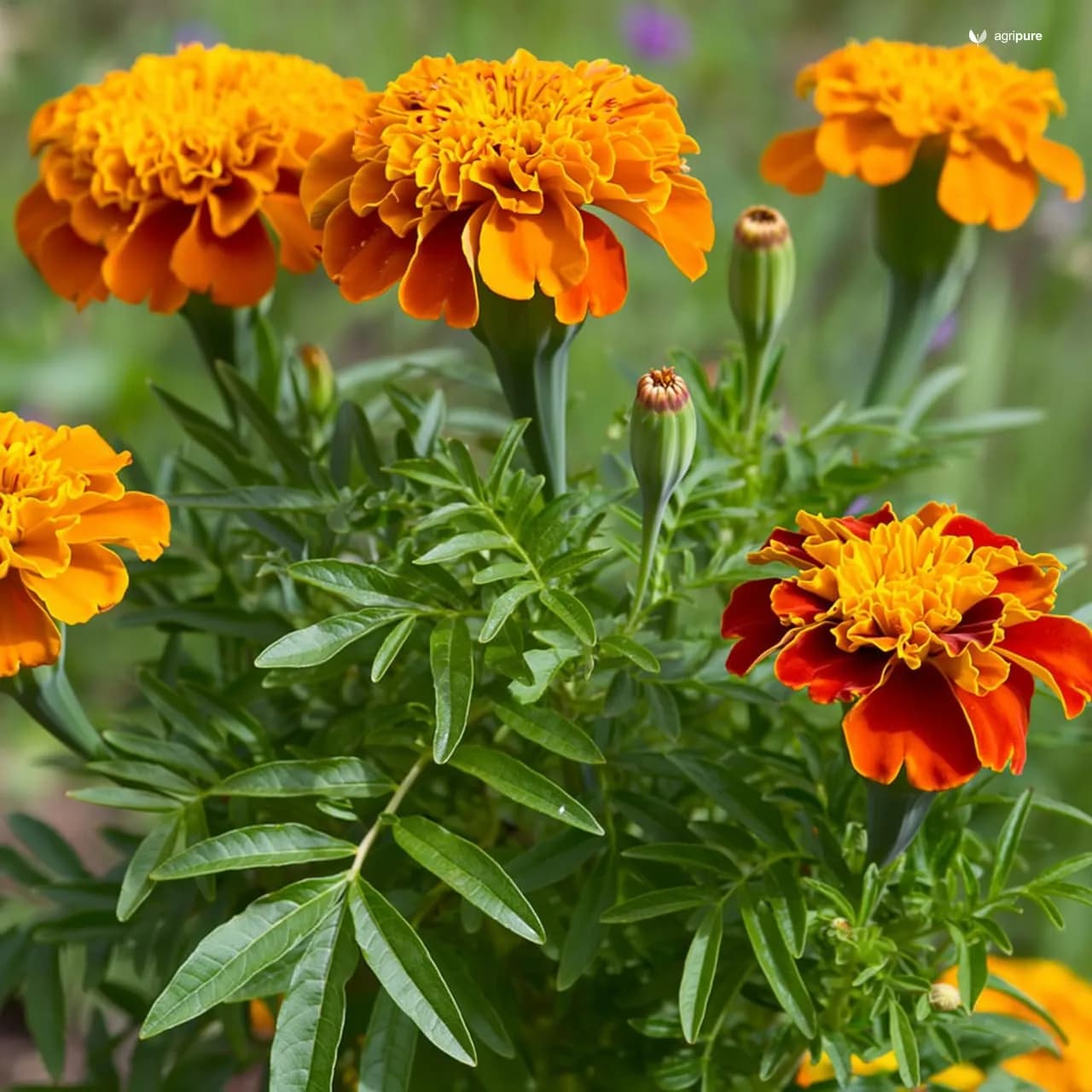
African marigold (Tagetes erecta) is a tender annual in the daisy family (Asteraceae), known variously as Aztec marigold, Mexican marigold, or big marigold. It is native to Mexico and Central America and is now grown the world over as one of the easiest warm-season bedding flowers a homesteader can sow. Its appeal is straightforward: from a packet of seed started indoors in spring you get a long-blooming, sun-loving plant that fills beds, borders, and containers with dense double pompoms, draws in butterflies, and asks for very little in return.
The plant is a bushy, upright annual that typically reaches about 1 to 4 ft tall and 1 to 2 ft wide, with angular stems and pinnate (divided) leaves. The flower heads are large and usually fully double, carried on stems above the foliage and most prominent on the taller cultivars; individual heads are often 2 to 4 in across, in shades of yellow, orange, and creamy white. In frost-prone climates it completes its whole life cycle in a single warm season and is killed by freezing weather, so it is treated everywhere as a warm-season annual.
Growing African marigold
Marigold is grown from seed, and the standard method is to start seed indoors and transplant after the danger of frost has passed.
- Propagation: Sow seed indoors roughly 6 to 8 weeks before the last frost, then set plants out after the last frost once the soil has warmed.
- Sun: Give it full sun for the best performance; in hot climates a little light afternoon shade is tolerated and can help.
- Soil: It prefers average, evenly moist, well-drained soil, but it is forgiving and will tolerate clay and dry soil.
- Water: It performs well through hot summer weather as long as it is watered regularly.
- Spacing: Set plants about 12 to 18 inches apart.
- Training: Pinch young plants to encourage bushy growth, and deadhead spent flowers promptly to keep the bloom coming.
- Support: Taller varieties can suffer stem breakage, so they may need staking or a sheltered planting site.
The botanical and extension sources here do not give a reliable days-to-maturity figure for the species, so none is stated rather than invented. In practice, treat it as a quick warm-season annual: start seed in spring, plant out after frost, and expect bloom through the warm months until the first hard freeze ends the season.
Harvest and uses
The flowers are the product, whether you are cutting them for the vase or simply enjoying the display. Blooms are gathered when fully open, and prompt deadheading of the tall varieties keeps fresh flowers forming; the species is well suited to cutting as well as to beds, borders, edging, and containers. The provided sources do not give a reliable field yield, per-plant flower yield, or commercial harvest figure for T. erecta, so no such number is claimed.
Beyond ornament, the plant earns its keep ecologically. NC State notes that it attracts butterflies and hummingbirds, making it a useful nectar plant tucked among vegetable beds and along borders. Marigolds (as a group, Tagetes spp.) are also commonly used as a biological deterrent for insects in vegetable and herb gardens, though that general observation applies to the genus rather than being documented for this species alone. The supplied research does not provide a reliable, species-specific source for culinary or medicinal use of Tagetes erecta, so this profile makes no edibility or medicinal claims for it.
Safety and cautions
Despite its cheerful looks, African marigold carries some sourced cautions and should not be treated as a food plant on the strength of this research.
- NC State Extension classifies Tagetes erecta as having low-severity poison characteristics, and lists the flowers, roots, and sap/juice as the poisonous parts.
- The plant’s sap or juice can cause a rash. Reported reactions include skin redness, burning pain, and blisters when broken skin contacts the cell sap together with sunlight, and the flower aroma can cause nose and eye irritation.
- Because the sources here do not provide a reliable edible-use reference for this species, the conservative, evidence-based course is to avoid treating it as an edible plant unless a species-specific food-use source is verified.
None of this makes marigold a difficult or dangerous plant to grow; it simply means handling the cut sap sensibly and not assuming the flowers are safe to eat without a proper source. Grown for its blooms and its draw for pollinators, it remains one of the most reliable annuals a homesteader can put in the ground.
Sources
- Tagetes erecta — Wikipedia
- Tagetes erecta — NC State Extension Plant Toolbox
- Tagetes erecta — Missouri Botanical Garden Plant Finder
- Tagetes erecta — University of Florida IFAS Extension
- Tagetes erecta — USDA PLANTS Database