pioneer
Berseem Clover
berseem
Trifolium alexandrinum
Also known as Egyptian Clover (India, United States, Australia).
- punjab plains
- sindh coast
- pothohar
International hardiness
- USDA 8-11
- RHS H3
- AU: Subtropical, Warm temperate, Mediterranean, Arid / semi-arid
Where it grows — regional guide
| Zones / rating | Regional notes |
|---|---|
USDA 8-11 | Grown as a cool-season annual forage and nitrogen-fixing cover crop in USDA zones 8 to 11; valuable for rapid green manure, but monitor intake in breeding livestock. Treat strictly as a non-edible crop for humans. |
| Zones / rating | Regional notes |
|---|---|
H3 (-5 to 1C) | No region-specific data yet |
| Zones / rating | Regional notes |
|---|---|
Subtropical, Warm temperate, Mediterranean, Arid / semi-arid | Sown as an autumn-to-spring annual pasture and cover crop under irrigation; provides high-protein forage, but limit prolonged heavy feeding to breeding herds. Treat strictly as a non-edible crop for humans. |
| Zones / rating | Regional notes |
|---|---|
USDA 8-11 (USDA scale) Canada uses its own zone system; Canadian zones run roughly one lower than USDA. | No region-specific data yet |
| Zones / rating | Regional notes |
|---|---|
Punjab plains, Sindh coast, Pothohar | Pakistan:The premier winter rabi fodder and green manure crop across irrigated Punjab and Sindh; manage feeding in breeding stock, as clover phytoestrogens can affect fertility. Treat strictly as a non-edible crop for humans. India:A staple irrigated rabi legume grown for multi-cut winter cattle forage; monitor long-term diet of breeding animals because plant phytoestrogens may alter reproduction. Treat strictly as a non-edible crop for humans. |
Grows alongside
Species that appear with Berseem Clover in 1 of our published guides — a starting list for a guild, not a planting plan.
Berseem clover (Trifolium alexandrinum), also called Egyptian clover, is a cool-season annual legume in the pea family (Fabaceae) grown for high-quality forage and as a soil-building cover crop rather than as a human food plant.125 It originates from the eastern Mediterranean, particularly Egypt and the Nile Delta, where it has long been a staple fodder of irrigated farming.1357 For a homesteader, its appeal is straightforward: it is a fast, lush winter or summer legume that smothers weeds, feeds livestock, and leaves the ground richer than it found it, making it an easy choice for resting a bed between cash crops.235
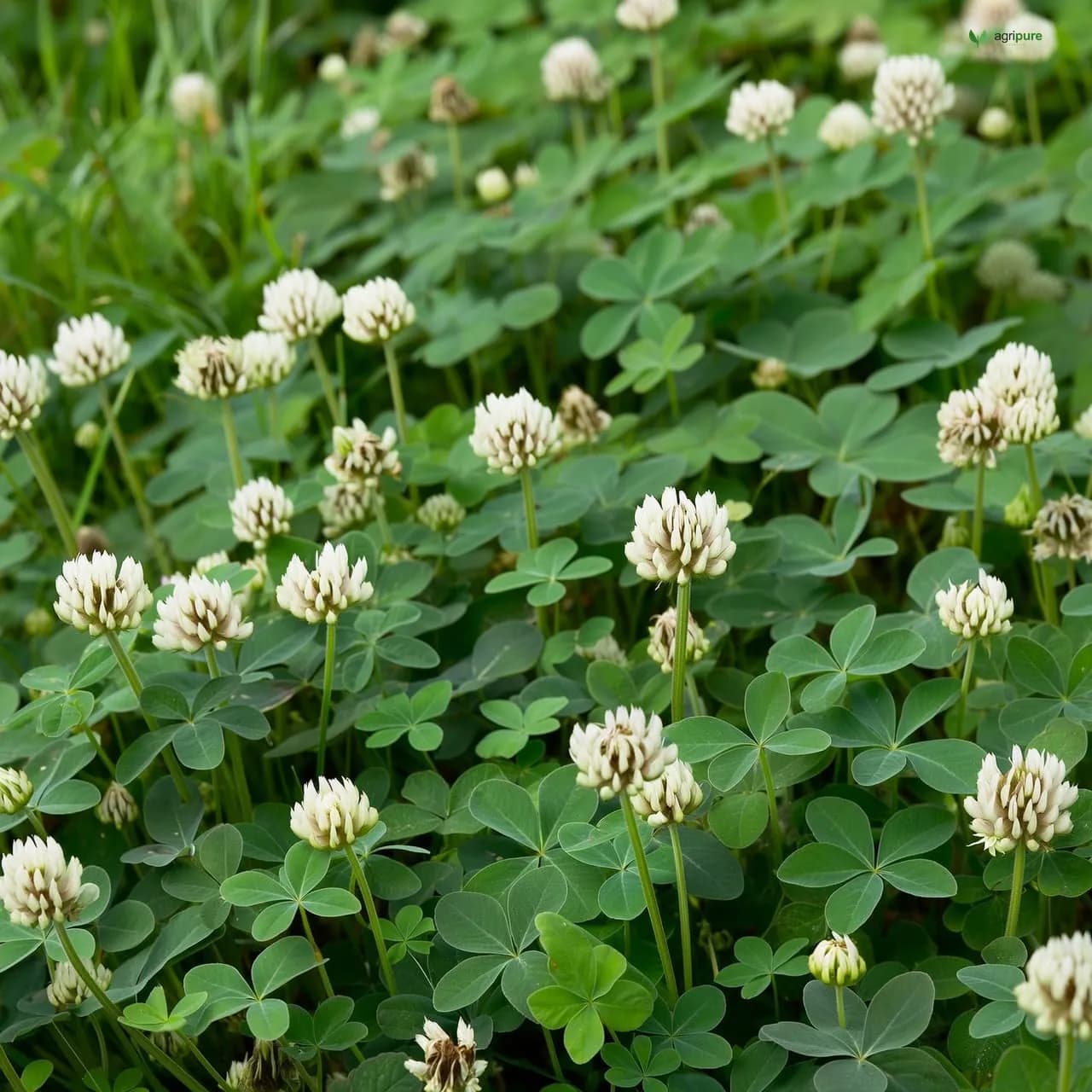
Berseem is an erect, upright annual with hollow stems, typically reaching about 45 to 80 cm (18 to 31 in) tall, and sometimes 75 to 90 cm in improved varieties.136 Its leaves are trifoliate, with oblong leaflets in groups of three; the USDA Plant Guide describes them as non-hairy, while UC Davis notes them as slightly hairy and, tellingly, lacking the pale watermark seen on some other clovers.13 Unlike many true clovers, it does not reseed itself in most production systems, so it behaves as a true annual that you re-sow each season.123
Growing berseem clover
Berseem is grown only from seed. The seed is small, oblong-rounded, golden-yellow, and about 5/64 in long.1 Like other legumes it forms nitrogen-fixing root nodules when the proper rhizobium is present, so inoculating the seed is worthwhile on ground that has not grown clover before.23 The root system itself is fibrous and fairly shallow, reaching only about 10 to 15 cm (4 to 6 in) deep under typical conditions, which is one reason the crop leans on steady moisture rather than deep drought reserves.1
For soil, berseem prefers fine-textured loams and silty soils and performs poorly on sands; SARE notes it favours slightly alkaline loam or silty ground but will grow on most soil types except sand.23 It is a cool-season plant that wants mild winters and a cool, moist growing season, and in drier regions it depends on irrigation or reliable rainfall to produce the dense, leafy stand it is known for.123 Where it is grown shapes how it is sown: in the southeastern United States it is grown as a winter annual, roughly from east Texas to Kentucky and along the West Coast where rainfall allows; in the Northeast it is instead grown as a summer annual, from the Atlantic to eastern Montana, with a southern boundary at the Ohio River.1
Cold tolerance is a real limitation. Berseem is the least winter-hardy of the true annual clovers, and in colder regions it is often deliberately left to winterkill as a quick, easily terminated cover.2 Some bred varieties, such as ‘Frosty’, have improved cold tolerance and have been reported to survive down to about 5 °F (roughly -15 °C) in trials.6 Because primary USDA documents do not assign explicit hardiness-zone numbers for this crop, treat any zone figure as an inference from its documented distribution rather than a sourced fact.12
Harvest and uses
Berseem is valued chiefly as forage and as a cover crop, not as something you put on the table.235 When well fertilized and irrigated it forms a lush, dense stand, which is exactly what makes it useful: the canopy crowds out weeds, the legume builds soil through nitrogen fixation, and the leafy top growth feeds livestock.235 It flowers in late spring to early summer, generally later than crimson clover (Trifolium incarnatum), producing round flower heads that are white to yellowish-white, occasionally with a faint pink tinge.13 On a homestead, treat it as a short-term green manure and grazing crop: sow it, let it cover and build the ground, cut or graze the growth, and turn the residue back into the soil before the bed moves on.23
How to identify it
Berseem clover can be told apart from other clovers by the following combination of features:13
- Habit: Erect cool-season annual with hollow stems, usually 45 to 80 cm tall.
- Leaves: Trifoliate, oblong leaflets in threes, with no pale watermark (a key distinction from some other Trifolium species).
- Flowers: Round heads, white to yellowish-white, sometimes faintly pink, late spring to early summer.
- Seeds: Small, oblong-rounded, golden-yellow, about 5/64 in long.
- Roots: Shallow, fibrous, around 10 to 15 cm deep, with nitrogen-fixing nodules when inoculated.
Pollination
Berseem flowers are mainly self-pollinated, so a stand will set some seed on its own, but cross-pollination improves seed set, meaning insect visitors are a benefit if you intend to save or produce seed.1
Safety and cautions
As forage, berseem clover is generally regarded as safe.5 However, research has identified measurable phytoestrogens (plant compounds with weak estrogen-like activity) in Trifolium alexandrinum.4 Because of this, very high, long-term intake by hormone-sensitive breeding livestock warrants some caution, even though the crop is otherwise considered safe fodder.45 This is a livestock-management note, not a human-health one: berseem is a fodder and cover crop, not a human food or medicinal plant, and the sources here make no health claims for it.25 If you graze breeding animals heavily on a pure berseem stand, it is sensible to balance their ration rather than relying on it alone for long stretches.4
Sources
- Berseem Clover (Trifolium alexandrinum) Plant Guide – USDA NRCS
- Berseem Clover, Managing Cover Crops Profitably – SARE (Sustainable Agriculture Research and Education)
- Berseem Clover Cover Crop Profile – UC Davis SAREP
- Identification of phyto-oestrogens in berseem clover (Trifolium alexandrinum) – Journal of Agricultural Science, Cambridge University Press
- Berseem Clover – Great Basin Seed
- Berseem Clover ‘Frosty’ – Turner Seed
- Trifolium alexandrinum (Egyptian Clover) – iNaturalist