pioneer
White Clover
safed clover
Trifolium repens
Also known as Safed Clover (Pakistan).
- pothohar
- kpk hills
International hardiness
- USDA 4-9
- RHS H7
- AU: Cool temperate, Warm temperate, Mediterranean
Where it grows — regional guide
| Zones / rating | Regional notes |
|---|---|
USDA 4-9 | A persistent perennial legume hardy across USDA zones 4 to 9 in pastures and lawns; mix with grass to prevent dangerous bloat in grazing cattle and sheep. |
| Zones / rating | Regional notes |
|---|---|
H7 (below -20C) | Hardy to RHS H7, it is a classic lawn and grazing perennial that fixes nitrogen; mix with companion grasses because lush, pure swards cause livestock bloat. |
| Zones / rating | Regional notes |
|---|---|
Cool temperate, Warm temperate, Mediterranean | Widely sown in temperate and Mediterranean pastures to fix nitrogen; manage grazing density and mix with grasses to avoid severe bloat in ruminant livestock. |
| Zones / rating | Regional notes |
|---|---|
USDA 4-9 (USDA scale) Canada uses its own zone system; Canadian zones run roughly one lower than USDA. | An extremely hardy creeping perennial used in pastures and mixed grass plantings; maintain mixed forage stands to stop lush clover from causing fatal bloat in herds. |
| Zones / rating | Regional notes |
|---|---|
Pothohar, KPK hills | Pakistan:A creeping perennial legume of the moist KPK hills and Pothohar; excellent for fixing nitrogen, but lush monoculture stands can trigger dangerous rumen bloat. |
Grows alongside
Species that appear with White Clover in 25 of our published guides — a starting list for a guild, not a planting plan.
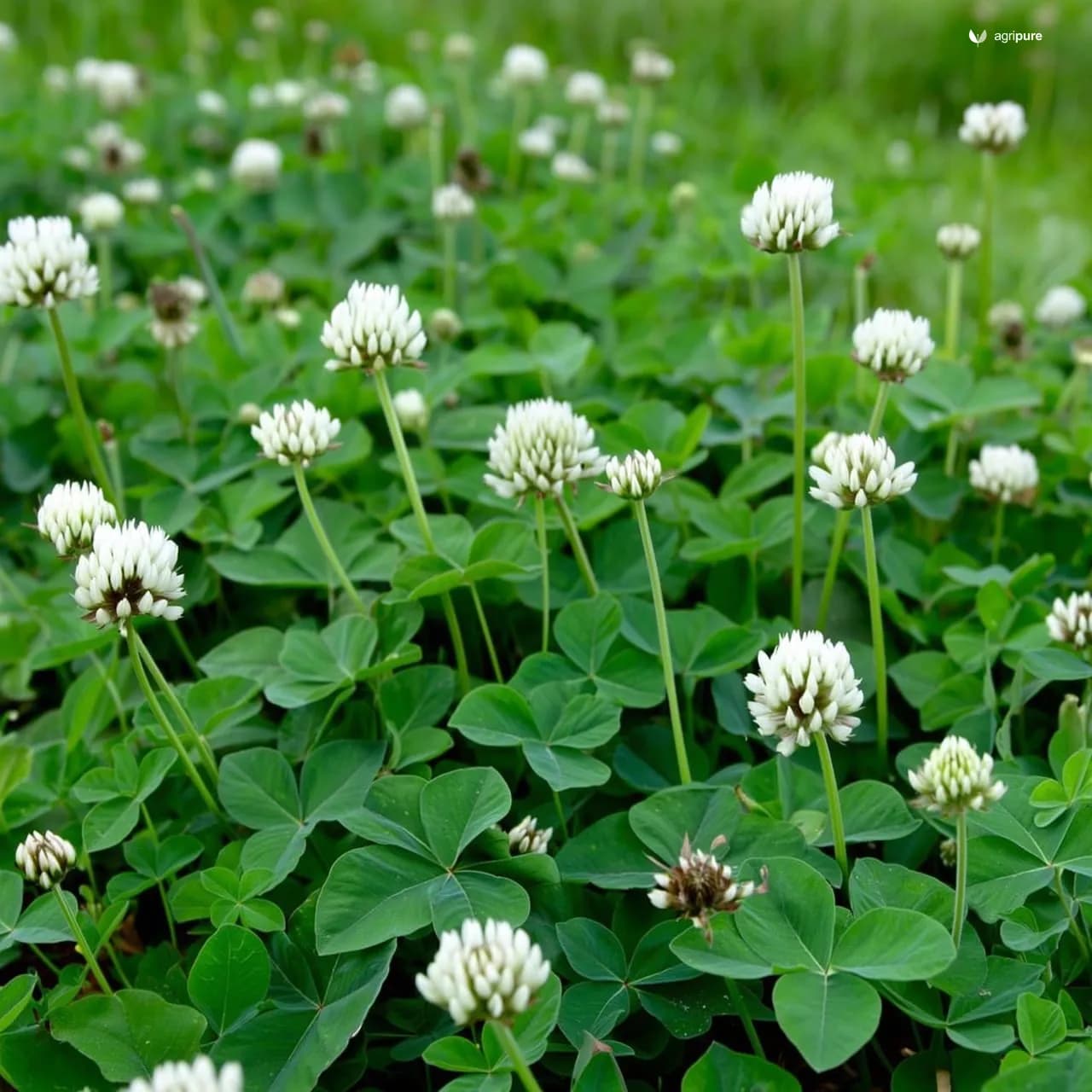
White clover (Trifolium repens) is a low, creeping perennial legume with three-part leaves and rounded heads of white, sometimes pink-tinged flowers. Native to Europe and central Asia, it has since been introduced and naturalized across temperate regions worldwide, including throughout Canada and the United States. For a homesteader it is one of the most useful workhorse legumes you can sow: it knits itself into a dense, self-spreading mat that doubles as living groundcover, pasture forage, and a steady summer-long resource for bees.
The plant spreads by prostrate stems, called stolons, that creep along the soil surface and put down roots at the nodes, building up a low turf rather than a single upright clump. Each leaf is usually divided into three leaflets that are green, hairless, and carried on long stalks, and the leaflets very often show a pale or dark crescent-shaped marking. The combination of creeping rooting stems, trifoliate leaves, and that distinctive crescent on the leaflets is the field signature most identification sources point to.
Growing white clover
White clover is grown from seed. The USDA plant guide gives a seeding rate of about 1 to 3 pounds of pure live seed per acre, and notes that where it is grown for seed production it can be planted in spaced rows of roughly 20 to 24 inches, which also allows cultivation between the rows for weed control. For ground-cover or pasture use the seed is simply sown across a prepared area to establish a continuous mat.
It does best on soils with ample lime, phosphate, and potash, since legumes draw heavily on calcium, phosphorus, and potassium. At the same time it is forgiving of conditions, tolerating a wide range of soils and turning up readily on medium to heavy, alkaline ground of low fertility. The species is a cool-climate plant: the USDA guide is explicit that it thrives best in a cool, moist climate, so it earns its keep in mild, reliably damp situations rather than hot, droughty ones. The sources here do not give a clean direct-sun requirement or a dependable days-to-maturity figure, so those are left out rather than guessed; for timing, the most reliable cue is flowering, which is reported from June to September in one British field guide and as a longer May to October window in turf references.
Harvest and uses
White clover is one of the most widely cultivated clovers and an important forage legume, grown extensively in pasture and mixed grass-legume systems. It is also a seed crop, which is why the USDA guide describes spaced-row planting for seed production. The supplied sources do not give reliable yield numbers for forage, seed, or edible harvest, so none are stated here rather than inventing figures.
Its value beyond forage is ecological. As a legume it fits naturally into pasture and mixed grass plantings and is a common component of lawns, meadows, and rough grassy ground. For pollinators it is a genuine asset: the flower heads are worked steadily by honey bees and bumblebees, and white clover is listed as a wildlife food plant in British sources. Because it blooms across much of the summer, a clover stand gives bees a long, dependable nectar window.
How to identify it
Use the following combination of features to confirm white clover in the field:1256
- Habit: a low, creeping perennial that roots at the nodes and forms a flat mat or turf rather than an upright plant.
- Leaves: three green, hairless leaflets on long stalks, frequently marked with a pale or dark crescent.
- Flowers: small white, sometimes pink-tinged flowers packed into rounded heads.
- Bloom period: reported as June to September in one field guide and May to October in turf references.
Safety and cautions
The sources reviewed here do not state that white clover is poisonous to people in ordinary use, so it is not labelled broadly toxic on this evidence. Equally, they do not provide a definitive, species-specific list of edible parts for human consumption, so no stronger edibility claim is made than the research supports. White clover is a legume widely fed to livestock, but the supplied material does not discuss poisoning thresholds or anti-nutritional risks for this species in particular, so no unsourced grazing cautions are added. No well-documented, species-specific medicinal use for Trifolium repens appears in these sources, and none is claimed here.
Sources
- Trifolium repens — Wikipedia
- White Clover (Trifolium repens) — NatureSpot
- White clover — The Wildlife Trusts
- White clover — UC Integrated Pest Management Program
- White clover identification and control — ICL Growing Solutions
- Everything about white clover — Southeast AgriSeeds
- White Clover Plant Guide — USDA NRCS