support
Red Clover
shaftal
Trifolium pratense
Also known as Shaftal (Pakistan).
- kpk hills
- punjab plains
International hardiness
- USDA 3-9
- RHS H7
- AU: Cool temperate, Warm temperate, Mediterranean
Where it grows — regional guide
| Zones / rating | Regional notes |
|---|---|
USDA 3-9 | Hardy perennial forage and nitrogen-fixing cover crop across USDA zones 4 to 8; safe for grazing, but avoid concentrated medicinal use in pregnancy. |
| Zones / rating | Regional notes |
|---|---|
H7 (below -20C) | Rated RHS H6, it is widely grown for green manure and pollinator forage; concentrated medicinal use should be avoided during pregnancy due to isoflavones. |
| Zones / rating | Regional notes |
|---|---|
Cool temperate, Warm temperate, Mediterranean | Grown as cool-season pasture and green manure in temperate and Mediterranean zones; beneficial for soil, but limit high medicinal use due to isoflavones. |
| Zones / rating | Regional notes |
|---|---|
USDA 3-9 (USDA scale) Canada uses its own zone system; Canadian zones run roughly one lower than USDA. | A cold-hardy short-lived perennial legume grown across Canada for pasture and soil nitrogen; avoid concentrated medicinal use while pregnant. |
| Zones / rating | Regional notes |
|---|---|
KPK hills, Punjab plains | Pakistan:A winter rabi green fodder and soil improver in KPK hills and irrigated Punjab; safe as animal feed, but avoid high-dose medicinal teas during pregnancy. |
Grows alongside
Species that appear with Red Clover in 10 of our published guides — a starting list for a guild, not a planting plan.
Red clover (Trifolium pratense) is a short-lived perennial or biennial legume in the pea family (Fabaceae), native to Europe, Western Asia, and northwest Africa and now naturalized across North and South America and beyond as a forage and cover crop. In North America it grows across most of the United States and Canada, turning up in meadows, pastures, fields, lawns, and roadsides. For a homesteader it earns its keep two ways at once: as a nitrogen-fixing legume it builds soil fertility as a green manure, and as a dense, leafy stand it feeds livestock and pollinators from a single inexpensive sowing.
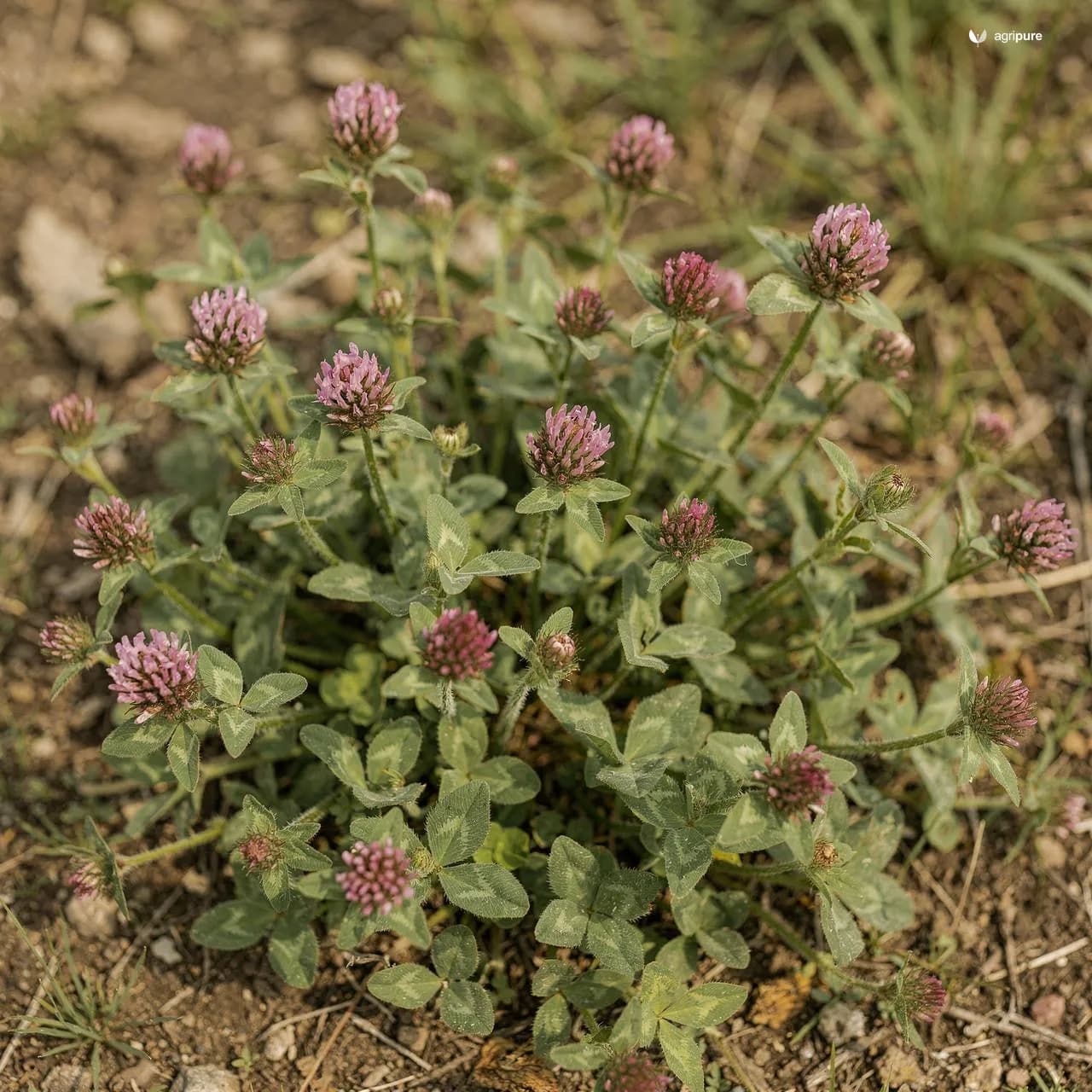
It is a tufted plant, branching mostly from the base and standing roughly 15 to 90 cm (6 to 36 in) tall on hairy, spreading-to-upright stems. The leaves are trifoliate, each made of three oval to elliptic leaflets about 1 to 4 cm long with finely toothed or entire margins; most leaflets carry a pale V-shaped chevron, which is a reliable field mark. At the base of each leaf the stipules narrow to a bristle-like point, a detail that helps separate it from some look-alike clovers. The flowers are pink to pink-purple (despite the name, rarely truly red), with many small pea-flowers packed into rounded heads about 2 to 2.5 cm across, usually sitting singly at the stem tips with one or two small leaves at the base. In temperate climates it blooms roughly from May or June into September, then sets small dry, non-splitting pods about 2 to 3 mm long.
Growing red clover
The standard method is direct seeding with commercial seed; red clover is widely sown for forage, pasture improvement, green manure, and cover cropping. Give it full sun — it is at home in open fields and sunny roadsides. It adapts to a range of soils across fields, pastures, meadows, waste areas, and roadsides, so it is not fussy about texture. On moisture it behaves as a facultative upland species: it favours grassy ground that is not regularly mowed and tolerates some wetter sites, but it is not a true wetland plant and is happiest on ordinary terrestrial soil. As a nitrogen-fixing legume it is grown specifically to improve soil fertility, which points to reasonably fertile, not strongly acidic ground for best performance.
Rather than spacing individual plants, growers sow red clover to form a dense stand, so the seeding rate, not plant spacing, sets the density. On a homestead that usually means broadcasting it across fields, pastures, or food plots, or interseeding it with grasses. The plant is self-seeding and also spreads from vigorous rhizomes, which aids its persistence but means it can become weedy and is listed as invasive in some U.S. states. Precise sowing dates, seed rates, and spacing are the province of regional agronomy manuals and are not given in the botanical sources used here, so they are left out rather than stated with false precision.
Harvest and uses
Red clover’s main return is not a single harvested fruit but the standing crop itself. It is grown extensively for forage (as pasture, hay, and silage) and for pasture improvement, and the same stand can be turned under as a green manure to bank nitrogen for the crop that follows. Because it fixes atmospheric nitrogen through its roots, it is a classic soil-fertility tool in rotations. The flower heads are also a strong draw for bees and other pollinators, making a clover ley useful well beyond the soil it improves. Tiny clover seed is the article of commerce, sold cheaply by the bag for these forage and cover-crop uses.
How to identify it
Use this combination of features to recognise red clover in the field:136
- Habit: Tufted, short-lived perennial or biennial, about 15 to 90 cm tall, branching from the base on hairy stems.
- Leaves: Trifoliate, with oval to elliptic leaflets 1 to 4 cm long, usually marked with a pale V-shaped chevron.
- Stipules: Narrowing to a bristle-like point at the leaf base.
- Flowers: Pink to pink-purple, many small pea-flowers in rounded heads about 2 to 2.5 cm across, usually with one or two small leaves just below the head.
- Bloom and fruit: Flowers roughly May/June to September; pods small, dry, and non-splitting, about 2 to 3 mm long.
Safety and cautions
Alongside its agricultural uses, red clover is also used as a medicinal herb, and the sources flag that this carries an important caution: the plant contains isoflavones, plant compounds that mean its medicinal use has notable safety considerations for some people. This profile makes no medical claims and gives no dosages; anyone considering medicinal use, particularly people who are pregnant or breastfeeding, or taking prescription medication, should seek qualified medical advice first. As a separate practical caution, remember that red clover is self-seeding and rhizomatous and is treated as invasive in parts of the United States, so check its status where you live before planting it widely.
Sources
- Red Clover (Trifolium pratense) – Minnesota Wildflowers
- Trifolium pratense – Go Botany, Native Plant Trust
- Red Clover – NatureSpot
- Trifolium pratense – Wikipedia
- Trifolium pratense species biography – Alaska Center for Conservation Science, University of Alaska Anchorage
- Trifolium pratense – North Carolina State Extension
- Trifolium pratense – iNaturalist
Sourcing notes
Seed is cheap and widely sold; inoculate with the appropriate rhizobium if clover has not grown in the ground before, and on the plains sow into irrigated land or the cooler seasons.