pioneer
Cattail
pater
Typha latifolia
Also known as Broadleaf Cattail (United States), Pater (Pakistan).
- punjab plains
- sindh coast
International hardiness
- USDA 3-11
- RHS H7
- AU: Cool temperate, Warm temperate, Subtropical, Tropical
Where it grows — regional guide
| Zones / rating | Regional notes |
|---|---|
USDA 3-11 | A hardy wetland perennial in USDA zones 3 to 11; only forage parts from clean, unpolluted water to avoid toxins, and control rhizomes to prevent channel choking. |
| Zones / rating | Regional notes |
|---|---|
H7 (below -20C) | Hardy to RHS H7, it is an emergent perennial for natural wastewater filtration; harvest shoots only from clean water, and contain roots to stop vigorous spreading. |
| Zones / rating | Regional notes |
|---|---|
Cool temperate, Warm temperate, Subtropical, Tropical | Grown in farm dams and wetlands for water filtration and erosion control; consume only from clean water sources, and contain vigorous rhizomes to avoid weediness. |
| Zones / rating | Regional notes |
|---|---|
USDA 3-11 (USDA scale) Canada uses its own zone system; Canadian zones run roughly one lower than USDA. | A cold-hardy native wetland emergent perennial across Canadian marshes; forage shoots strictly from unpolluted water, and manage beds to prevent clogged waterways. |
| Zones / rating | Regional notes |
|---|---|
Punjab plains, Sindh coast | Pakistan:A native wetland perennial of the Punjab plains and Sindh coast harvested for fibre; eat roots only from clean water, and curb runners from choking water channels. |
Grows alongside
Species that appear with Cattail in 6 of our published guides — a starting list for a guild, not a planting plan.
Broadleaf cattail (Typha latifolia) is a hardy, perennial emergent wetland plant that forms the tall, dense reed stands you see at the edges of ponds, marshes, and slow water. It is native across most of Eurasia and North America, and more locally in parts of Africa and South America, growing wild over an enormous spread of climates from near the Arctic Circle south to roughly 30 degrees south latitude. For a homesteader with any standing water on the property, it is the plant that turns a wet ditch, pond margin, or boggy corner into a multi-use resource: food, fibre, and habitat from a single self-spreading stand.
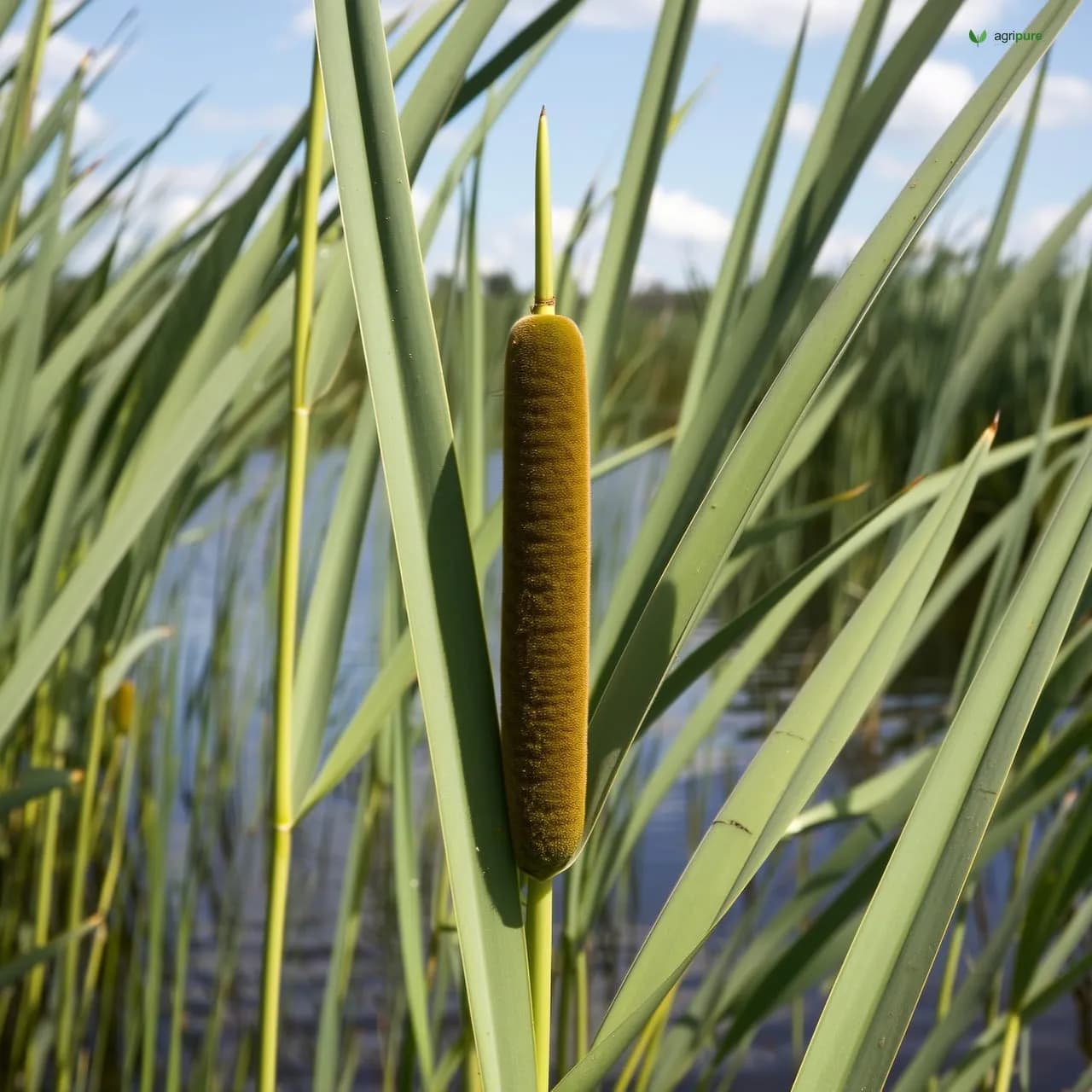
Cattail is an erect herbaceous perennial that grows from thick rhizomes, typically reaching about 1 to 3 metres (3 to 10 feet) tall. Its leaves are basal, stiff, and strap-like, flat in cross-section, about a half to three-quarters of an inch (roughly 10 to 23 mm or more) wide and blue-green when fresh. The signature feature is the brown, sausage-like flower spike. The plant is monoecious, carrying separate male (staminate) and female (pistillate) spikes on the same stem; in T. latifolia there is usually no gap between the upper male spike and the lower female spike, so they read as one continuous “cigar.” The fruiting spike is thick and cylindrical, up to about 9 inches (23 cm) long.
Growing broadleaf cattail
Water is the non-negotiable requirement. Cattail is an obligate wetland species, “always found in or near water,” and in the wild it occupies the shallow margins of lakes and ponds, marshes, wet meadows, saturated ditches, and other permanently or seasonally waterlogged ground. That makes it a natural fit for pond edges and shallow shelves, swales and ditches that stay wet, and constructed wetland or graywater cells (the last being a non-edible use; see safety).
It grows in a wide variety of wetland soils and tolerates some acidity and moderate salinity, though its salt tolerance is limited. For light, give it full sun: its documented habitat is open, unshaded wetland in “sun; wet; marshes, wetlands, wet ditches, along lake, pond and stream edges,” and stands are typically out in the open rather than under cover. Propagation in the wild is by spreading rhizomes that build dense, often monoculture stands, which means an established patch tends to fill in and expand on its own once it has wet feet and sun.
The detailed horticultural figures a grower might want — exact planting dates, plant spacing, and a fixed time to maturity — are not given in the botanical and floristic sources used here, so they are intentionally left out rather than stated with false precision. What the sources do support is straightforward: site it where water sits, give it full sun, and expect it to establish and spread readily across the wet zone.
Harvest and uses
Cattail is unusual in that virtually all of its major plant parts have traditional uses as food, materials, and habitat. Where the water is clean and unpolluted, the plant is generally considered edible, and across its range different parts have long been eaten. Beyond the kitchen it is valued as a source of fibre and structural material and as wildlife cover, the dense stands providing shelter and nesting habitat in wetlands. It is described as a cosmopolitan emergent aquatic perennial with a large range and abundant habitat, which is part of why it is such a dependable, low-input resource where conditions suit it.
The sources here do not give specific yield figures or detailed culinary preparations, so no numbers are invented for them; the honest summary is that cattail is a broadly useful wetland plant whose edibility is real but conditional on water quality.
How to identify it
Use this combination of features to separate broadleaf cattail from look-alikes:124
- Habit: Tall, erect perennial forming dense stands, often monocultures, rooted in shallow water or saturated soil.
- Height: Roughly 1 to 3 metres (3 to 10 feet) tall.
- Leaves: Stiff, flat, strap-like, about a half inch or wider, blue-green when fresh.
- Spikes: Brown, cylindrical, sausage-like fruiting spikes up to about 9 inches (23 cm) long, with usually no gap between the male spike above and the female spike below.
In at least parts of North America, the wider leaves (a half inch or more) and the absence of a gap between the male and female spikes distinguish T. latifolia from some narrow-leaf or hybrid cattails, which often show a visible gap.
Where it grows
Cattail occupies wetlands across a broad spectrum of climates — tropical, subtropical, and both southern and northern temperate. Its native range covers large regions on most continents; CABI records it as native across much of Eurasia and the Americas, present in at least seven African countries, and introduced in several Oceanian and Southeast Asian locations. Typical habitats include marshes, wet meadows, lake shores, pond and stream margins, roadside ditches, bogs, fens, rice paddies, and seacoast estuaries with moderate salinity. Primary sources describe broad climatic tolerance from Arctic to subtropical but do not assign formal USDA hardiness zones; based on that range, it is commonly treated as hardy in roughly USDA zones 3 to 10, an informed horticultural inference rather than a figure stated in the cited literature.
Safety and cautions
The main caution with cattail is not the plant itself but the water it grows in. Toxicity is indirect: T. latifolia is generally considered edible where clean, unpolluted water is assured, but it readily accumulates pollutants and pathogens from contaminated wetlands. Because of that, water quality and site selection are critical for any safe culinary use. This same trait is precisely why cattail is valued in constructed wetlands and graywater treatment cells — but plants grown to clean dirty water should be treated as a non-edible, working crop, not as food.
In short: only harvest cattail for the kitchen from clean water you trust, well away from sewage, industrial, or agricultural runoff, and keep any phytoremediation stands strictly separate from anything you intend to eat.
Sources
- Typha latifolia (broadleaf cattail) — CABI Compendium
- Typha latifolia (Broad-leaf Cat-tail) — Minnesota Wildflowers
- Typha latifolia — Wikipedia
- Typha latifolia — Missouri Botanical Garden Plant Finder
- Typha latifolia — NatureServe Explorer