pioneer
Cowpea
lobia
Vigna unguiculata
Also known as Lobia (Pakistan), Black-Eyed Pea (United States).
- punjab plains
- sindh coast
International hardiness
- USDA 9-12
- RHS H2
- AU: Tropical, Subtropical, Warm temperate, Arid / semi-arid
Where it grows — regional guide
| Zones / rating | Regional notes |
|---|---|
USDA 9-12 | A heat- and drought-hardy summer annual in USDA zones 9 to 12; harvest young green pods or dried seeds, and cook dry beans thoroughly to break down antinutrients. |
| Zones / rating | Regional notes |
|---|---|
H2 (1 to 5C) | No region-specific data yet |
| Zones / rating | Regional notes |
|---|---|
Tropical, Subtropical, Warm temperate, Arid / semi-arid | Suited to tropical, subtropical, and arid summer cropping as a resilient legume; fixes nitrogen and yields high-protein food, but dry seeds must be cooked thoroughly. |
| Zones / rating | Regional notes |
|---|---|
USDA 9-12 (USDA scale) Canada uses its own zone system; Canadian zones run roughly one lower than USDA. | No region-specific data yet |
| Zones / rating | Regional notes |
|---|---|
Punjab plains, Sindh coast | Pakistan:A heat- and drought-hardy summer kharif legume across the Punjab plains and Sindh; pick young pods for cooking and boil dried seeds fully to break down antinutrients. India:A popular warm-season pulse and green manure grown for tender pods and dry beans; cook mature dried seeds thoroughly before eating to neutralize antinutritional factors. |
Grows alongside
Species that appear with Cowpea in 13 of our published guides — a starting list for a guild, not a planting plan.
Cowpea (Vigna unguiculata) is a warm-season annual legume domesticated in Africa and now grown around the world for its high-protein seeds, tender young pods, and edible leaves. It is one of the most useful plants a hot-climate homesteader can keep in rotation: it shrugs off heat and drought, sets a crop on poor sandy ground, and pulls triple duty as food, livestock fodder, and a soil-building cover crop.
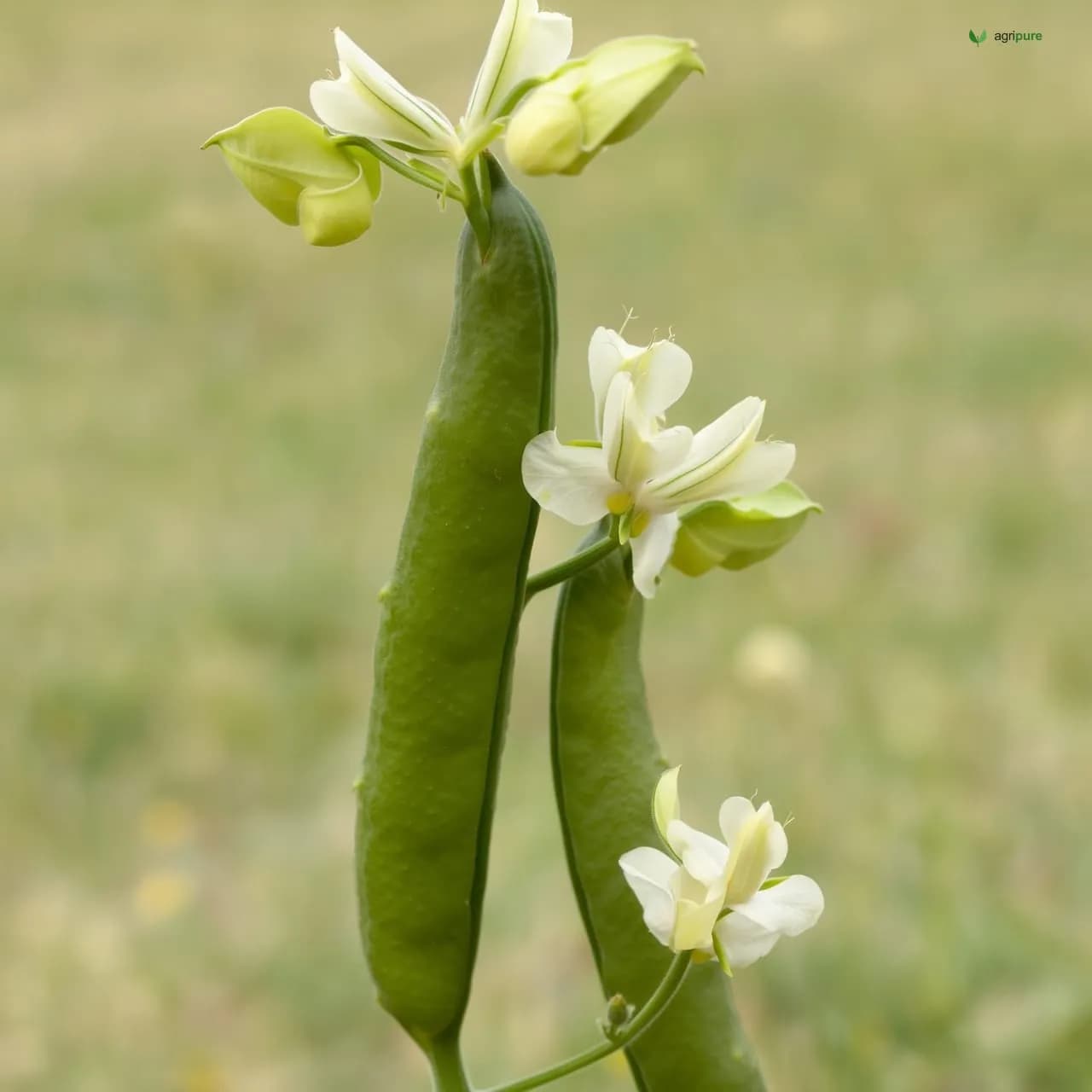
The species is botanically variable, and that matters before you grow it. Plants may be short and bushy, prostrate and trailing, or vining and climbing depending on the cultivar, so the same species can serve as a bush bean, a ground-cover sprawler, or a trellised climber. The leaves are the classic legume trifoliate type: three leaflets borne alternately, and the young foliage is cooked as a leafy vegetable in many cultures. The pea-type flowers cluster in white to purple and give way to long, slender, often slightly curved pods with the seeds spaced inside like a string of beads. Immature pods are eaten as a vegetable, and one well-known subspecies, the yardlong bean (V. unguiculata subsp. sesquipedalis), takes this to an extreme with very long pods while remaining the same species.
How to identify cowpea
The most reliable identification features sit in the seed. Cowpea seeds are generally oblong or D-shaped and slightly compressed, though some cultivars run cylindrical or rounded. Many show a distinct black or brown ring around the hilum — the “eye” that gives black-eyed peas their name. The hilum is raised and ringed by hard tissue, with a radicle ridge on dried seeds and a lens that is not prominent; together these seed-coat features separate V. unguiculata from other Vigna species. In the field, the trifoliate leaves, pea-type flowers, and slender bead-like pods confirm the plant.
Growing cowpea
Cowpea is propagated by seed — there is no routine vegetative method. Sow into warm soil: it is a frost-tender, warm-season crop, so wait until frost danger has passed and the ground has heated up. The seeds are short-lived in soil and the species disperses poorly, part of why cowpea is not considered an invasive crop pest.
For soil, cowpea is unusually forgiving: it is well adapted to sandy, drought-prone, low-rainfall ground yet also performs well on rich, well-drained land. The one firm rule is drainage — it should not be grown on wet or poorly drained soils. Aim for a pH of 6.0 or higher and give it full sun; cowpea is a heat-lover that does its best work in hot conditions, which is why it is a mainstay of semi-arid farming worldwide.
Its drought reputation is well earned: it is considered more drought-tolerant than soybean, a sensible choice for dryland beds and unirrigated corners. Precise figures for spacing, sowing temperature, and days to maturity vary by cultivar and region and are not consistently given in the sources here, so rather than invent numbers, treat cowpea like other warm-season dryland legumes: sow direct into a warm, well-drained bed in full sun, keep it lean and dry, and avoid soggy ground.
Harvest and uses
Cowpea is a genuinely multi-purpose harvest, yielding high-protein dry seeds for storage, tender immature pods as a fresh vegetable, and young leaves as a cooked green. Beyond the kitchen it is widely grown as a drought-tolerant fodder and as a cover crop that protects and builds soil — three roles from one planting. Pick immature pods while still slender and bead-like inside, and leave part of the crop to dry on the plant for mature seed to store and replant.
Its place in a cropping system reflects its origins: cowpea evolved in semi-arid savannas alongside sorghum and pearl millet and remains a natural legume partner for cereals in hot, dry rotations.
Native range and distribution
Cowpea was domesticated in its native Africa at least roughly 3,500 years ago — evidence points to East or West Africa and possibly more than one domestication event, with ancestral wild forms tracing to central Africa. It is native to the tropical and subtropical regions of Africa, especially the semi-arid savannas where it grew up beside sorghum and millet. From there it has spread widely across sub-Saharan Africa and Asia and been introduced throughout the Americas, the Middle East, Australia, and parts of Europe; in the United States it is grown from the Great Lakes to Florida, the Atlantic to Texas, and in California, mainly as a cultivated crop.
Primary sources describe its climate needs but do not assign USDA hardiness zones. Given its frost-tender, warm-season nature, it is best treated as a summer annual wherever a long, warm, frost-free season exists — an agronomic inference consistent with its requirements rather than a figure quoted from the literature.
Safety and cautions
Cowpea is generally regarded as edible and non-toxic when properly cooked. Like many legumes, however, raw or undercooked seeds are not recommended because of naturally occurring antinutritional factors, so the seeds should be cooked thoroughly before eating. This is the standard precaution for dry beans and pulses rather than any unusual hazard — simply cook the seeds fully, as you would any dried bean.
Sources
- Vigna unguiculata seed fact sheet – Seed ID Guide (USDA / Iowa State)
- Vigna unguiculata (L.) Walp. – Global Biodiversity Information Facility (GBIF)
- Cowpea – Iowa State University Extension and Outreach
- Cowpea (Vigna unguiculata) Plant Guide – USDA NRCS
- Cowpea – Genesys Plant Genetic Resources
- Cowpea (Vigna unguiculata) review – PMC, National Library of Medicine
- Cowpea – Backyard Nature