pioneer
Moth Bean
mut
Vigna aconitifolia
Also known as Mut (Pakistan).
- sindh coast
- punjab plains
- balochistan highlands
International hardiness
- USDA 9-11
- RHS H2
- AU: Arid / semi-arid, Subtropical, Tropical
Where it grows — regional guide
| Zones / rating | Regional notes |
|---|---|
USDA 9-11 | Grown as a drought-tolerant warm-season cover crop and pulse in USDA zones 9 to 11; cook the nutritious dried seeds thoroughly to break down trypsin inhibitors. |
| Zones / rating | Regional notes |
|---|---|
H2 (1 to 5C) | No region-specific data yet |
| Zones / rating | Regional notes |
|---|---|
Arid / semi-arid, Subtropical, Tropical | Suited to arid and tropical summer cropping as a hardy cover crop and drought pulse; always cook mature beans thoroughly to eliminate raw trypsin inhibitors. |
| Zones / rating | Regional notes |
|---|---|
USDA 9-11 (USDA scale) Canada uses its own zone system; Canadian zones run roughly one lower than USDA. | No region-specific data yet |
| Zones / rating | Regional notes |
|---|---|
Sindh coast, Punjab plains, Balochistan highlands | Pakistan:An exceptionally drought-resistant summer kharif pulse across Punjab, Sindh, and Balochistan; cook harvested beans thoroughly to neutralize trypsin inhibitors. India:A premier drought-hardy arid-zone summer pulse grown in dryland cropping; boil and cook dried beans well before consumption to destroy antinutritional factors. |
Moth bean (Vigna aconitifolia) is a small, drought-tolerant warm-season legume in the bean family, Fabaceae, grown mainly across the arid and semi-arid regions of the Indian subcontinent for food, fodder, and green manure. It is generally considered native to the Indian subcontinent, with India regarded as its main center of origin and diversity, and it is also cultivated in Sri Lanka, Myanmar, China, Malaysia, parts of Africa, and the south-western United States. For the homesteader working dry, marginal ground, its appeal is simple: it is a low-input creeping legume that fixes its own nitrogen, mats over bare soil, and keeps producing on rainfall that would defeat most other pulses.
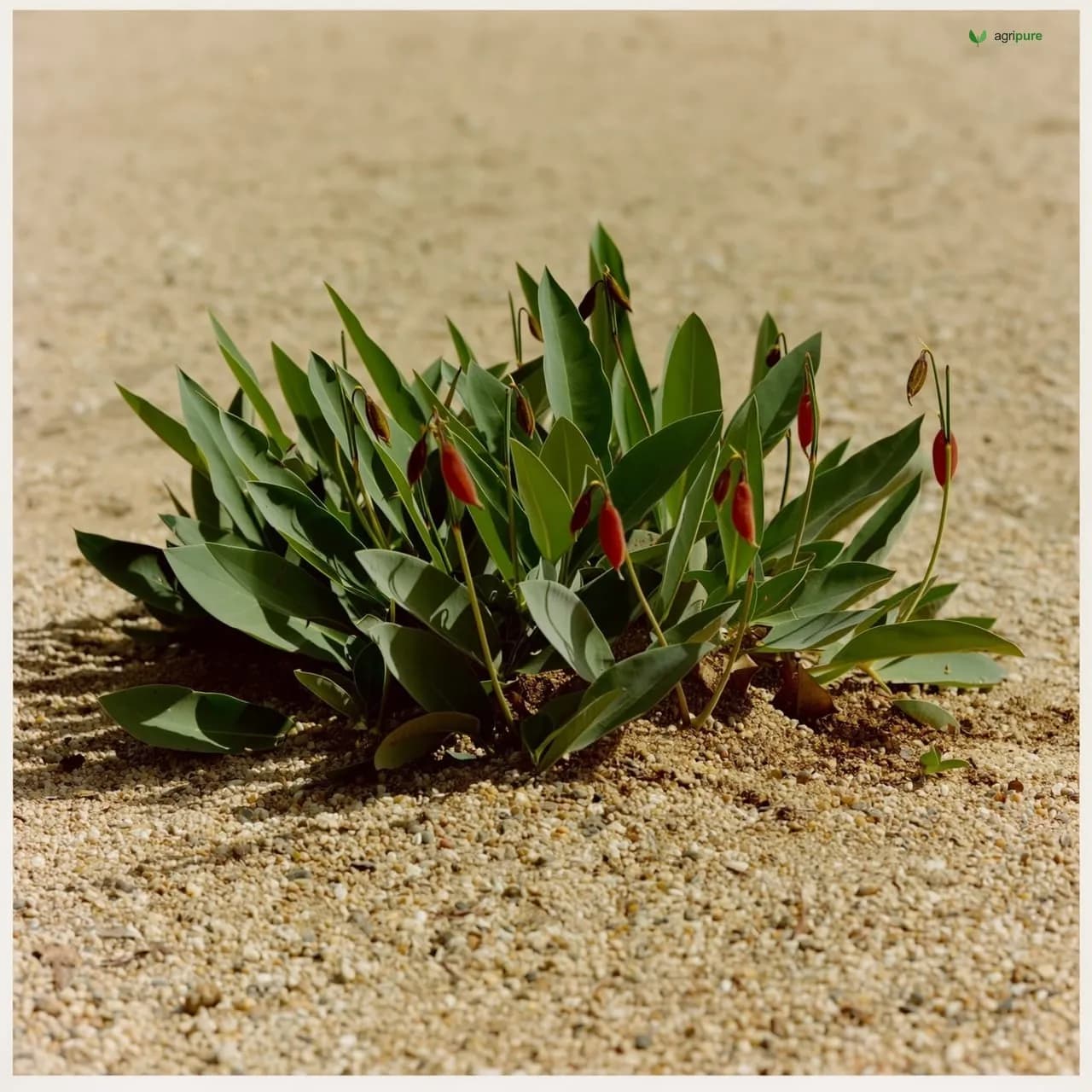
The plant is a creeping, prostrate annual herb with a mat-forming habit, reaching only about 40 to 50 centimetres high. Its stems are prostrate to semi-erect and densely hairy, and the leaves are trifoliate and densely hairy, with leaflets that are often palmately lobed. The dense, low canopy gives good ground cover, which moderates soil temperature and reduces erosion. Flowers are borne in racemes on axillary stalks about 5 to 6 centimetres long, with a yellow corolla roughly 4 to 5 millimetres long; the plant is a short-day species, so flowering is promoted by shorter daylengths. Pods are about 5 to 6 centimetres long, pubescent at first and becoming smooth at maturity, and in many cultivars they are held on short racemes above the foliage.
Growing moth bean
Moth bean is a warm-season annual and is best treated as frost-sensitive; it performs well in warm, dry habitats and tolerates marginal land and low-input systems. Once established, it withstands high temperatures up to about 45 degrees Celsius, with an ideal growing range of roughly 25 to 37 degrees Celsius. It is notably tough on water, needing only about 250 to 500 millimetres of seasonal rainfall and able to tolerate 30 to 40 days without rain in open fields after establishment; where rainfall is higher, good drainage becomes essential.
Propagation is straightforward: it is grown from seed by direct seeding as an annual field crop, sown about 2.5 to 4 centimetres deep in prepared soil. It prefers light-textured soils such as sandy loam but, given good drainage, will also tolerate clayey soils; well-drained ground matters, as yields decline in poorly drained fields, especially under higher rainfall. As a legume it fixes nitrogen, so fertiliser needs are modest, with only a light basal application typically suggested. Its dense, mat-like canopy gives good ground cover that moderates soil temperature and reduces erosion, part of why this drought-tolerant crop performs so well on warm, dry, marginal ground.
Harvest and uses
Moth bean is grown for several products at once: a food pulse, livestock fodder, and a green-manure cover. The seeds are small and protein-rich, with a typical seed protein content of about 22 to 24 percent; 100 grams of raw seed provides roughly 343 kilocalories, 23 grams of protein, 62 grams of carbohydrate, and 1.6 grams of fat. As a low, dense groundcover the plant doubles as a soil-protecting cover crop, moderating soil temperature and reducing erosion while leaving residual nitrogen behind in the system. It fits naturally into low-input dryland systems on the marginal lands of arid and semi-arid regions, where it is valued precisely because it keeps producing where most other pulses cannot.
Safety and cautions
Moth bean is eaten as a staple food legume, and no specific poisoning of humans or livestock is reported in the literature. That said, the raw seeds contain trypsin inhibitors and other antinutritional factors, so they are best eaten cooked or otherwise well processed rather than raw. This is the same straightforward precaution that applies to most dried pulses, and proper cooking addresses it.
Sources
- “Vigna aconitifolia.” Wikipedia.
- National Center for Biotechnology Information. “Moth bean (Vigna aconitifolia): a minor legume with major potential.” Frontiers in Plant Science (PMC).
- eFlora of India. “Vigna aconitifolia.”
- Growables. “Moth Bean (Vigna aconitifolia).”
- ECHO Community. “Moth Bean (Vigna aconitifolia).”