pioneer
Black Gram
mash
Vigna mungo
Also known as Mash (Pakistan), Urad (India), Urad Bean (United States), Black Matpe (Australia).
- punjab plains
- sindh coast
International hardiness
- USDA 10-12
- RHS H1b
- AU: Tropical, Subtropical
Where it grows — regional guide
| Zones / rating | Regional notes |
|---|---|
USDA 10-12 | Grown as a frost-tender warm-season annual pulse in USDA zones 10 to 12; harvest black seed pods and cook seeds completely to avoid raw legume digestive upset. |
| Zones / rating | Regional notes |
|---|---|
H1b (10 to 15C) | No region-specific data yet |
| Zones / rating | Regional notes |
|---|---|
Tropical, Subtropical | Suited to humid tropical and subtropical summer cropping rotations; fixes atmospheric nitrogen, and harvested dry seeds must be well cooked to prevent digestive upset. |
| Zones / rating | Regional notes |
|---|---|
USDA 10-12 (USDA scale) Canada uses its own zone system; Canadian zones run roughly one lower than USDA. | No region-specific data yet |
| Zones / rating | Regional notes |
|---|---|
Punjab plains, Sindh coast | Pakistan:A premier warm-season summer kharif pulse across the Punjab plains and Sindh; soak and cook beans thoroughly to ensure easy digestion and prevent stomach upset. India:A vital summer and monsoon pulse crop valued for dal, flour, and soil nitrogen; cook dried beans thoroughly before eating to prevent digestive distress. |
Black gram (Vigna mungo) is a warm-season annual pulse in the bean family (Fabaceae), grown across South and Southeast Asia for its small, protein-rich seeds.13 It goes by many names on the kitchen shelf and in seed catalogues, including urad bean, urid, urad dal, mash, and black matpe.13 The crop was domesticated in India from the wild form Vigna mungo var. silvestris roughly 3,500 to 4,500 years ago, and it has been cultivated since ancient times.23 For a homesteader, the appeal is straightforward: a fast, frost-tender legume that yields a storable dried bean, fixes its own nitrogen, and fits into a single warm season.12
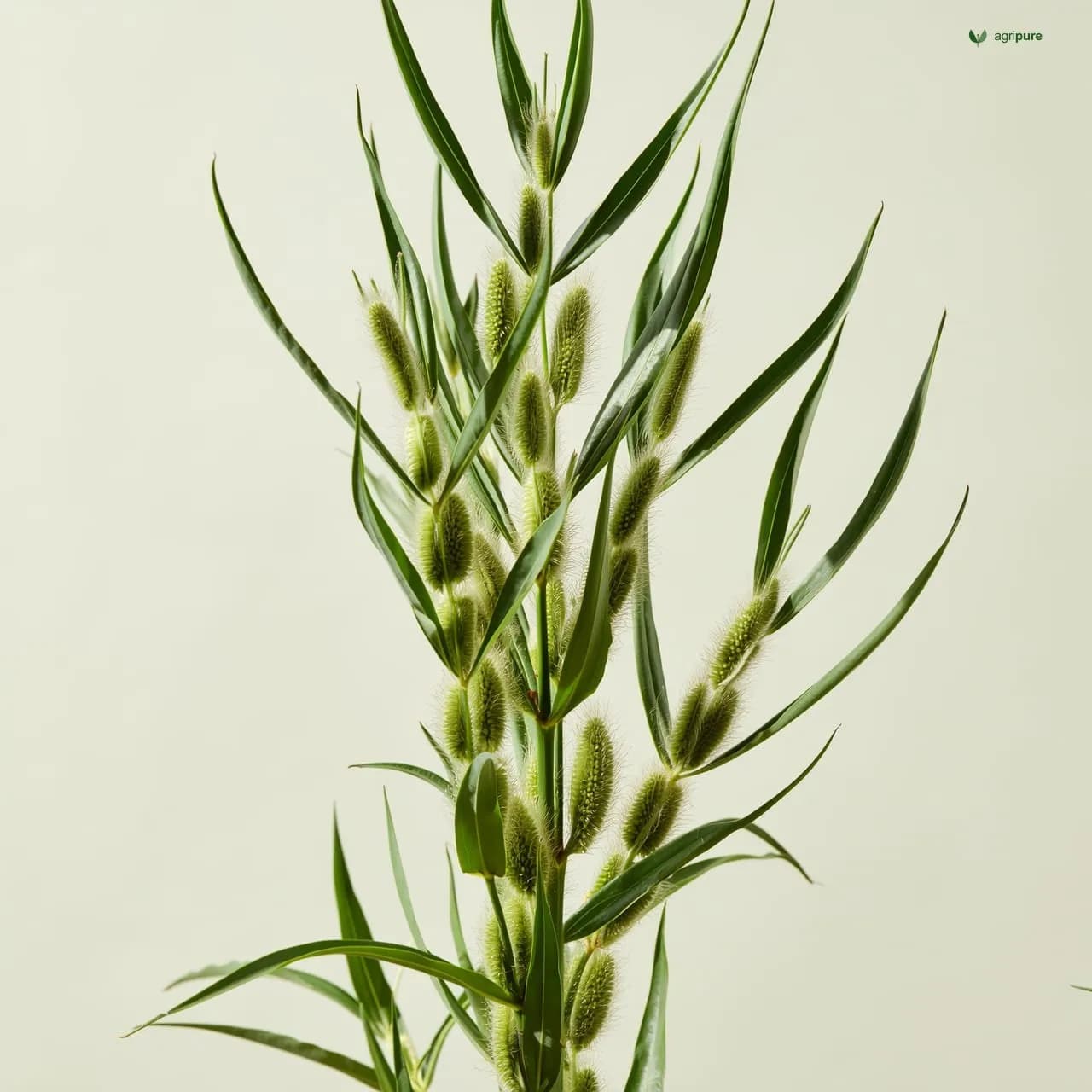
Black gram is an annual bush, upright to trailing in habit, that reaches roughly 30 to 100 cm tall.13 Botanically it is described as an erect, suberect, or trailing, densely hairy annual with a well-developed taproot and a branched root system carrying smooth, rounded nitrogen-fixing nodules.13 A key field character is how conspicuously hairy the stems and leaves are, noticeably more so than the closely related mung bean.1 The leaves are large, hairy, and trifoliate, the usual three-leaflet arrangement of the genus.13 Flowers are the typical pea-type (papilionaceous) bloom, and the pods are narrow and cylindrical, up to about 6 cm long, densely hairy, and borne in clusters.13
The seeds give the crop its name: they are black, carried in hairier pods than mung bean, with a white hilum (the seed scar) that protrudes slightly.1 The whole black seed is sold as black gram, while the split, dehulled seed, which is white inside, is marketed as “white lentil” in Indian cuisine.1
Growing black gram
Black gram is grown exclusively from seed. It is a grain legume and is not propagated vegetatively in the agronomic literature, so sowing seed directly is the standard and only practical method.235 It is a short-duration crop, taking roughly 90 to 120 days from sowing to maturity, and is grown as a summer crop in tropical and subtropical regions.23
Treat it as a warm-season, frost-sensitive annual. The species is consistently described as a tender, short-duration legume suited to warm, frost-free conditions, much like cowpea or mung bean.12 The USDA PLANTS database lists it in the continental United States as an annual crop rather than a winter-hardy perennial.4 Specific USDA hardiness zone numbers are not given in the primary sources; the practical takeaway is simply that black gram needs a warm, frost-free growing window of roughly three to four months, comparable to other warm-season beans.124
On soil, the documented preference is for heavier ground, the crop being sown on heavier soils than some other pulses.5 Detailed figures for sowing dates, sowing temperature, plant spacing, and irrigation timing are not consistently set out in the botanical and breeding sources here, so they are left out rather than stated with false precision. In practice, sow into warm soil after frost, give it an open, sunny position as you would any warm-season bean, and let the short season carry it to maturity.12
Harvest and uses
The harvest is the dried seed, gathered once the pods have matured at the end of the roughly 90 to 120 day season.23 The crop’s main value is culinary: the seeds are protein-rich and are eaten widely as a pulse across South and Southeast Asia.13 The whole black seed and the split, dehulled white seed are both staple kitchen ingredients, the latter sold as “white lentil.”1 The seeds are safe to eat when properly cooked.13
Beyond the kitchen, black gram earns its place in a rotation as a nitrogen fixer. Its roots carry smooth, rounded nodules that host nitrogen-fixing bacteria, so the plant builds soil fertility while it grows and leaves benefit for whatever follows it.13 The species also has documented traditional medicinal uses, outside the scope of food-crop growing.13
Native range and where it grows
Black gram was domesticated in India and is now grown mainly across South and Southeast Asia, including India, Afghanistan, Bangladesh, Myanmar, Pakistan, Sri Lanka, Thailand, and Vietnam.23 It is described as a staple crop of central and Southeast Asia.23 On a smaller scale it is also cultivated in parts of East Africa, including Kenya, Uganda, and Tanzania, and in South America in Argentina and Brazil.2 Wherever it is grown, it is treated as a warm-season, short-duration legume of tropical to subtropical climates with warm, frost-free summers.23
Safety and cautions
Black gram is a food crop, and no part of the plant is reported as acutely poisonous.13 The standard cautions are those that apply to beans generally: the seeds should be properly cooked, because raw or undercooked beans can cause digestive upset.13 The plant has a history of traditional medicinal use, but that is not the same as a proven treatment, and this profile makes no medical claims and gives no dosages; any medicinal use carries the standard cautions that apply to legumes.13