support
Five-leaved chaste tree
Vitex negundo
- punjab plains
- pothohar
International hardiness
- USDA 6-11
- RHS H4
- AU: Tropical, Subtropical, Arid / semi-arid, Warm temperate
Where it grows — regional guide
| Zones / rating | Regional notes |
|---|---|
USDA 6-11 | A deciduous flowering shrub hardy across USDA zones 6 to 11, grown for fragrant blooms and pollinator draw; do not ingest preparations without medical supervision. |
| Zones / rating | Regional notes |
|---|---|
H4 (-10 to -5C) | Hardy to RHS H4 as an aromatic late-summer flowering shrub for sunny, sheltered borders; grown for ornament and pollinators, but avoid internal herbal consumption. |
| Zones / rating | Regional notes |
|---|---|
Tropical, Subtropical, Arid / semi-arid, Warm temperate | Cultivated in warm-temperate and subtropical gardens as an ornamental, bee-friendly shrub; avoid unregulated internal use because tissues possess strong pharmacological activity. |
| Zones / rating | Regional notes |
|---|---|
USDA 6-11 (USDA scale) Canada uses its own zone system; Canadian zones run roughly one lower than USDA. | No region-specific data yet |
| Zones / rating | Regional notes |
|---|---|
Punjab plains, Pothohar | Pakistan:An aromatic deciduous shrub suited to sunny ditch banks and field borders across Punjab and Pothohar; avoid internal self-medication, particularly during pregnancy. India:A widespread medicinal shrub valued in traditional systems for aromatic foliage and pest deterrence; avoid casual internal consumption due to potent bioactivity. |
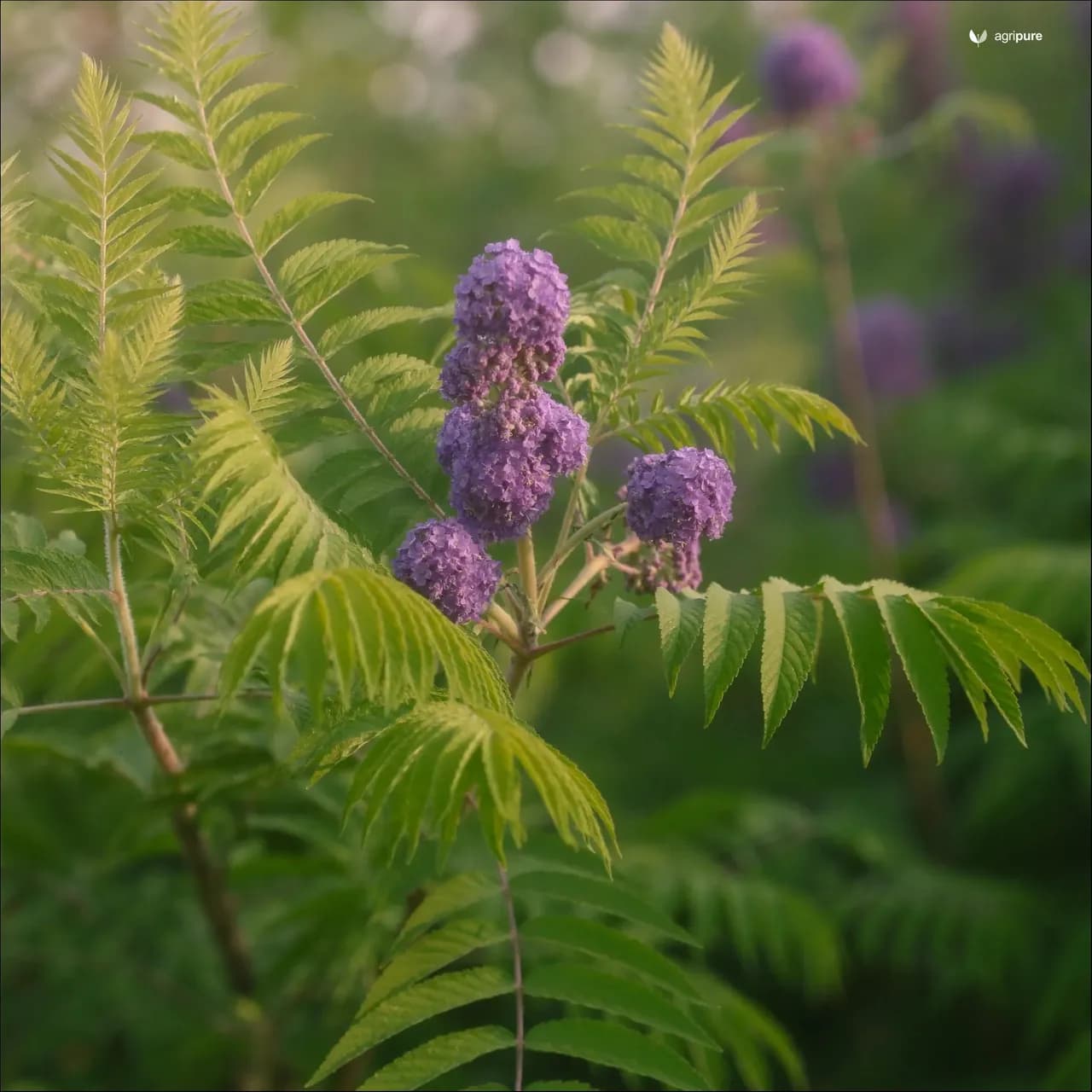
The five-leaved chaste tree (Vitex negundo) is a deciduous, strongly aromatic shrub or small tree native to tropical eastern and southern Africa and across much of Asia. Its indigenous range spans India, China, Japan, Nepal, Sri Lanka, the Philippines, Kenya, and Madagascar, and it is now widely cultivated in warm regions. For a homesteader it earns its place as a tough, low-input utility plant rather than a food crop: it shrugs off heat and poor ground, draws pollinators through a long summer bloom, and supplies fragrant, insect-repellent foliage long used in traditional medicine.
In the wild it turns up near water, on disturbed land, in grasslands, and in mixed open forests, as well as on Himalayan wastelands and mountain slopes from roughly 600 to 6,500 ft in elevation — a range that marks it as opportunistic and adaptable, at home on marginal sites where fussier plants struggle.
How to identify it
This is an erect, branched shrub or small tree, usually 2 to 8 m (about 6.6 to 26 ft) tall and deciduous in most climates. A few features make it recognizable in the field:125
- Bark and stems: Bark is pale reddish-brown, slightly rough, peeling in papery flakes; young branchlets are distinctly four-angled (quadrangular) and densely clothed in whitish hairs.
- Leaves: Palmately compound (the source of the “five-leaved” name), typically with 3 to 5 (occasionally up to 7) lance-shaped leaflets to about 10 cm (4 in) long, grayish-green with soft woolly hairs beneath and serrated margins. They are strongly aromatic when crushed, a reliable confirming cue.
- Flowers: Small, fragrant blooms in loose panicles 12 to 20 cm (5 to 8 in) long, opening mid to late summer, ranging from white through blue to bluish-lavender.
- Fruit: Small four-seeded drupes, typical of the genus, which are used as a pepper-like condiment in some traditions.
Growing five-leaved chaste tree
This is among the easier woody plants to keep happy: give it a warm, sunny, well-drained position and it largely looks after itself.
- Sun: Performs best in hot weather and full sun, which also gives the strongest bloom.
- Soil: Best grown in loose, medium-moisture, well-drained soil; both Missouri Botanical Garden and NC State emphasize loose, free-draining ground.
- Water and drainage: It wants medium moisture and tolerates heat well, but not waterlogged ground — root rot can set in on poorly drained or stressed plants, so err dry.
- Propagation: Propagated by conventional methods (seed and vegetative means); micropropagation protocols using axillary shoot proliferation have also been developed for nursery production.
On hardiness, Missouri Botanical Garden and NC State list it for USDA zones 6 to 9, but it is not reliably winter-hardy at the cold end: in zones 5 to 6, harsh winters often kill it back to the ground, so it behaves like a woody perennial cut down each year rather than a standing shrub. Plant it in a sheltered spot there and expect it to regrow from the base; in warm-winter climates it keeps its woody structure and grows larger.
Mature size in cultivation is more modest than its wild ceiling: Missouri Botanical Garden lists roughly 10 to 15 ft tall with a 3 to 8 ft spread in warm climates, and NC State reports 10 to 15 ft tall by 6 to 10 ft wide. For a hedge or windbreak, a spacing of about 6 to 10 ft between plants follows from that spread.
Harvest and uses
This is a utility and medicinal plant first, not a yield crop, so think in services and harvestable parts rather than tonnage. The long, fragrant summer bloom is a genuine pollinator draw, and the same aromatic foliage carries the insect-repellent qualities valued in traditional practice. The small four-seeded drupes are a pepper-like condiment in some food traditions (the clearest documented culinary use), while a tea and the seeds account for the limited food uses on record. Otherwise it is grown mainly as a medicinal and utility plant, with multiple sources noting significant pharmacological activity in its tissues. Harvest cues, per-plant yields, and time-to-maturity figures are not reliably documented in the sources here, so they are omitted rather than invented.
Safety and cautions
The sources are explicit that this is primarily a medicinal and utility plant whose medicinal use calls for caution. A few grounded points for any homesteader considering it:
- Food uses are limited and specific (chiefly the seeds, the fruit as a pepper-like condiment, and a tea) rather than the plant being a general edible; the bulk of its documented value is medicinal, not culinary.
- Sources note significant pharmacological activity alongside an explicit need for caution; that activity is not the same as a proven treatment, and this profile makes no claim that the plant treats or cures any condition.
- Approach it conservatively and do not self-administer; anyone pregnant or breastfeeding, or taking prescription medication, should seek qualified medical advice first.
Sources
- Vitex negundo – Wikipedia
- Vitex negundo – Missouri Botanical Garden Plant Finder
- Morphology, Taxonomical Description and Antiviral Activity of Vitex negundo – International Research Journals
- Vitex negundo – ScienceDirect Topics (Agricultural and Biological Sciences)
- Vitex negundo – NC State Extension Gardener Plant Toolbox
- Vitex negundo – NatureServe Explorer