secondary
Spring Onion
hari pyaaz
Allium fistulosum
Also known as Scallion (United States), Welsh Onion (UK & Ireland), Green Onion (Canada), Hari Pyaaz (Pakistan).
- punjab plains
- pothohar
- kpk hills
International hardiness
- USDA 4-9
- RHS H6
- AU: Cool temperate, Warm temperate, Mediterranean
Where it grows — regional guide
| Zones / rating | Regional notes |
|---|---|
USDA 4-9 | Grown as a perennial bunching onion across temperate zones, returning each spring from clumps after a winter rest. |
| Zones / rating | Regional notes |
|---|---|
H6 (-20 to -15C) | Fully hardy under RHS H6 for allotments, forming perennial evergreen clumps that provide cut-and-come-again green tops. |
| Zones / rating | Regional notes |
|---|---|
Cool temperate, Warm temperate, Mediterranean | Grown across temperate and Mediterranean zones as a perennial bunching salad vegetable that yields across multiple seasons. |
| Zones / rating | Regional notes |
|---|---|
USDA 4-9 (USDA scale) Canada uses its own zone system; Canadian zones run roughly one lower than USDA. | Hardy across cold-winter regions as a clump-forming perennial that goes dormant under snow and regrows in spring. |
| Zones / rating | Regional notes |
|---|---|
Punjab plains, Pothohar, KPK hills | Pakistan:Grown as a cool-season salad green in kitchen beds across the plains and hills, cropping through the winter months. |
Grows alongside
Species that appear with Spring Onion in 5 of our published guides — a starting list for a guild, not a planting plan.
Spring onion (Allium fistulosum) is a perennial bunching onion grown for its mild-flavoured, hollow green leaves and leaf bases rather than for any swollen bulb. It goes by a long list of names depending on where you garden: Welsh onion, bunching onion, green onion, scallion, Japanese bunching onion, stone leek, and rock onion. The species is native to China and is now cultivated and naturalised across much of the temperate and subtropical world, both as a vegetable and as an ornamental. For the homesteader its great virtue is that it is a true cut-and-come-again perennial: plant a clump once, snip green tops as you need them, and the same patch keeps producing season after season with very little fuss.
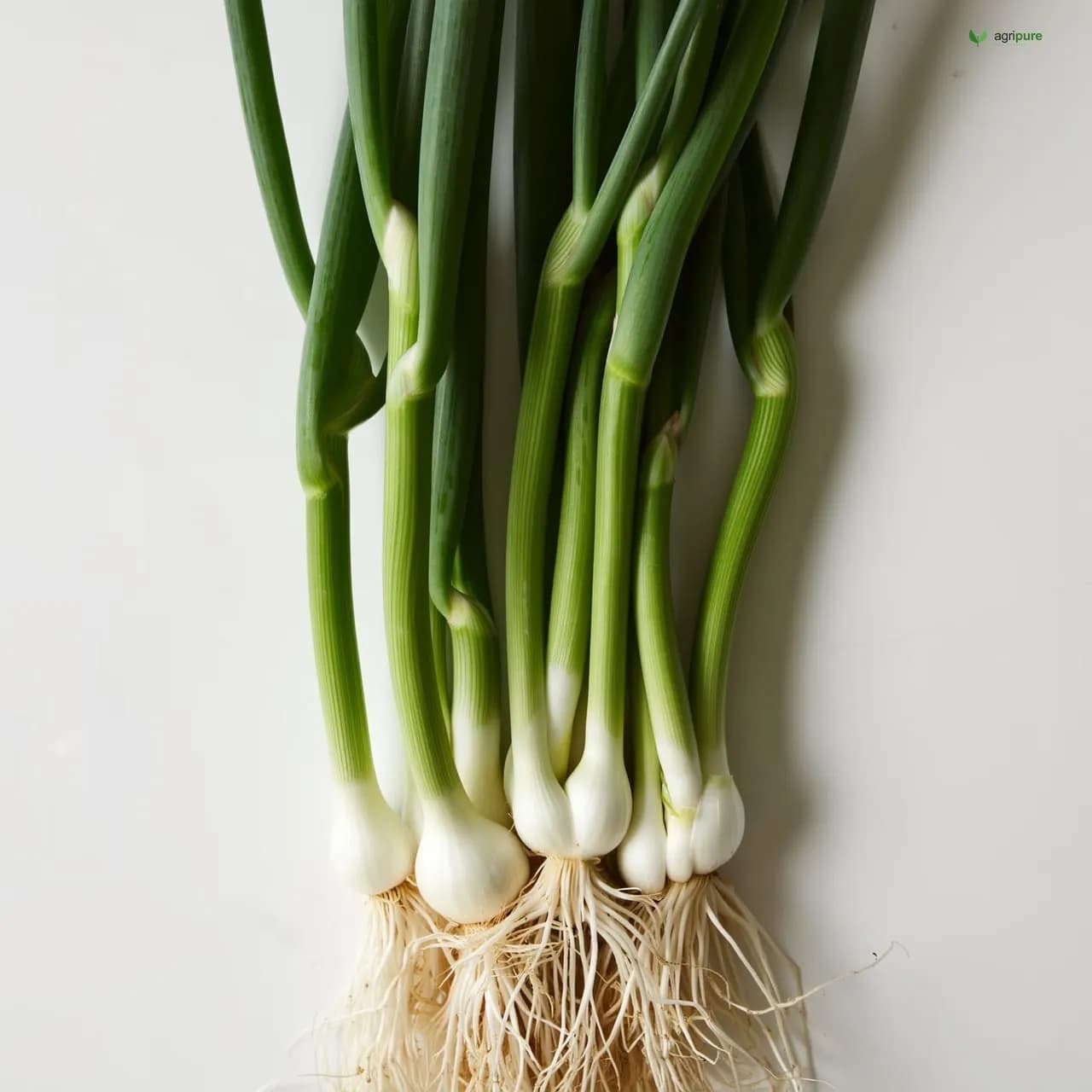
The plant grows as a clumping, slowly spreading perennial that forms dense evergreen clumps in suitable climates. Its leaves are linear, hollow, and tube-like, which is exactly what the species epithet fistulosum (“hollow”) refers to, and they range from blue-green to green. Unlike the common onion (Allium cepa), it does not develop a large, swollen bulb; instead it has an elongated, scallion-like base. A mature clump typically reaches up to about 60 cm (24 in) tall and roughly 30 cm (12 in) wide. In behaviour it is best described as deciduous to semi-evergreen: in mild climates it stays green for most of the year, while in colder areas it goes partly dormant over winter and regrows from the clump in spring.
Growing spring onion
Spring onion is easy to start from seed and can be grown from seed and harvested within the first year, which makes it a quick return for a new bed. It is commonly raised as a vegetable crop from seed sown directly in the field or in beds. Once a clump is established, the simplest way to multiply your stock is by division: lift and split established clumps to make more plants. Division can be done at almost any time of year, though spring is suggested as especially suitable, and in temperate climates clumps can be lifted, divided, and replanted in early spring to keep the patch going.
For soil, the plant prefers light, fertile, nutrient-rich, well-drained ground and performs well in ordinary garden soil under basic vegetable-bed conditions. The retrieved sources do not give a specific pH range, so none is stated here. Spring onion thrives in full sun to part shade, but as a leafy allium the best yields are generally obtained in full sun in vegetable-production systems. On water, it is described as drought tolerant, yet regular moisture is required for optimum growth, and steady soil moisture improves vegetative growth and yield when it is grown as a field crop. The detailed spacing, sowing temperatures, and day-count-to-harvest figures vary by region and are not consistently documented in the sources here, so they are deliberately left out rather than stated with false precision.
Harvest and uses
The harvest is the green leaf and leaf base rather than a bulb, and the plant is typically cut for its tops rather than pulled for any swollen root. Because it is a hardy perennial, harvesting can be spread over a long window: in warm climates spring onion may be harvested year-round, while in colder areas it returns from its clumps each spring after a winter rest. That perennial, regrowing habit is what makes a single planting so productive over time.
In the kitchen, the mild green leaves are used much like any scallion, eaten raw or cooked. Beyond its everyday culinary role, spring onion (green onion) is esteemed as an aromatic vegetable crop valued for its food, nutritional, and therapeutic significance, and is widely grown as a field crop in many countries. The retrieved sources frame these as general nutritional and food-science observations rather than specific medical claims, so this profile makes no claim that the plant treats or cures any condition.
How to identify it
Spring onion is recognisable by a clear combination of features. It forms a clump of upright, linear, hollow, tube-like leaves in blue-green to green, with the hollow interior being the most reliable tell. The base is elongated and scallion-like rather than a rounded bulb. In late spring to early summer it sends up hollow, blue-green flower stalks (scapes) that rise above the leaf clump and carry ivory-white, globular to somewhat elongated flower heads (umbels), each of which can contain up to roughly 100 small flowers. The whole clump usually stands up to about 60 cm tall and 30 cm wide at maturity.
Sources
- “Allium fistulosum” – Wikipedia
- “Allium fistulosum (Bunching Onion)” – Gardenia
- “Spring Onion (Allium fistulosum)” – Roger’s Gardens
- “Green Onion (Allium fistulosum): An Aromatic Vegetable Crop Esteemed for Food, Nutritional and Therapeutic Significance” – PMC, National Library of Medicine
- “Allium fistulosum” – iNaturalist
- Review of Allium fistulosum compounds and properties – ScienceDirect