pioneer
Oats
jai
Avena sativa
Also known as Jai (Pakistan).
- pothohar
- kpk hills
- balochistan highlands
International hardiness
- USDA 7-10
- RHS H5
- AU: Cool temperate, Warm temperate, Mediterranean
Where it grows — regional guide
| Zones / rating | Regional notes |
|---|---|
USDA 7-10 | Sown as a cool-season grain, green manure or winter cover crop; grain can trigger allergic reactions and is unsafe for coeliacs. |
| Zones / rating | Regional notes |
|---|---|
H5 (-15 to -10C) | Fully hardy under RHS H5 as a cool-season green manure or grain crop; the harvested grain can provoke allergic reactions in coeliacs. |
| Zones / rating | Regional notes |
|---|---|
Cool temperate, Warm temperate, Mediterranean | Grown across temperate and Mediterranean zones as a winter green feed and dual-purpose grain; grain carries coeliac allergy warnings. |
| Zones / rating | Regional notes |
|---|---|
USDA 7-10 (USDA scale) Canada uses its own zone system; Canadian zones run roughly one lower than USDA. | Grown widely across Canadian prairie belts as a cool-season spring cereal or cover crop; the grain is unsafe for some coeliacs. |
| Zones / rating | Regional notes |
|---|---|
Pothohar, KPK hills, Balochistan highlands | Pakistan:Sown as a premier winter rabi green fodder and cereal across northern hills and Pothohar; grain carries coeliac allergy warnings. |
Grows alongside
Species that appear with Oats in 30 of our published guides — a starting list for a guild, not a planting plan.
The common oat (Avena sativa) is an annual cereal grass in the family Poaceae, grown worldwide for grain, fodder, and as a cover crop. Unusually for a major crop, it is known only in cultivation: its wild origin is unclear, but it most likely evolved in central or northern Europe from wild Avena sterilis germplasm that originated in south-western Asia. Today it is grown extensively across the cooler, northern temperate world, especially Europe and North America, with smaller production in the highland tropics. For a homesteader, oats earn their keep three ways from one sowing: a nourishing grain for the kitchen, a fast green feed for livestock, and a vigorous, weed-smothering cover crop.
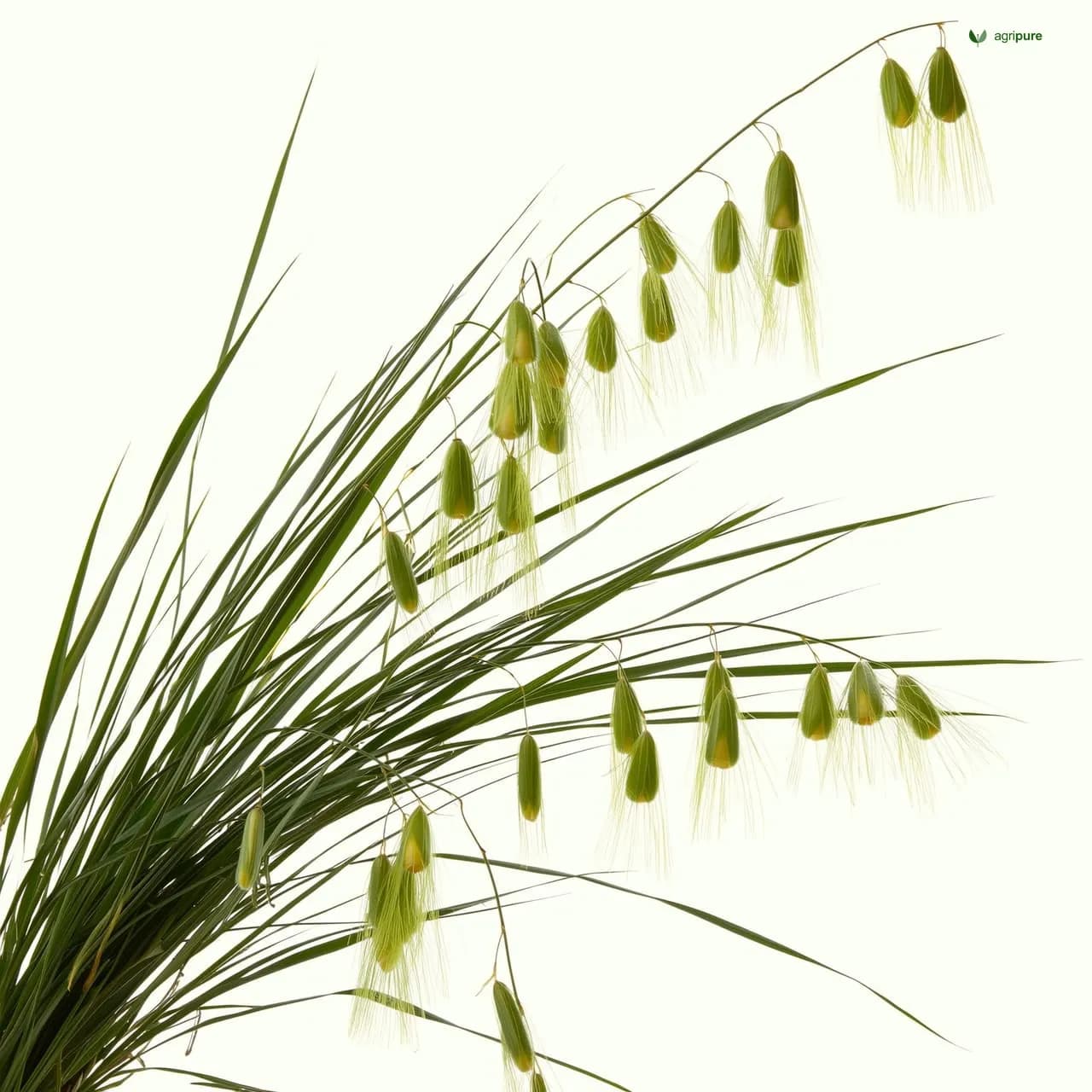
Oat is a tufted, upright grass, typically 0.6 to 1.5 m tall depending on variety and conditions. Its leaves are the linear, parallel-veined blades typical of grasses, arising alternately from the stem and ranging from smooth to sparsely hairy by cultivar. The seed head is a loose, open panicle of drooping spikelets that nods in the wind, making the crop easy to recognise. In A. sativa the spikelets are usually two-flowered (against three in some wild oats), with papery, nine- to eleven-veined glumes that often overtop the florets; in hulled cultivars they are roughly 25 to 32 mm long. The lemmas are generally smooth and usually unawned, and any awns are fairly straight and hairless — separating cultivated oat from the bristlier wild oats. The grain is a narrow, elongated caryopsis, normally enclosed in hulls in traditional varieties, while “naked” oats have hulls that thresh free.
Growing oats
Oats are propagated by seed only, sown as grain directly into the ground; there is no other practical method for an annual cereal. Under suitable conditions, germination begins about seven days after sowing, so a stand establishes quickly.
This is a cool-season cereal that tolerates cool, moist conditions far better than heat, which is why it dominates the northern temperate belt and also performs in cool highland tropics. In Africa it is grown mainly in Ethiopia and Kenya, with further production in South Africa, Morocco, Algeria, and Tunisia, and it reaches the higher, cooler valleys of the Himalayas such as Himachal Pradesh in India. Primary botanical sources do not assign formal USDA hardiness zones to oats; as a rough field guide, homestead references commonly treat common oat as suited to roughly USDA zones 3 to 8, but that is an inference from its temperate, high-elevation range rather than a figure from the botanical literature.
Grow oats in full sun, as is standard for a field cereal sown in open ground and meadows. They are normally grown in regions of moderate to high rainfall and, in many African systems, are harvested at the end of the rainy season — pointing to a reliance on seasonal moisture and adequate soil water through vegetative growth. Oat is a relatively tolerant cereal grown on ordinary arable soils across temperate agriculture; the sources here give no precise pH or texture optimum, so specific soil targets are left out rather than stated with false precision. Sowing dates, seeding rates, and row spacing also vary by region and are not documented in these sources, so treat oats like other cool-season small grains: sow into a moist, firm seedbed in the cool part of the year and keep the ground from drying out as the crop grows.
Harvest and uses
Oat grain is broadly edible and is one of the more nutritious cereals, which is the heart of its appeal on a self-reliant homestead. Per 100 g of edible grain, the dossier sources record roughly 16.9 g protein, 6.9 g fat, 66.3 g carbohydrate, 10.6 g dietary fibre, and 389 kcal — notably high protein and fibre for a cereal. In tropical African systems the grain is harvested at the end of the rainy season; for the kitchen, hulled oats need their hulls removed before milling or rolling, whereas naked oats thresh free and are simpler to process at small scale.
Beyond the grain, oats are a classic dual-purpose plant, grown widely as fodder and forage for livestock and as a cover crop, where a quick-germinating, leafy stand builds biomass and crowds out weeds before being cut, grazed, or turned in. That combination of food, feed, and soil cover from one annual sowing is what makes oats a staple of mixed, rotation-minded homesteads.
Safety and cautions
Oats are broadly edible and eaten as both food and feed, so they are not a toxic plant. The sources do flag two grounded cautions worth knowing before a homegrown crop reaches the kitchen: oats can cause allergic reactions in some people, and they may not be safe for all people with coeliac disease. Anyone who is gluten-intolerant or coeliac, or who reacts to cereal grains, should treat homegrown oats with the same care as any commercial oat product and seek qualified medical guidance. This profile makes no medical claims; it simply reports the safety notes given in the sources.
Sources
- Avena sativa L. — PROTA (Plant Resources of Tropical Africa)
- Avena sativa (common oat) — Go Botany, Native Plant Trust
- Oat (Avena sativa) — NatureSpot
- Avena sativa fact sheet — Seed ID Guide
- Avena sativa (common oat) — iNaturalist
- Avena sativa — eFlora of India