pioneer
Centro
centro
Centrosema pubescens
- punjab plains
- sindh coast
International hardiness
- USDA 10-12
- RHS H1c
- AU: Tropical, Subtropical
Where it grows — regional guide
| Zones / rating | Regional notes |
|---|---|
USDA 10-12 | Perennial in USDA zones 10 to 12 or grown as a summer annual; it builds soil fertility and provides living mulch in warm weather. |
| Zones / rating | Regional notes |
|---|---|
H1c (5 to 10C) | No region-specific data yet |
| Zones / rating | Regional notes |
|---|---|
Tropical, Subtropical | Grown as a tropical and subtropical pasture legume; it fixes nitrogen and suppresses weeds beneath young orchard canopies. |
| Zones / rating | Regional notes |
|---|---|
USDA 10-12 (USDA scale) Canada uses its own zone system; Canadian zones run roughly one lower than USDA. | No region-specific data yet |
| Zones / rating | Regional notes |
|---|---|
Punjab plains, Sindh coast | Pakistan:Grown as a warm-season cover crop and living mulch across the plains; sow into moist ground after frost danger has passed. India:Planted as a nitrogen-fixing cover crop and grazing forage under plantation trees through the humid tropical monsoon. |
Grows alongside
Species that appear with Centro in 1 of our published guides — a starting list for a guild, not a planting plan.
Centro (Centrosema pubescens) is a vigorous, twining perennial legume in the pea family (Fabaceae), native to Central and South America and now naturalized across the humid lowland tropics. It is one of the classic tropical cover crops: a sprawling, deeply rooted vine grown chiefly as living ground cover, nitrogen-fixing green manure, and grazing forage rather than as a food plant. For a homesteader working warm, frost-free ground, centro earns its place by smothering weeds, holding soil, and feeding the land — it is the plant you sow under young tree crops or across bare patches to build fertility while you wait for slower plantings to mature.
What centro looks like
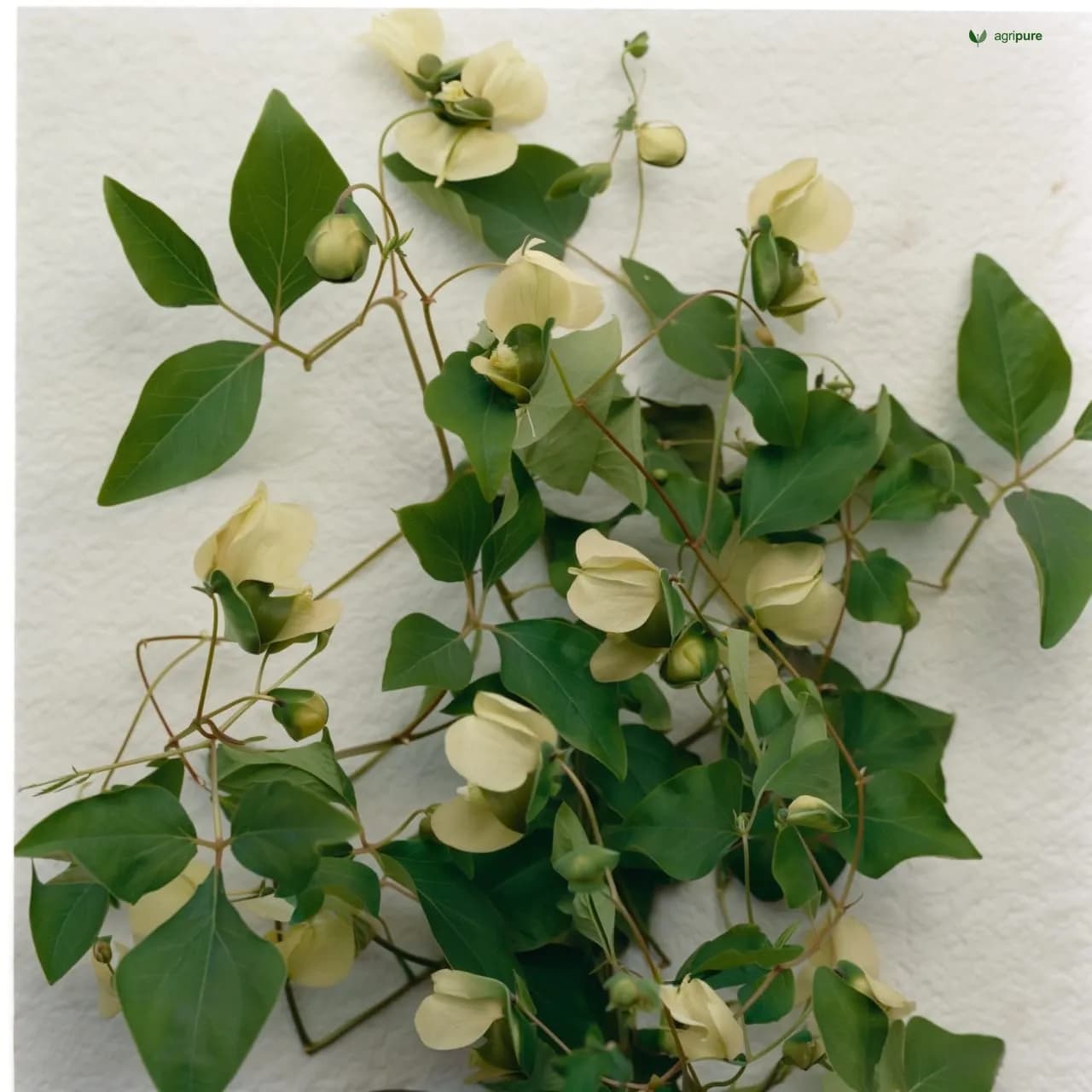
Centro is a herbaceous, climbing perennial vine with vigorous stems that scramble flat across the ground or twine up into anything they meet. Below ground it develops a deep taproot, which is the anchor for both its drought tolerance and its persistence. The foliage is notably leafy, forming a dense green mat that performs well even under shade — one reason it has long been planted between rubber and other plantation trees. Its flowers are the easiest field marker: relatively large and lilac-coloured with darker violet veins, in the characteristic “butterfly-pea” form of the genus. In leafy ground-cover stands the canopy is often described as standing only around 40 to 45 cm high, even though the trailing vine stems themselves run much longer. To identify it in the field, look for a low, twining, very leafy legume forming dense cover, topped by large lilac flowers with violet veining.
Growing centro
Centro is a plant of the moister tropics and is propagated from seed. Its seed is often hard-coated: up to about 60% of a batch may be “hard” and slow to take up water, so scarification before sowing markedly improves germination. At homestead scale, the simplest method is hot-water treatment: pour very hot water over the seed, soak it for a few minutes, then leave the seed in warm water for 12 to 24 hours before sowing. Alternatively, mechanically chip a small piece of the seed coat near the embryo, taking care not to damage the seed itself; brief immersion in sulfuric acid is used at commercial scale but is not needed on a homestead. For pasture or cover-crop use, a seeding rate of roughly 5 kg of seed per hectare is typical, and the species is normally direct-sown rather than raised in a nursery.
It is widely regarded as one of the most productive green-manure crops for fertile soils in the humid tropics, and it tolerates waterlogging well. It grows best where annual rainfall is at least 1,500 mm, but it can persist in pastures receiving as little as about 800 mm, helped by that deep taproot and its noted drought resistance. It naturally occupies low elevations near sea level, along roadsides, waste places, riverbanks, and within plantations, and its strong shade tolerance makes it a dependable understorey legume. The cited botanical sources do not give a precise soil pH range, optimal spacing, or a firm time-to-maturity figure, so those are left out here rather than stated with false precision; in practice, treat centro as a warm-season tropical cover crop sown into clean, moist ground.
Primary floristic sources do not assign USDA hardiness zones to centro directly. It is consistently described as a humid-tropical, low-elevation, frost-sensitive perennial, which corresponds to roughly USDA zones 10 to 12 in terms of frost tolerance — an informed inference from those climate descriptors rather than a figure taken from the literature. Where hard frosts occur it should be treated as a tender perennial, grown as a warm-season annual and not expected to overwinter outdoors.
Harvest and uses
Centro is grown for what it does to the land and the herd rather than for a harvested crop. As a green manure and cover legume it builds and protects fertile tropical soils, forming a dense, weed-suppressing mat that doubles as living mulch. The leaves are the part most used in local practice, and the plant is grazing forage as well as cover. Its value in plantation systems is well established: the low, twining habit lays down dense ground cover beneath tree crops, and its shade tolerance lets it keep working where many forages fade — a role classically filled in rubber plantations. The cited sources do not provide reliable per-hectare yield figures or any culinary use, so none are invented here; centro is best understood as a soil-building, weed-suppressing, forage cover crop rather than a kitchen plant.
Sources
- Centrosema pubescens – Wikipedia
- Centrosema pubescens – Useful Tropical Plants Database
- Centrosema pubescens classification – USDA PLANTS Database
- Centrosema pubescens – iNaturalist
- Centrosema – eFlora of India