support
Field Bindweed (Hiran Khuri)
lehli / hiran-khuri
Convolvulus arvensis
Also known as Lehli (Pakistan).
- punjab plains
- pothohar
- balochistan highlands
International hardiness
- USDA 4-10
- RHS H6
- AU: Cool temperate, Warm temperate, Arid / semi-arid, Mediterranean
Where it grows — regional guide
| Zones / rating | Regional notes |
|---|---|
USDA 4-10 | Noxious agricultural weed in USDA zones 4 to 10; never eat as it contains toxic tropane alkaloids, and do not rototill infested plots. |
| Zones / rating | Regional notes |
|---|---|
H6 (-20 to -15C) | Hardy under RHS H6 as a troublesome garden weed; avoid foraging due to toxic alkaloids, and dig roots repeatedly rather than chopping. |
| Zones / rating | Regional notes |
|---|---|
Cool temperate, Warm temperate, Arid / semi-arid, Mediterranean | Troublesome weed of temperate pastures and crops; do not forage as it carries toxic alkaloids, and avoid tilling to prevent root spread. |
| Zones / rating | Regional notes |
|---|---|
USDA 4-10 (USDA scale) Canada uses its own zone system; Canadian zones run roughly one lower than USDA. | Common weed across agricultural provinces; plant contains toxic tropane alkaloids so never consume, and avoid tilling to limit spread. |
| Zones / rating | Regional notes |
|---|---|
Punjab plains, Pothohar, Balochistan highlands | Pakistan:Persistent weed of plains crops; do not forage because tropane alkaloids are toxic, and avoid tilling which scatters roots. India:Widespread weed across cultivated fields; avoid eating as it contains toxic tropane alkaloids, and pull roots repeatedly to manage it. |
Grows alongside
Species that appear with Field Bindweed (Hiran Khuri) in 2 of our published guides — a starting list for a guild, not a planting plan.
Field bindweed (Convolvulus arvensis) is a long-lived, creeping perennial vine in the morning glory family (Convolvulaceae), native to Europe and Asia and also reported as native to northern Africa. It now grows as a naturalized weed across most of North America and much of the temperate world, turning up on roadsides, in gardens, and through cultivated fields. For a homesteader, the honest hook is not how to grow it but how to recognize and live with it: this is one of the most persistent weeds you will ever meet, and knowing it on sight saves a great deal of trouble later.
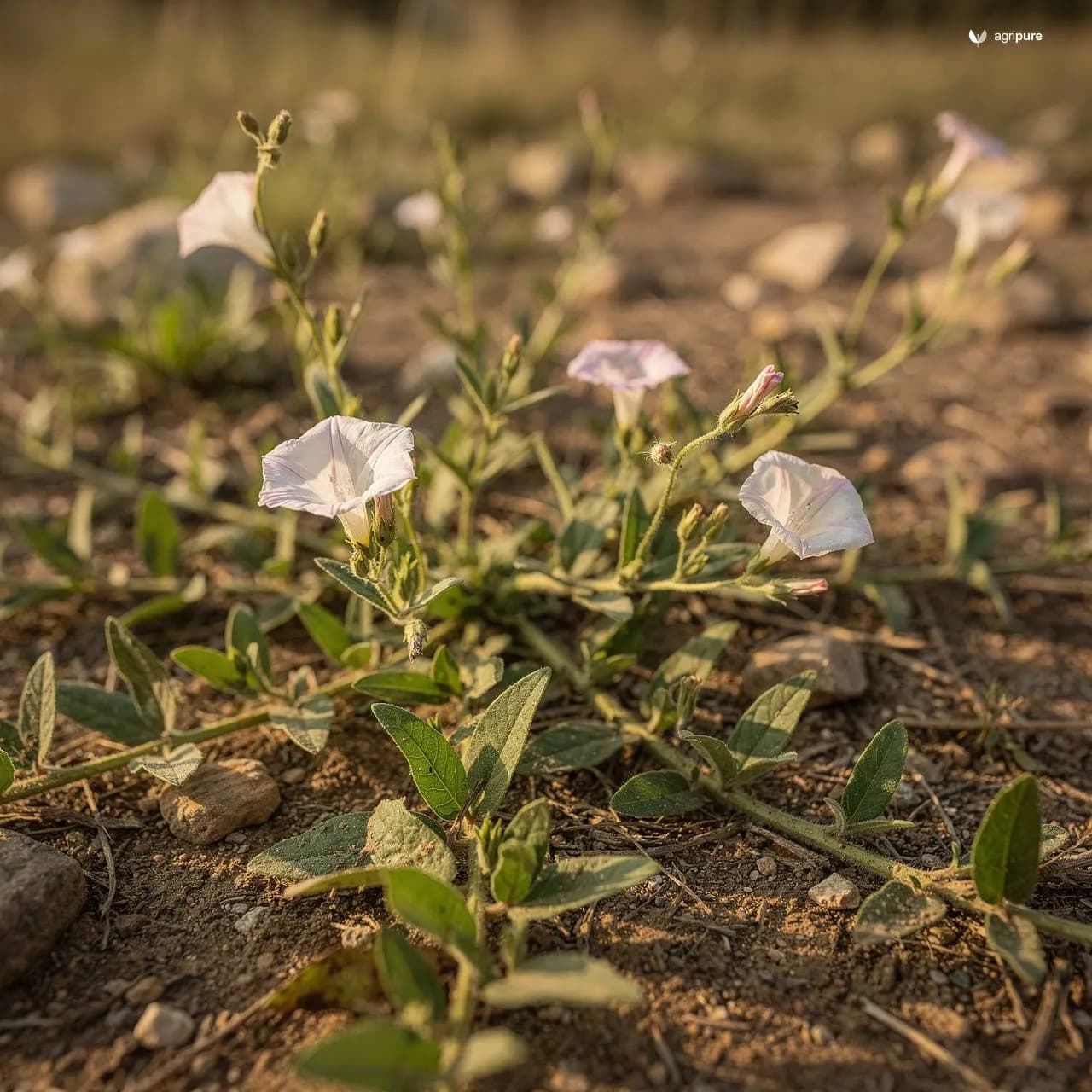
It goes by many names — small bindweed, European bindweed, wild morning glory, and the unflattering “devil’s guts.” The plant has slender, twining or trailing stems, typically 0.5 to 2 m (about 1.6 to 6.6 ft) long, that form dense mats over the ground or wind up through other plants and fences. Its flowers are the classic funnel- or trumpet-shaped “morning glory” bloom, roughly 1 inch (2 to 2.5 cm) across, white to pink and sometimes pink-and-white striped.
How to identify field bindweed
Because several twining vines look alike, a few details separate field bindweed from its lookalikes:1256
- Habit: A perennial vine with slender creeping or twining stems forming mats, climbing through vegetation rather than standing upright.
- Leaves: Alternate, arrow- or triangular-shaped with two basal lobes spreading away from the stem; hairless to slightly hairy.
- Flowers: Funnel-shaped, about 1 inch across, white to pink. The clearest tell is two small bracts on the flower stalk set about half an inch to an inch below the flower, not pressed up against the base of the bloom.
- Seeds: Small (around 3 mm), pear-shaped, grayish-black, and warty or bumpy on the surface.
That bract position is worth memorizing: in the similar hedge bindweed the bracts sit right at the base of the flower, while in field bindweed they are spaced well down the stalk.
How it grows and why it persists
Most homesteaders manage this plant rather than plant it, but its growth biology explains why it is so hard to be rid of. Field bindweed reproduces two ways at once. It is a prolific seed producer, with an average plant setting more than 500 seeds, and it also spreads vegetatively through an extensive system of roots and rhizomes and even broken stem fragments. That underground network is deep and aggressive, capable of spreading laterally more than 10 feet in a single growing season, and the plant readily regenerates from severed root fragments left behind by tillage.
Its seeds are remarkably durable. They need warmer soil to germinate, typically emerge in late spring to early summer, and can remain viable in the soil for 50 years or more — the reason a patch reappears long after the visible plants seem gone. Bindweed is otherwise unfussy: it tolerates full sun to full shade, is strongly drought-tolerant, and grows across mesic to dry sites. It is found even in dry, gravelly field soils but prefers rich, fertile ground with moderate moisture while still enduring long dry spells. It thrives in temperate, tropical, and Mediterranean climates and occupies roadsides, disturbed and arable ground, waste places, and fields.
In North America it is present in the agricultural regions of every Canadian province except Newfoundland and Prince Edward Island, and is common to abundant throughout the United States except the extreme Southeast and parts of southern Texas, New Mexico, and Arizona. Formal USDA hardiness-zone numbers are not consistently given in the literature; weed profiles simply treat it as hardy wherever temperate crops are grown. On a homestead you are most likely to encounter it in vegetable beds, along fence lines, and in tilled or recently disturbed ground.
Management and uses
This is a plant to control, not cultivate, so the practical “harvest” is keeping it in check. Because it regrows from both seed and root fragments, single efforts rarely succeed: chopping or shallow tilling can multiply a patch by scattering root pieces that each resprout, so the durable seed bank and deep, far-spreading roots make repeated, persistent management the realistic goal, not a one-time pull. Field bindweed itself has no established food or forage value documented in these sources; the reputable references treat it consistently as an agricultural and garden weed.
Safety and cautions
Field bindweed is mildly toxic and is not recommended as food or medicine for homestead use. The plant contains tropane alkaloids and has been reported to cause gastrointestinal effects, so despite its morning-glory flowers it should not be foraged or eaten. Treat any twining vine you cannot confidently identify as off-limits for the table. This profile describes the plant’s botany and behavior only and makes no medicinal claims; the safe approach is to recognize field bindweed, keep it out of food beds, and manage it as the persistent weed it is.
Sources
- Bindweed Identification – Cornell University Weed Science (CALS)
- Field Bindweed, Weed Identification Guide for Ontario Crops – Government of Ontario
- Convolvulus arvensis – USDA Forest Service Fire Effects Information System
- Convolvulus arvensis – Wikipedia
- Field Bindweed – Washington State Noxious Weed Control Board
- Field Bindweed – Oregon State University Horticulture
Sourcing notes
A near-ubiquitous field weed across the plains and Pothohar — never deliberately sourced or planted; the only practical task is controlling existing stands.