secondary
Stranglewort (Soldier Vine)
khip-bel
Cynanchum acutum
Also known as Khip-bel (Pakistan).
- sindh coast
- punjab plains
International hardiness
- USDA 7-10
- RHS H5
- AU: Mediterranean, Warm temperate
Where it grows — regional guide
| Zones / rating | Regional notes |
|---|---|
USDA 7-10 | No region-specific data yet |
| Zones / rating | Regional notes |
|---|---|
H5 (-15 to -10C) | No region-specific data yet |
| Zones / rating | Regional notes |
|---|---|
Mediterranean, Warm temperate | No region-specific data yet |
| Zones / rating | Regional notes |
|---|---|
USDA 7-10 (USDA scale) Canada uses its own zone system; Canadian zones run roughly one lower than USDA. | No region-specific data yet |
| Zones / rating | Regional notes |
|---|---|
Sindh coast, Punjab plains | Pakistan:Twines along saline ditch banks and canal edges; wear gloves against irritant milky latex, and keep off irrigated crop beds to avoid weed spread. India:Pioneer vine of saline scrub and banks; wear gloves when handling irritant latex, and keep off crop beds as deep roots become persistent weeds. |
Stranglewort (Cynanchum acutum, khip-bel) is a twining milkweed vine of saline plains and ditch banks, a perennial that winds through low cover and hedges on disturbed, often salty ground. Across its wide range it grows on seacoasts, sandy and saline slopes, riverbanks, and field margins from southern Europe through south-west Asia, with its phenolic chemistry shifting in step with soil chloride — a sign of real adaptation to salinity.2 Where it occurs it is used in folk medicine and lightly browsed, and on a syntropic site it behaves as a secondary-stage twiner on rough, marginal land.
Where it thrives
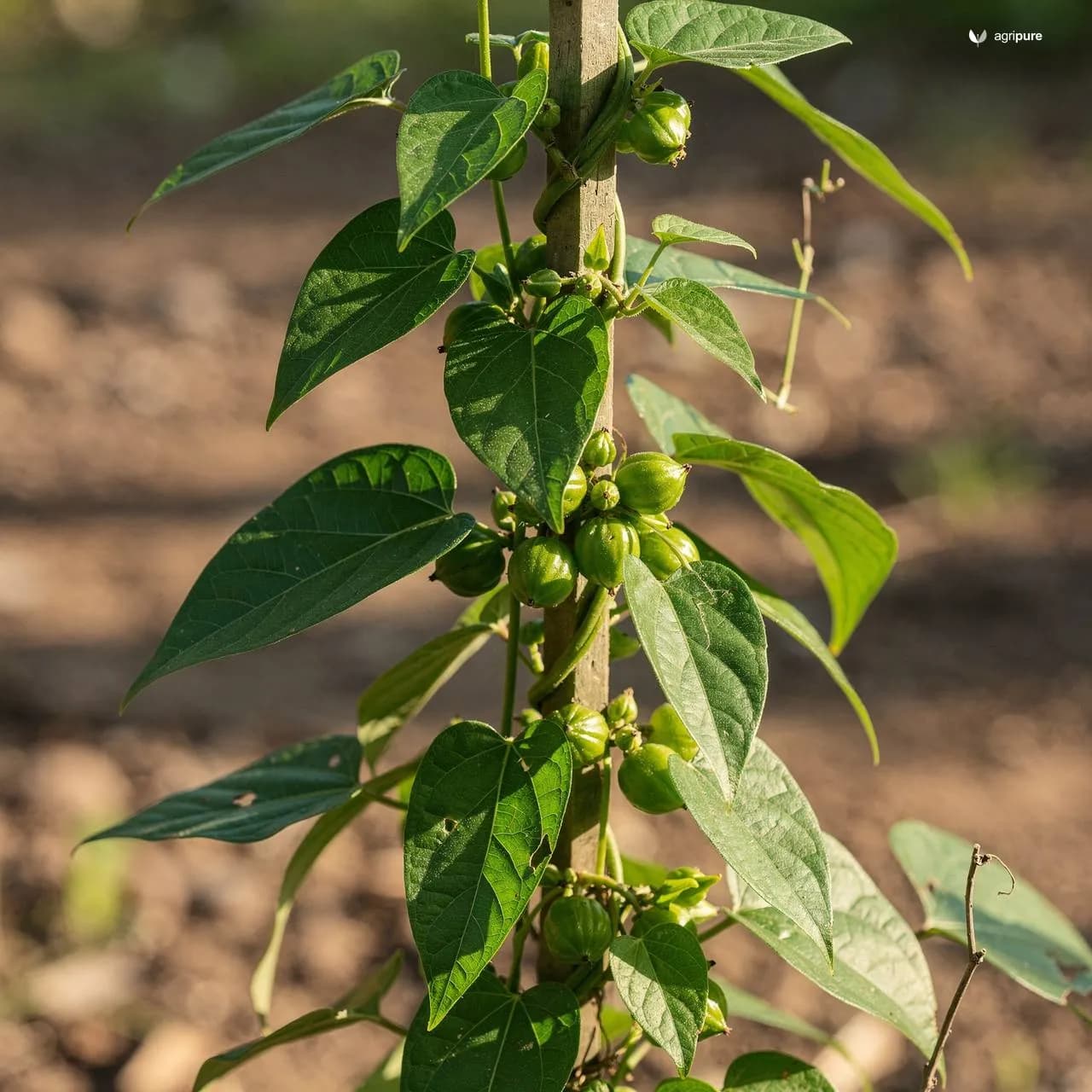
It is a perennial twining plant with heart-shaped leaves and slender, paired seed follicles, flowering from June to August. It is at home on saline and sandy ground, ditch banks, and riverbanks, and tolerates salt well enough to colonise solonetz slopes and coastal margins that exclude less hardy vines. One honest qualification belongs here: the Flora of Pakistan records this species from the northern valleys — Gilgit, Hunza, and Chitral — rather than from the southern plains, so its placement on the Sindh coast and Punjab plains is by habitat analogy and not yet confirmed by the national flora. Identify the plant with care before relying on it.
Role in the system
Where it is genuinely present, treat it as a secondary twining vine for difficult, saline or disturbed ground. Its winding growth covers banks and rough margins that defeat other plants, holding loose soil on ditch sides, canal banks, and field edges where salt or disturbance keeps the ground bare. Its real niche is the salty, broken land at the edges of a system rather than a productive layer at its centre: it is not a heavy-biomass species, and on irrigated land it can run as a stubborn weed, spreading from deep roots that resist both hoeing and herbicide. So the design value is narrow but real — cover and soil-holding on saline margins — and it comes with a clear rule: keep it off cropped beds, give it only the rough edges, and cut it back if it climbs into plants you mean to keep.
Uses
The plant carries a folk-medicine record across its range, and recent work backs part of it: flavonoids isolated from Cynanchum acutum show antioxidant and anti-inflammatory activity in laboratory models of type-2 diabetes. It is also lightly browsed by stock. Two cautions apply: as a milkweed relative its latex can be irritant and the genus includes toxic species, so it is a remedy plant handled knowingly rather than a free forage, and on irrigated land it can become a stubborn weed.
Sources
- Useful Temperate Plants. “Cynanchum acutum.” (saline and riverbank habitat, weediness, salt tolerance).
- Eldeen, M. S., et al. (2019). “Ecophysiological study on the invasive weed Cynanchum acutum L.” (phenolics correlated with soil chloride).
- Flora of Pakistan. “Cynanchum acutum.” eFloras.org (Gilgit, Hunza, Chitral; description; flowering).
- Abdel-Sattar, E., et al. (2021). “Antioxidant and anti-inflammatory activity of Cynanchum acutum L. isolated flavonoids.” PMC.
Sourcing notes
Distribution in Pakistan is not fully settled: the Flora of Pakistan records it from the northern valleys of Gilgit, Hunza, and Chitral rather than the southern plains, so treat any plains use of this twining milkweed as provisional and identify the plant carefully before relying on it.