climax
Mango — Tota Pari
aam — Tota Pari (طوطا پری)[unverified]
Mangifera indica var. Tota Pari
- sindh coast
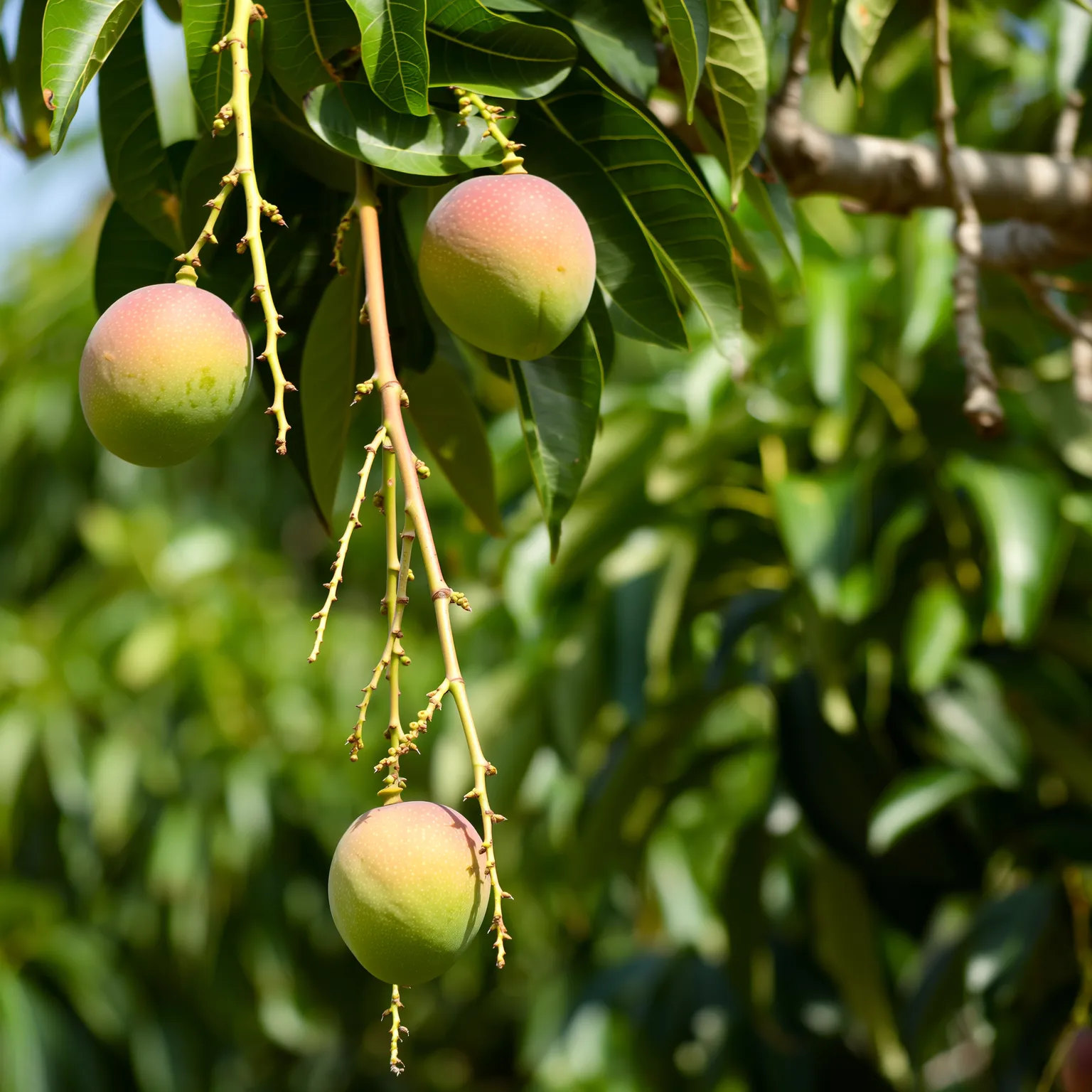
Tota Pari (aam — Tota Pari, آم طوطا پری) takes its name from the parrot’s beak: a long, oblong mango that curves to a sharp pointed tip at the non-stem end. It is a firm-fleshed, mildly tangy-sweet mango with thick, tough skin and a small stone, giving a high proportion of usable flesh.1 The honest reason to plant it on the Sindh coast: it is a robust, firm slicing mango that travels and stores better than soft dessert varieties, which makes it forgiving to handle and steady to sell.
Where it thrives
Tota Pari suits the hot subtropical lowlands of the Sindh coast. Mango as a species fruits best where a warm season is followed by a clear post-monsoon dry spell that triggers flowering rather than vegetative flush.2 The tree wants deep, well-drained soil, tolerates sandy and lighter ground, and dislikes waterlogging or persistent salinity. It copes with coastal heat once established, but rain or heavy humidity during bloom reduces fruit set, and winter cold near 4 degrees Celsius damages foliage and young wood.3 Its deep roots make it reasonably drought-tolerant between irrigations.
Role in the system
Tota Pari is a vigorous climax-canopy mango that occupies the upper, emergent stratum and structures the food forest around its broad head. Its mid-season fruiting window slots between early and late cultivars so the climax layer crops in succession across the season. Like other Indian-type mangoes it is monoembryonic and carried on grafted rootstock; flowering runs late winter to early spring and depends on flies, thrips and other small insects, not honeybees.4 Beneath and around it, run a guild of nitrogen-fixing pioneers and biomass shrubs whose chop-and-drop prunings build the mulch layer through the dry months, giving way to shade-tolerant understorey species as the canopy closes in normal syntropic succession.
Growing it
Start with a grafted, named Tota Pari, never a seedling. Three decisions decide success. First, the graft: a clean union on vigorous rootstock gives a true, even tree. Second, irrigation timing: water through fruit growth, then ease off before flowering, since wet, humid conditions at bloom cut fruit set. Third, give the vigorous tree room and keep the large canopy open with light annual pruning after harvest, which also tempers the swing between heavy and light bearing years. Space full-size trees about 10 metres apart, or use a high-density, pruned layout if you want earlier returns.
What you get
A long, beak-tipped mango with firm, fibre-free flesh, a mild sweet-tart balance and a small stone, harvested mid-season. The firm texture and thick skin give it good shelf life and handling tolerance, so it suits slicing, salads and pickling as readily as fresh eating, and its sturdiness supports reliable farm-gate and market sales rather than fragile premium trade.
Sourcing notes
Buy grafted Tota Pari from a nursery that can name the mother block, and avoid unnamed seedlings, which will not run true. Establish leguminous pioneers and biomass species beneath young trees for early mulch and ground cover while the wide canopy develops.
Sources
- P. Vijayanand, E. Deepu, S. G. Kulkarni (2013). “Physico-chemical characterization and the effect of processing on the quality characteristics of Sindura, Mallika and Totapuri mango cultivars.” Journal of Food Science and Technology (Springer).
- J. Morton (1987). “Mango (Mangifera indica L.), Fruits of Warm Climates.” Purdue University NewCROP.
- J. H. Crane, J. Wasielewski, C. F. Balerdi, I. Maguire (2023). “Mango Growing in the Florida Home Landscape.” University of Florida IFAS Extension.
- M. Saleem et al. (2019). “Antidiabetic Potential of Mangifera indica L. cv. Anwar Ratol Leaves: Medicinal Application of Food Wastes.” Medicina (MDPI).