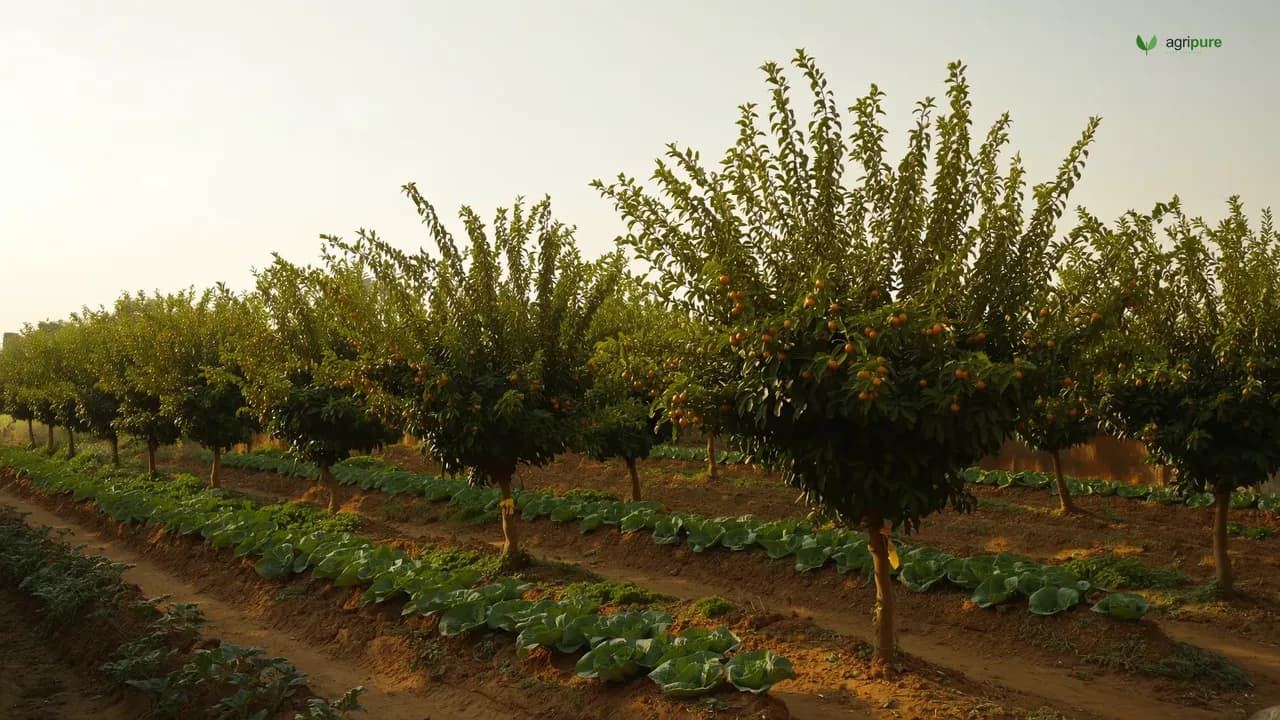
The secondary stage is where most syntropic plantings either compound or stall, and the understorey is the reason. By years two to five the pioneers have done their work, the climax trees are in but years from canopy, and a wide, light-rich middle layer opens up. Fill it well and the system pays you while it matures. Fill it badly — or leave it bare — and you have invited the weeds, the evaporation, and the wasted sunlight that the whole design was meant to prevent. The understorey question is really a question about not leaving sunlight and soil on the table.
Related Agripure guides

An understorey during the secondary stage of a syntropic planting. Strategic plant selection fills the middle layer, prevents bare soil, and keeps the system productive as it matures.
- Custard apple as a chaperone — the secondary stage’s most patient teacher
- Pruning leucaena for biomass — Götsch’s chop-and-drop, applied (Note: Leucaena leucocephala can self-seed invasively in frost-free regions and contains the amino acid mimosine; limit Leucaena foliage to no more than 20–30% of ruminant fodder rations.)
- A seven-layer food forest, sized for a Pakistani smallholding
- Pioneer species for Sindh coastal salinity — what works at 8 dS/m and above
What the understorey is for
Ernst Götsch’s principle is that every layer of a system should be occupied by something the farmer chose, because if it is not, it will be occupied by something the farmer did not. During the secondary stage the understorey has three jobs at once: produce harvestable food while the trees cannot, shade and cover the soil against the Pakistani summer, and keep the biological pump running — roots in the ground, exudates feeding the soil life, biomass cycling. A good understorey species does at least two of the three. The best do all three.
Species that work under a young Pakistani canopy
The shortlist is governed by shade tolerance, because the defining feature of the secondary-stage understorey is 30–40 percent shade and rising. Turmeric and ginger are the standout choices — both are rhizome crops that genuinely prefer dappled shade, both tolerate the heat, and both are high-value, storable, and harvested by simply lifting the rhizome without disturbing the trees. Chillies and okra carry the sunnier edges and the earlier years before the canopy thickens. Leafy greens — local saag, spinach, coriander — fill the cool-season window and the shadier pockets. The design instinct is to match each crop to the light it is standing in, and to move the sun-lovers outward as the canopy closes inward.
Source: [1] Götsch, E. — syntropic-agriculture layer-occupation & succession principles (collected papers)Source: [2] Hemenway, T. — Gaia’s Garden: A Guide to Home-Scale Permaculture (2009), guild & understorey designSource: [3] PARC Horticultural Research Institute / PHDEC — shade-tolerant intercrop performance (institutional reference)
Sequencing so layers don’t compete
The trap is planting everything at once and watching the layers fight for the same nutrient pulse. The fix is to sequence by function and by root depth. The biomass species (the chop-and-drop legumes) set the nutrient rhythm; cut them and the flush of decomposition is the moment the food crops want to be actively growing to catch it. Stack roots, not competition: shallow rhizome crops (turmeric, ginger) under deeper-rooted shrubs and trees draw from different soil horizons and coexist. The microclimate modifiers (the taller, leafier secondary trees) go in first to create the shade the rhizome crops will later want, not the other way round.
The yield trade-off, stated honestly
A shaded understorey will not match a full-sun monoculture of the same vegetable on a per-plant basis. That is simply true, and pretending otherwise discredits the whole approach. What it offers instead is total system yield: the understorey crop plus the soil it builds plus the trees it nurses plus the water it saves through shade and cover. A 30–40 percent shaded turmeric crop yields less turmeric than an open field of turmeric, and far more than the bare ground that is the actual alternative beneath a young orchard. The secondary-stage understorey is not competing with monoculture. It is competing with emptiness, and against emptiness it wins every time.
Source: [1] Mollison, B. — Permaculture: A Designer’s Manual (1988), stacking & guild theorySource: [2] FAO — intercropping & agroforestry understorey management guidance
References
- Carbon Sequestration Potential of Agroforestry Systems: Opportunities and Challenges — World Agroforestry Centre (ICRAF) / Springer. Synthesizes evidence that multi-strata agroforestry increases ground cover, reduces soil evaporation, and buffers microclimate compared with open cropland.
- Challenges and Opportunities for Agroforestry Practitioners to Improve Adoption — University of Nebraska–Lincoln, School of Natural Resources. Documents how inter-row and understory vegetation management is a major technical issue affecting early productivity and weed pressure before the overstory matures.
- Challenges and Solutions for Strengthening Agroforestry Cocoa Production — Swiss Platform for Sustainable Cocoa (SWISSCO), via Fundo Vale. Describes how multi-strata systems with shade trees and understory components improve soil fertility, reduce erosion, and stabilize yields versus simplified plantings.
- Agroforestry systems and their role in productivity and resource use — ScienceDirect (peer-reviewed). Peer-reviewed evidence on how vertically layered agroforestry uses light and space more completely than single-layer monocultures.
- Documenting the Key Challenges Facing Agroforestry Technologies in Vihiga County, Kenya — Journal of Agroforestry and Environment. Field documentation of establishment and management challenges that cause agroforestry plantings to stall during the transition phase.