secondary
Wild Pistachio
khinjuk
Pistacia khinjuk
- balochistan highlands
- kpk hills
International hardiness
- USDA 7-10
- RHS H4
- AU: Arid / semi-arid, Mediterranean, Warm temperate
Where it grows — regional guide
| Zones / rating | Regional notes |
|---|---|
USDA 7-10 | No region-specific data yet |
| Zones / rating | Regional notes |
|---|---|
H4 (-10 to -5C) | No region-specific data yet |
| Zones / rating | Regional notes |
|---|---|
Arid / semi-arid, Mediterranean, Warm temperate | No region-specific data yet |
| Zones / rating | Regional notes |
|---|---|
USDA 7-10 (USDA scale) Canada uses its own zone system; Canadian zones run roughly one lower than USDA. | No region-specific data yet |
| Zones / rating | Regional notes |
|---|---|
Balochistan highlands, KPK hills | Pakistan:A tough native wild pistachio shrub-tree of rocky Balochistan uplands; highly drought-hardy, functioning as rootstock for pistachio. |
Grows alongside
Species that appear with Wild Pistachio in 1 of our published guides — a starting list for a guild, not a planting plan.
Wild pistachio (Pistacia khinjuk Stocks) is a small, drought-tolerant nut tree in the cashew family (Anacardiaceae), native to the dry mountains of the Middle East and Central Asia. It is recognised as native to Iran — especially the Zagros Mountains — and ranges across Iraq, Turkey, Afghanistan, Pakistan, and the adjacent Central Asian highlands, where it is a characteristic tree of dry mountain woodlands and steppe-forest mosaics. For a homesteader working hard, stony, low-rainfall ground, the appeal is straightforward: this is a xerophytic (dry-adapted) tree that crops on rocky, shallow soils where most fruit trees simply give up, supplying small edible nuts, an oil-rich seed, and an aromatic resin from genuinely marginal land.
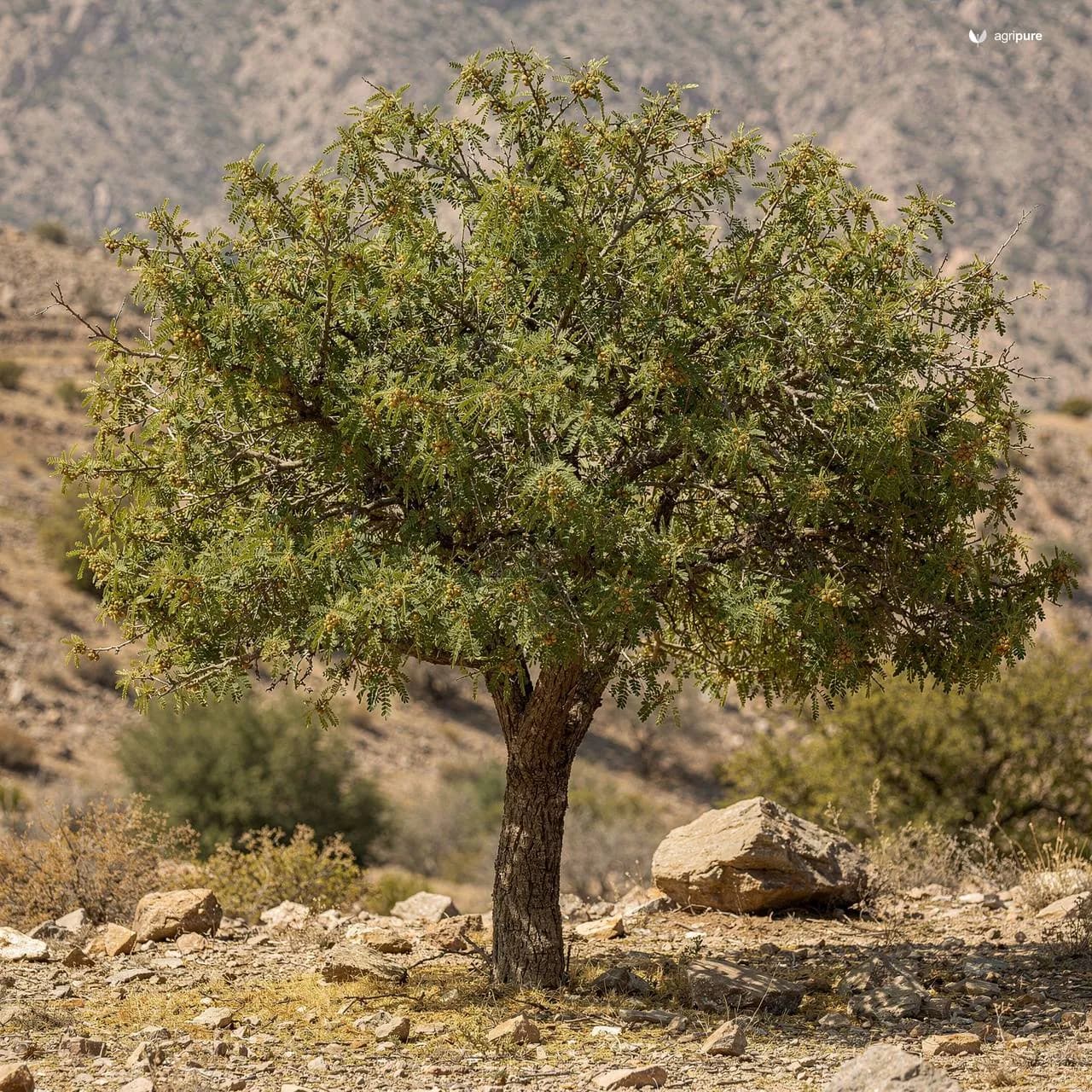
It is a deciduous shrub or small tree, usually 2 to 5 m tall and occasionally reaching 10 m, with a crown that is often irregular; many wild plants are multi-stemmed and shrubby on exposed dry slopes. The leaves are pinnate, as is typical of the genus, and are small and thick, the classic xerophytic build that limits water loss in a hot, dry climate. Like other members of Pistacia, the plants are dioecious, meaning male and female flowers are borne on separate trees, so fruiting needs both sexes present. The fruits are small drupes (the “nuts”), smaller than those of the commercial pistachio (P. vera) but used similarly in local cuisine and traditional medicine. The tree is also resin-bearing, exuding an aromatic resin from the bark, and chemical work on its fruit essential oil reports high levels of phellandrene and alpha-pinene.
Growing wild pistachio
Detailed, homestead-ready cultivation protocols for this species are limited; most of what is documented comes from forestry, genetic-resource, and rootstock studies rather than modern orchard trials, so the honest approach is to grow it on its known habitat preferences rather than invent precise numbers.
- Propagation: Wild P. khinjuk is commonly regenerated from seed in forestry and genetic-resource programmes. Pistacia seed generally benefits from stratification or scarification to break dormancy, but the sources here do not give an exact dormancy-breaking protocol specific to this species, so none is invented.
- Rootstock and grafting: The species is valued in pistachio rootstock breeding, crossed with P. vera and other Pistacia species to develop improved, stress-tolerant rootstocks. This means it is compatible as a rootstock for cultivated pistachio and is raised in nurseries for that purpose, though the sources do not provide step-by-step grafting instructions for home use.
- Soil: It is described as a very tolerant species of poor, dry soils, thriving on rocky, calcareous, and shallow substrates that defeat softer trees.
- Sun and climate: A plant of semi-arid to arid mountain climates, it grows on open rocky slopes in regions with hot, dry summers and cold winters, typically at medium to high elevations.
- Water: Being xerophytic, it is built for dry conditions and shallow, free-draining ground rather than damp, fertile flats.
The sources do not give reliable, species-specific figures for plant spacing, sowing dates, or time to first harvest, and these vary by region, so they are intentionally left out rather than stated with false precision. Specific USDA hardiness-zone trials are not reported either; the tree’s natural distribution in continental, high-elevation country with freezing winters implies real cold tolerance — which is partly why it is used in breeding programmes aimed at improving stress and cold tolerance — but no source assigns it an exact zone, so none is given.
Harvest and uses
The harvest is the small fruit. P. khinjuk produces small drupes that are eaten as a wild nut and used much like the commercial pistachio in local cuisines, and the same fruit features in traditional medicine. Because the plant is dioecious, only female trees set fruit, so a productive planting needs at least one male nearby for pollination. Alongside the nuts, the tree yields an aromatic resin tapped from the bark, used traditionally for chewing, flavouring, and medicine — a minor secondary harvest on top of the fruit. Beyond direct yield, the species earns its place ecologically as a characteristic component of dry mountain woodland and steppe-forest, holding ground on rocky slopes and poor soils where it forms part of the standing canopy. Its main agricultural role, though, is as a hardy rootstock: by lending its tolerance of dry, shallow, marginal soils to cultivated pistachio, it extends where the orchard crop can be grown.
How to identify it
Use this combination of features to separate wild pistachio from other dryland shrubs and trees:1356
- Habit: Deciduous shrub or small tree, usually 2 to 5 m and occasionally to 10 m, often multi-stemmed and irregularly crowned on dry slopes.
- Leaves: Pinnate, with several leaflets, and notably small and thick — a drought-adapted leaf that reduces water loss.
- Sexes: Dioecious, so any single plant is either male or female; only female trees carry fruit.
- Fruit: Small drupes (“nuts”), smaller than commercial pistachio.
- Resin: An aromatic resin exuded from the bark, a useful confirming cue for the genus.
Safety and cautions
The fruit of P. khinjuk is documented as edible and used in local cuisine, and its resin has a long record of traditional use for chewing, flavouring, and folk medicine. Traditional use, however, is not the same as a proven treatment, and this profile makes no claim that the plant treats or cures any condition. As with foraging any wild nut, identify the tree with confidence before eating from it, and treat medicinal or resin use conservatively rather than self-administering on the strength of folklore alone.
Sources
- Pistacia — Wikipedia
- Chemical composition of the essential oil of Pistacia khinjuk Stocks (Zagros Mountains, Iran) — European Journal of Experimental Biology
- Pistacia khinjuk — Useful Temperate Plants Database
- Pistacia khinjuk ethnobotany and pharmacology — PMC (National Library of Medicine)
- Pistacia — ScienceDirect Topics
- Pistacia khinjuk in dry mountain woodland — CABI Digital Library
- Pistacia rootstock breeding with P. khinjuk — International Society for Horticultural Science (Acta Horticulturae)
Sourcing notes
Collect ripe fruit from a wild hill tree, clean off the pulp, and sow fresh, since stored seed loses viability fast. Seedlings double as drought-hardy rootstock for grafted pistachio.